

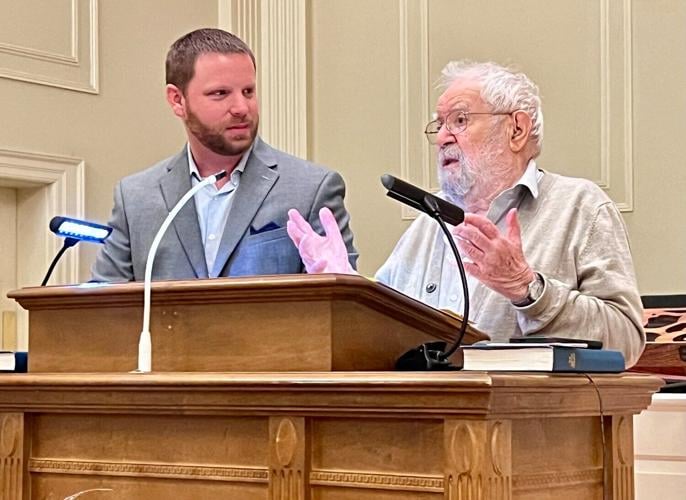
The sanctuary at First Baptist Valdese was three-fourths full as heavy rain came down on Saturday, Jan. 27 — International Holocaust Remembrance Day.
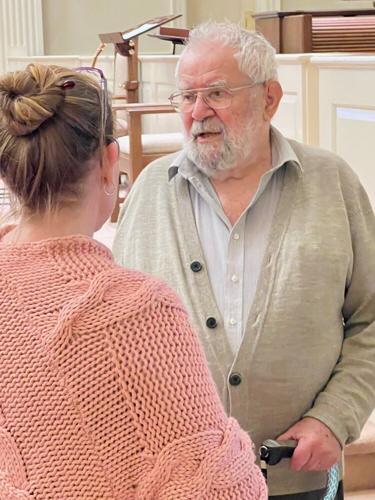
Church and community members had gathered to hear Dr. Walter Ziffer share his experiences as a slave laborer in Nazi concentration camps.
Ziffer, who will be 97 years old in March, spoke for more than 90 minutes. While much of his talk centered on his time at multiple concentration camps, he was also forthcoming about his opinions of the present day.
He called the Oct. 7 Hamas attack that killed 1,139 in Israel “absolutely brutal.” Perhaps equally concerning to him was Israel’s reaction.
“To my horror, I’m told 25,000 Palestinians have been killed,” he said.
Jewish law, Ziffer said, calls for an eye for an eye, but that it is not meant to be taken literally. The law’s purpose is not to give the offended carte blanche to retaliate in any way they deem necessary. The law was written during a time when the consequence was often out of proportion to the crime.
“Proportionality has not been observed by Israel, as far as I’m concerned,” he said. “Many Jewish people in America do not approve of what’s happening. It makes savages out of us. … I think it’s time for Israel to end its occupation of Palestine and let the Palestinian people be in an independent and free land.”
Ziffer knows something about savages.
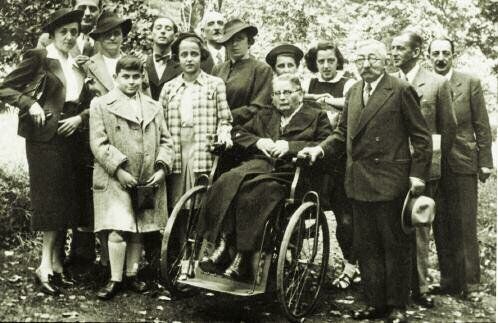
In 1942, his small hometown of Cesky Tesin in Czechoslovakia was emptied of all Jews. The Nazis took his family from their home and separated them. His father was taken to Auschwitz No. 4, a subcamp of the main Auschwitz concentration camp.
Instead of the gas chamber, his father was forced into labor. He and other prisoners built a chemical plant that was bombed by Allied forces. They constructed another plant only to have that destroyed, too.
Everyone in the sanctuary sat quietly as Ziffer reflected on what happened 60 years ago, though he explained he would not go into great detail. The passage of time has not dulled his pain.
“I just can’t deal with it,” he said.
He did, however, give enough specifics to understand the gruesomeness of the camps. SS officers would appear and pick out individuals destined to be killed. There was never enough food or water. The loose weave of the fabric made clothes practically transparent. Shoes were made of wooden soles and cloth tops and laces.
The laces and cloth tops would invariably deteriorate and as they were marched to their worksites, the prisoners would struggle to keep their shoes on as they made their way through deep snow. Should one person fall, the others were ordered to walk right over them.
“Then behind us, we would hear the gunshots,” Ziffer said. No one looked back but there was no escaping what had happened. On the March back, the bodies would still be along the path.
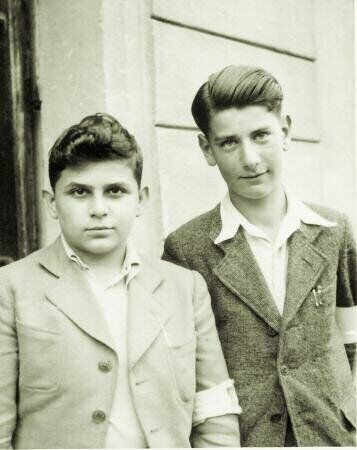
Between the ages of 15 and 18, Ziffer survived seven concentration camps. He does not know why he was moved so many times, though he believes that helped keep him alive.
Another advantage that he had was that he spoke German. If he was ordered to do something in German, he understood. Others were severely beaten – or worse – when they did not appropriately respond.
At his last camp, the teen Walter was forced to work on the construction of an addition to IG Farben, a conglomerate of six German chemical and pharmaceutical companies including aspirin maker Bayer.
Then came May 8, 1945. Liberation Day at his camp.
He remembers looking up at the guard towers that surrounded the camp. The guns were still there, but there were no soldiers. The triple gates were open. A member of the SS tossed his large keyring into the camp. Nothing made sense at first.
He and another prisoner walked out of the camp to the deserted town nearby. They found cans of pork that they ate, one after another, until they passed out. The next thing he remembers is waking up in the home of a “little lady wearing black” who explained that “We lost the war.” She fed them bowls of beans and potatoes.
“Then what do you do? In three years, I didn’t have to make a single decision. What did we do? We went back to camp,” he said.
The camp, as horrible as it was, was the only thing he had known. Before long he had the strength and courage to begin the walk to the camp where his mother and sister had been imprisoned.
When he arrived, he asked for them and was told they were out gathering food to bring back to the camp. He waited. When they returned, his mother and sister walked right past him.
“I had to reintroduce myself to my mother,” Ziffer said, the emotion causing his voice to crack.
He eventually found his father, too. He had made it back to their hometown, living in the same house as the woman who had been their housekeeper.
“My father was transformed by what he experienced,” he said. “When I walked in, he was sitting in a chair staring at the wall. When I told him who I was and that his wife and daughter had also survived, he had no reaction.”
The once-gregarious man who enjoyed telling jokes was now silent, a pale copy of the father Ziffer adored and respected.
Ziffer's immediate family survived, but he did lose 14 relatives in the Holocaust. He wondered out loud how such cruelty could happen.
“How the greatest writers, artists, and poets could sink to such lows,” he said. “People simply accepted what was going on. I am convinced that had more people asked why, things may have gone differently.”
He worries, however, that Americans have not learned the lessons of history, leaving the country vulnerable to repeating mistakes. Too much bitterness permeates daily life.
“We have to be decent enough to listen to each other and consider what the other person says,” he said.
The Rev. Dr. Josh Lail, pastor of First Baptist Church Valdese, agreed with his friend and former professor.
“It’s important for the church to hold events like this, to have conversations like this. The church today has the privilege to lead civil discourse. What we hear in today’s headlines is ominous,” Lail said. “We live in this kind of time where people have forgotten what happened. We need to remember what happens when people ignore situations.”
Angela Copeland is managing editor of The Paper. She may be reached at 828-445-8595 or via email at angela@thepaper.media.













(0) comments
Welcome to the discussion.
Log In
Keep it Clean. Please avoid obscene, vulgar, lewd, racist or sexually-oriented language.
PLEASE TURN OFF YOUR CAPS LOCK.
Don't Threaten. Threats of harming another person will not be tolerated.
Be Truthful. Don't knowingly lie about anyone or anything.
Be Nice. No racism, sexism or any sort of -ism that is degrading to another person.
Be Proactive. Use the 'Report' link on each comment to let us know of abusive posts.
Share with Us. We'd love to hear eyewitness accounts, the history behind an article.