


About 160 miles northeast of Burke County sits Stagville Plantation, the largest plantation in North Carolina. About 900 enslaved people were forced to work the 30,000 acres of wheat, corn, rye, and other crops.
The geography of Western North Carolina meant there was no operation of that scale here, but slavery was very much a part of Burke County.
In fact, this area had one of the largest percentages of slaves in all of Appalachia, comprising nine states and 215 counties. In 1850, 27% of the population was enslaved, 26% 10 years later.
“That’s the highest number of Black people you’ve ever had in Burke County,” said Dr. Leslie McKesson, a local historian who led a class this spring in the Honors College at Appalachian State University called “Interrogating Antebellum Slavery in Appalachia.”
The area didn’t have large plantations like the eastern half of the state. Instead, slaves were put to work in sustainability farming and raising hogs and cattle. They also were forced labor in mining and building railroads.
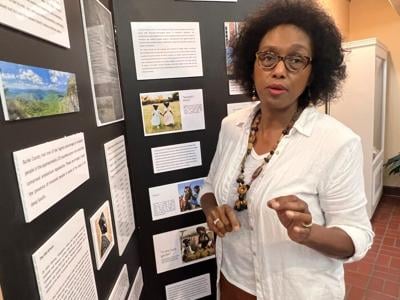
The misconception that there were few slaves in Burke County is only one of the myths debunked in the new exhibit “Shadows of a Time Gone By: Glimpses of the Lives of Enslaved People at the Historic Captain Charles McDowell, Jr. House.”
The exhibit is a collaboration between the Historic Burke Foundation and ASU. Student research during McKesson’s class formed the slave narratives in “Shadows,” the voices of the enslaved people at Quaker Meadows Plantation in Morganton. The students recorded the stories, which can be listened to on any smartphone using the QR codes provided in the exhibit.
The students will perform the slaves’ stories reading-theater style in a special presentation today, Saturday, Oct. 7, at the Historic Burke County Courthouse. Doors open at 2 p.m. with the presentation beginning at 2:30 p.m. in the courtroom.
“I designed the class around the Charles McDowell House,” McKesson said. “I knew Burke County would be the perfect microcosm to study (slavery in Appalachia). Morganton is the oldest city in Western North Carolina, so a lot of the things that were going to happen around slavery would have happened here. I knew there would be documentation from the McDowell House and a lot of documentation from the Avery plantation Swan Ponds that we could use to help us figure out how to tell the story.”
The methodology of the class and the resulting exhibit is called deeply informed imagining. The term is thought to have been coined by poet Elizabeth Alexander, who is also a scholar of African-American literature and culture.
Stories weave history together into a storyline. McKesson will lead a similar class focused on slavery at Fort Defiance in Caldwell County in the Interdisciplinary Studies Program at ASU in the spring of 2024.
The exhibit is the realization of a goal that’s been years in the making. Before this exhibit, lessons centered around the McDowell House, often focused on general Colonial life and the Overmountain Men’s pivotal role in the American Revolution.
“The McDowell family was the wealthiest in the county for 150 years, up to the time of the Civil War. The influence of the McDowells in this place for 150 years can’t be denied,” said Dr. Linda Lindsey, president of the Historic Burke Foundation. “We’ve always wanted to tell the whole story and not part of the story.”
Lindsey and McKesson reiterate that the exhibit is not connected to the Confederate monument that sits on the square outside the courthouse.
“This was envisioned long before the monument became such a talking point. When I designed the class, my goal was to bring humanity and agency and self-emancipation to enslaved people,” McKesson said.
The six Honors students participating in McKesson’s class used scholarly research and documentation as the basis of each of the characters they voice in the exhibit. Some exhibit characters are based on documented enslaved people at McDowell House, while others are pieced together from what was learned about the people and events of the time.
“While not all the characters (in the exhibit) are people we can point to and say this person existed here on this property and did this particular thing, we have placed the characters within historical events we know happened,” she said.
Learning through narratives
McKesson saw firsthand the value of learning through narratives.
She wrote a ghost story based on the Quaker Meadows cemetery for the Historic Burke Foundation newsletter a few years back. She discovered how putting historical facts into a story helped her to remember those details.
“There were too many names, too many years, but when I put it in the form of a ghost story that talked about the people at Quaker Meadows, I got it.”
The stories found in the exhibit are supplemented by census records, letters, and other documentation. For example, “Shadows” includes the pages of the 1850 census, which shows that Isaac T. Avery of Swan Ponds plantation was the largest slave owner at the time with 122 slaves. Swan Ponds is about 2 miles down NC-126 from Freedom High School.
“The stories are probably 10%, 15% of the presentation,” McKesson said. “The majority of the presentation is straight-up history. The majority of what you are seeing here is straight history. There is a heavy focus on facts, documents, and textbooks. These are things written by people who are deemed credible academics. We want people to realize that this is based on the kind of facts that they hold high.”
“Shadows" aims to push back against the “Lost Cause” mythology that enslaved people were happy and treated like family. Reading the letters of slaves at face value could give someone the impression they were content.
But that’s not understanding the context in which they wrote. Slaves showed deference to their masters out of fear that not doing so would have grave repercussions for themselves and their families. The slave narratives provide vital context to the documents included in the exhibit.
“In my mind, even when you look back on some of the choices they made, that’s an act of agency,” she said. “That’s me taking a step trying to protect my family. If I have to blow up the master’s skirt to do it, then doggone I’m going to do it.
“The thing this project has shown me is that every situation is different.”
McKesson hopes those who view the exhibit will have a similar experience to the students who helped put “Shadows” together.
Building relationships
“We built relationships. We got close to each other during the course of this study. There was no one that ever felt they were being put on the spot or called out. We had to work through some hard conversations, but there was an understanding that we were only trying to understand what happened historically,” she said.
Yet that history doesn’t come to life without showing the humanity of the people involved. McKesson hopes the exhibit shows enslaved people as “a fuller, more human person and help Black people move away from the abject shame of being enslaved and help White folks see these were real humans. Africans who came over here were people with vital cultures and belief systems.
“White folks, when you talk about slavery, it’s the guilt thing. Black folks when you talk about slavery, it’s the shame thing. And my goal with this is to move beyond that. To tell stories of formerly enslaved people or people who were enslaved their entire lives that reflect their humanity. They were not this monolithic stereotype of slaves that we have in our minds.”
Stripping away their humanity facilitated dehumanization.
“I think this exhibit, the humanity comes through loud and clear,” Lindsey added. “Five of her students told me that (the class) was a life-changing experience and that they would never look at the world the same. This is not just a course. This is something that’s pivotal for people. I believe this exhibit will be pivotal.”
“Shadows of a Time Gone By: Glimpses of the Lives of Enslaved People at the Historic Captain Charles McDowell, Jr. House” will be the featured exhibit at the Heritage Museum inside the Historic Burke County Courthouse until next fall.
Angela Kuper Copeland is the arts & entertainment editor at The Paper. She may be reached at angela@thepaper.media or 828-445-8595.









(0) comments
Welcome to the discussion.
Log In
Keep it Clean. Please avoid obscene, vulgar, lewd, racist or sexually-oriented language.
PLEASE TURN OFF YOUR CAPS LOCK.
Don't Threaten. Threats of harming another person will not be tolerated.
Be Truthful. Don't knowingly lie about anyone or anything.
Be Nice. No racism, sexism or any sort of -ism that is degrading to another person.
Be Proactive. Use the 'Report' link on each comment to let us know of abusive posts.
Share with Us. We'd love to hear eyewitness accounts, the history behind an article.