

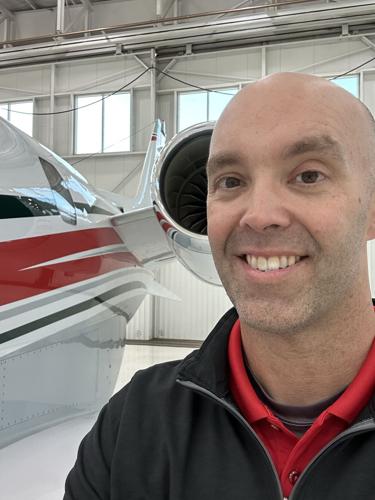

Corporate jet pilot and local flight instructor Brandon NeSmith.

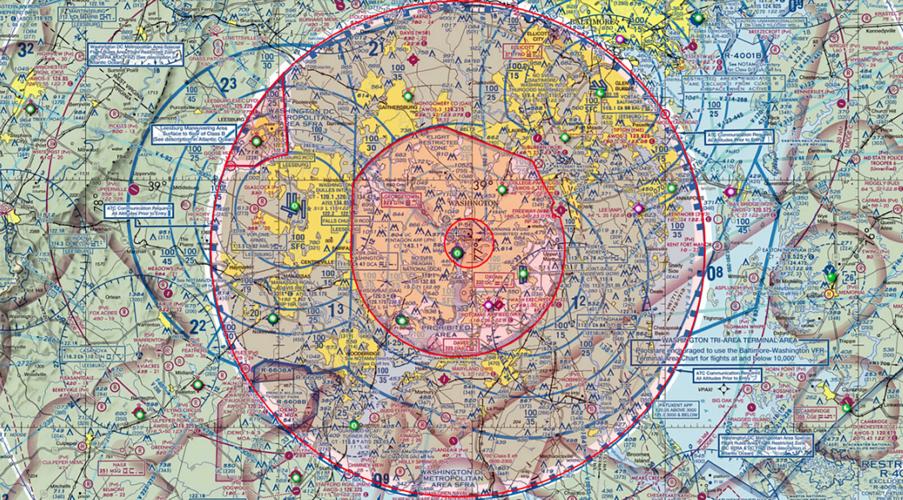
Complex airspace surrounding Reagan National Airport.
Of all the nation’s big city airports, none are as unique and complicated for pilots as the Reagan National Airport in Washington, D.C.
It is one of the busiest in the country with about 850 takeoffs and landings per day. It is one of the few remaining large commercial airports with a triangular-shaped runway pattern that contains dangerous overlapping intersections.
Due to the proximity of sensitive government facilities (e.g. The White House and The Pentagon) it is surrounded by some of the most restricted airspace in the country, airspace shared by military helicopters and other official aircraft.
The recent mid-air collision between an Army Blackhawk helicopter and a commercial airline over the Potomac River near Washington, D.C.’s Reagan National Airport, which claimed 67 lives, has highlighted the importance of effective communication between air traffic controllers and pilots in maintaining aviation safety.
Corporate jet pilot and local flight instructor Brandon NeSmith recently shared aviation insights and experiences of flying into challenging areas similar to Reagan.

Corporate jet pilot and local flight instructor Brandon NeSmith.
FOR THE PAPERNeSmith, 44, a resident of Lenoir, is a fixture at Foothills Regional Airport that straddles the Burke and Caldwell county lines. With over 7,700 accident-free flight hours, he is an ATP-rated pilot and flies a Citation XLS business jet all over the country for a Charlotte-based business.
A pilot for 28 years, NeSmith has taught over 100 flight students, a couple of dozen of which have advanced with Commercial ratings. He’s also founder and owner of Table Rock Aviation, a flight school that operates out of Foothills airport
Married to a Lenoir educator, Rebecca, they are parents of two boys, Pierce, 11, and Myers, 5.
Sitting in the terminal at Foothills, with helicopters, business jets and small airplanes visible through the window beside him, NeSmith talked aviation while he waited for an instrument student to arrive for lessons.
Aviation is a tight-knit community. Air traffic controllers and pilots get to know each other well. News travels fast. Bad news, faster.
Reagan National is about the only major airport in the country NeSmith has not flown into. He’s flown into and out of every airport around Reagan — Dulles, Baltimore, Fredericksburg, Manassas — so he’s very familiar with the airspace.
“It’s very congested airspace,” he said. “Of the things about that airspace, number one, is that there’s very close proximity to prohibited areas that really nobody except explicitly authorized people can fly into and out of. So, for example, the airspace over the White House: No aircraft can fly over the top of the White House from the surface of the ground all the way up to at least 18,000 feet.”
Surrounded by huge blocks of restricted airspace, coupled with the outdated airport layout, tight approach and departure paths follow the Potomac River. Just north of the runway lies Gravelly Point Park, a popular public area where visitors can watch planes fly low and slow over the Potomac River as they land.
“When you are making approaches into the DCA airspace, you have to be very cautious and careful to fly over a prescribed route that you can’t deviate off to one side of the other.” he said. “You’re threading the needle. You do not wish to stray off the path of the Potomac River on one side or the other.”
Complex airspace surrounding Reagan National Airport.
FAAAt night, unforgivable flight paths combined with an abundance of background municipal lights increase exponentially the need for caution and precision.
“A concern as a pilot is that it can be difficult to sometimes spot other aircraft in the surrounding area when you have just this immense glow of lights that are overlaying the surrounding areas of the airport,” he said.
The Jan. 29 midair collision occurred in good weather at night.
The causes of the accident are still under investigation. Preliminary findings made public by the National Transportation Safety Board (NTSB) investigating the accident are pointing to altitude errors by the helicopter.
“Right now, based on the information that has been released from the NTSB, the appearance is that the helicopter was not in the right place and where it should have been, per the published route for the helicopter,” he said.
Furthermore, there is the passenger jet was in a left hand turn at the time of the collision.
“When it is beginning to make that left hand turn, imagine you’re sitting in the cockpit of the airplane. The left wing is down, and the right wing is banked up,” he said. “The person that would be sitting in the right seat of the aircraft is going to have a very limited field of view looking down on the right side.”
“The NTSB has released information that in the last two seconds of flight that the pilots initiated a pitch up maneuver, which means, unfortunately, without any time left to adequately avoid, they saw the helicopter at the very last minute” he said.
Unlike commercial aircraft, the Army Blackhawk helicopter is painted in dark colors and does not have an abundance of safety light.
“It would have been even harder to be seen if the airplane’s wing is banked up to where visibility becomes restricted below them in a blind spot,” NeSmith said.
Questions have been raised whether it was the fault of the air traffic controller. Highly improbable, says NeSmith.
ATC training is rigorous and demanding. It takes up to five years to become fully qualified. Typically, the FAA doesn’t hire ATC candidates older than 31 years because the mandatory retirement age is 56 years.
After graduating from ATC schools, candidates are assigned to an airport and an airspace and are expected to spend their entire careers at that location. Air Traffic Controllers are very familiar with designated airspace and its unique character.
A lingering question regards communication between aircraft and ATC. Helicopter pilots were asked if they had the CRJ (passenger jet) in sight, and the response from Pat Two, the helicopter, was they had “the aircraft” in sight. The response lacked specificity.
Consequently, NeSmith said, he will “make sure I positively identify” back to ATC aircraft communication.
A father of two young boys who makes a living as a commercial jet pilot, said air travel is safe. “The modern airspace system we have is extremely safe. Accidents are exceedingly rare. More people get hit by lightning, or bit by sharks, than suffer aircraft accidents,” he said.
Allen VanNoppen is the publisher. He may be reached at 828-445-8595 or allen@thepaper.media.

Publisher
{{description}}
Email notifications are only sent once a day, and only if there are new matching items.
















Sorry, there are no recent results for popular videos.
Success! An email has been sent to with a link to confirm list signup.
Error! There was an error processing your request.


Sorry, an error occurred.
Already Subscribed!
Cancel anytime
Thank you .
Your account has been registered, and you are now logged in.
Check your email for details.
Submitting this form below will send a message to your email with a link to change your password.
An email message containing instructions on how to reset your password has been sent to the email address listed on your account.
No promotional rates found.
Secure & Encrypted
Thank you.
Your gift purchase was successful! Your purchase was successful, and you are now logged in.
| Rate: | |
| Begins: | |
| Transaction ID: |
A receipt was sent to your email.







(0) comments
Welcome to the discussion.
Log In
Keep it Clean. Please avoid obscene, vulgar, lewd, racist or sexually-oriented language.
PLEASE TURN OFF YOUR CAPS LOCK.
Don't Threaten. Threats of harming another person will not be tolerated.
Be Truthful. Don't knowingly lie about anyone or anything.
Be Nice. No racism, sexism or any sort of -ism that is degrading to another person.
Be Proactive. Use the 'Report' link on each comment to let us know of abusive posts.
Share with Us. We'd love to hear eyewitness accounts, the history behind an article.