


It doesn’t take long for word to catch the wind in rural counties like Burke and Rutherford.
Especially when a nearly 18,000-acre tract of land goes up for sale to the highest bidder. Known as the Rollins Tract, this hilly forested terrain in the heart of the South Mountains had been owned by a textile family since at least the 1950s, but many folks in the region felt a deep sense of shared stewardship, recalls Susie Hamrick Jones, founding executive director of Foothills Conservancy of North Carolina (FCNC), a land trust based in Morganton celebrating its 30th anniversary this year.
“The communities on all sides of these big private tracts had always treated it like it was public land, almost,” she says. “Everybody felt like it was okay to go up and hunt, hike, do whatever. There were very strong feelings that this was a critical ecosystem to protect.”

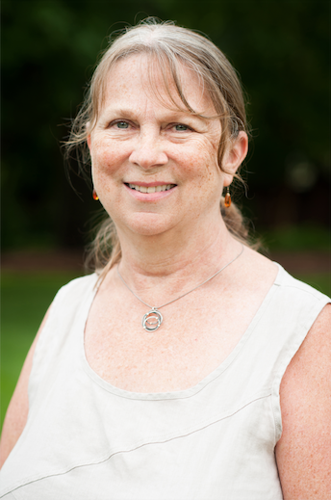
Susie Hamrick Jones
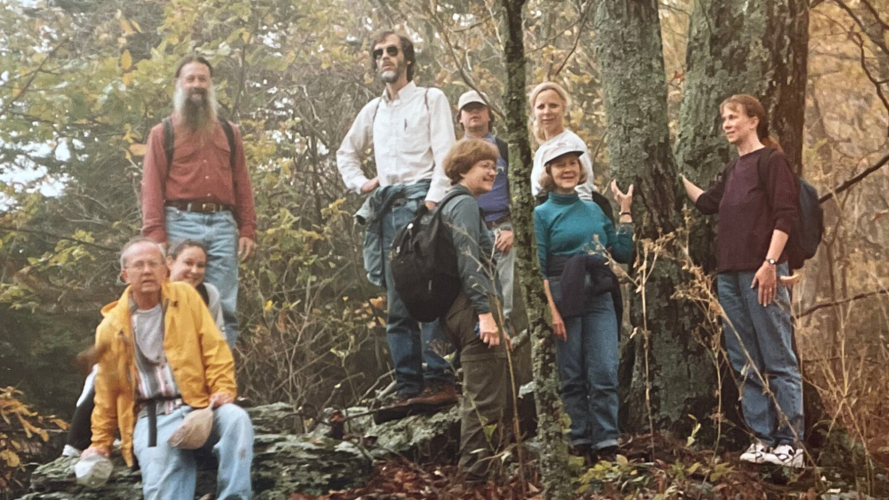
FOR THE PAPERHamrick Jones and her friends, many of whom had known each other since elementary school and “lived deep in the South Mountains,” gathered for a campout Memorial Day weekend 1994 on the very property that was at risk of being sold. They wrestled over what had to be done to protect this land from timber companies wanting to clear-cut it.
“We weren’t thinking of it as a group or an organization at all,” she remembers. “It was just people trying to figure out how to do something that seemed monumental and way too big to do. We just thought, ‘This is not okay. We can’t let this happen.’”
This fireside discussion among motivated, conservation-minded friends gave birth to FCNC, having now protected roughly 71,500 acres across eight counties in the foothills of North Carolina. It has taken ongoing efforts by a flurry of environmental partners, government and corporate sponsors, donors, and community members passionate about nature and the need to preserve this region’s rich natural heritage.
“This is a lot of money. I don’t know how you’re going to do it.”
Many tributaries make a mighty river. It’s certainly true of conservation, which requires elaborate networks of political support and fundraising to be effective.
Following advice from The Nature Conservancy, a global environmental nonprofit, Hamrick Jones and her compatriots formalized their grassroots efforts into a nonprofit, creating South Mountains Coalition, initially not thinking of it as a land trust but as an advocacy group.
Ambition is what made this effort so remarkable—no conservation group had ever attempted to conserve such a large piece of property in North Carolina.
Even sympathetic voices from within prominent conservation circles were skeptical, saying, “This is a lot of money. I don’t know how you’re going to do it,” Hamrick Jones remembers. But the provincial crew of concerned citizens knew the argument was “easy to make”: the South Mountains are headwaters for the Broad and Catawba rivers, and home to numerous rare plant and animal species.
Raising money in an economically distressed region, building partnerships, and confronting county commissioners and state legislators takes resources few are willing to sacrifice. “A lot of people gave up a lot of their time and energy, and definitely put their lives on hold,” Hamrick Jones says, reflecting on her family. “I did, and my girls will tell you that.”
These conservation efforts attracted the attention of other projects in the area, inspiring the Coalition to formally reorganize and expand its mission in 1997, becoming Foothills Conservancy of North Carolina. This transition reflected a broader vision to protect lands beyond just the South Mountains area, encompassing the eight counties it serves today.
The Rollins Tract was sold multiple times before FCNC secured the $14 million necessary to finally purchase the land in spring 1998. In partnership with The Nature Conservancy, the 17,829-acre Rollins tract was then conveyed to the NC Wildlife Resources Commission to be managed as public wildlife lands.
“You have to do the right thing.”
There wasn’t much rest, however, before another major project presented itself. Having barely made the transition from board member to executive director, Hamrick Jones vividly recalls, “Paul Braun walked into the office one day and I had no idea who he was and he asked to see me and he said, ‘I know what you did on the Rollins tract. You’ve got to help me save Lake James.’”
He would prove a relentless advocate as FCNC turned its gaze to the 150-mile shoreline reservoir straddling McDowell and Burke counties.
With only smaller tracts of land up for grabs around Lake James, the threat wasn’t the timber industry, but real estate development. Nonetheless, she described the saga as “equal to the Rollins tract in terms of complexity. There was so much politics and money.”
At the time, Duke Energy’s real estate division, Crescent Resources, was planning extensive development along the shorelines, including gated communities and golf courses, threatening to “basically privatize the entire lakeshore,” Hamrick Jones says. In addition to making the case for the impact this would have on water quality and public access, they also highlighted the economic benefits conservation would have on the region: more tax revenue from tourism.
Crescent Resources eventually replaced their initial developer—a man Hamrick Jones describes as “resistant to conservation ideas” and “hellbent” on developing the entire lakeshore. The new developer for Crescent Resources, however, understood conservation development principles; he was somebody she says became “one of us” and worked in partnership with FCNC to protect land around the lake.
FCNC has since protected over 11,000 acres surrounding Lake James, including the 2,915 acres purchased from Crescent Resources in 2005 to expand Lake James State Park.
This project has had a lasting impact, spurring the development of several state trails, such as the Fonta Flora Trail, with Lake James serving as a central hub for public access to the outdoors throughout western North Carolina.
“I always said I’m looking out at least 100 years.”
Susie Hamrick Jones stepped down as executive director after more than two decades with FCNC, passing the torch to Andrew Kota in 2017, who had worked with her and for the conservancy for 12 years prior.
Under her leadership, and that of Kota’s, Foothills Conservancy of North Carolina has grown into a respected, nationally accredited land trust that has protected vast acreage across the eastern slopes of the Blue Ridge Mountains and their foothills. That includes ecosystems at Chimney Rock State Park; land along National Wild and Scenic River Wilson Creek, the Linville River, and the Johns River; and more than 4,000 acres in Pisgah National Forest and the Blue Ridge Parkway.
“There are things that cannot be undone or that you can’t fix in one lifetime,” she says. “I’ve always said I’m looking out at least 100 years. You want to look out for seven generations from now. And you’re not going to be able to do it all, but at least you’ll do more than would have been done if you didn’t exist.”









(0) comments
Welcome to the discussion.
Log In
Keep it Clean. Please avoid obscene, vulgar, lewd, racist or sexually-oriented language.
PLEASE TURN OFF YOUR CAPS LOCK.
Don't Threaten. Threats of harming another person will not be tolerated.
Be Truthful. Don't knowingly lie about anyone or anything.
Be Nice. No racism, sexism or any sort of -ism that is degrading to another person.
Be Proactive. Use the 'Report' link on each comment to let us know of abusive posts.
Share with Us. We'd love to hear eyewitness accounts, the history behind an article.