



Domestic violence seems an unlikely topic of conversation between two old friends as they linger over an excellent lunch at Morganton’s LongHorn Steakhouse on a gray and rainy early August day.
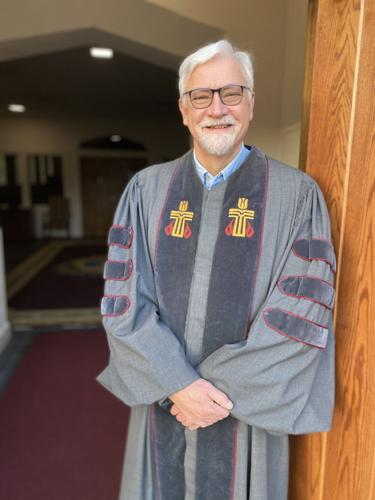
As he nears his 70th birthday, still tall and strong with a full shock of white hair and a carefully trimmed goatee, Kevin Frederick looks as if he could answer the call from central casting for a distinguished Southern senator, an eloquent lawyer in the Atticus Finch tradition, or perhaps a well-loved and respected minister of the Gospel.
He is, of course, the third of those choices, having “retired” in 2021 after 13 years as the senior minister at Waldensian Presbyterian Church in Valdese and more than 35 years in professional Christian service.
Since that retirement, however, Frederick has had little time for either the La-Z-Boy recliner or the fishing hole.
Instead he has worked with the Burke Coalition for Reconciliation and the Burke NAACP to ease the racial divisions in the county and to raise awareness of the harmful impact of lingering racism.
He has continued to speak and write about the history of the Waldenses, following up on his 2017 book, “With Their Backs Against the Mountains: 850 Years of Waldensian Witness.”
And, he has continued to be a warrior in the battle against domestic violence, an effort he took up more than 30 years ago.
As a youngster coming of age in the late 1960s and early 1970s, Frederick remembers being appalled when CBS News Anchor Walter Cronkite announced each evening the number of American troops who had been killed in South Vietnam that day.
Later, however, when he began grappling with the issue of domestic violence and what he as a Christian minister could do to fight against it, he was equally appalled by the horrifying statistics that battle entailed:
- A woman is abused every nine seconds in the United States.
- Domestic violence results in nearly 1,300 deaths and 2 million injuries each year.
- More than three women are killed by husbands or boyfriends each day.
- Most incidents of domestic violence are not reported to the police — only 20% of rapes/sexual assaults, 25% of physical assaults, and 50% of stalking incidents are reported.
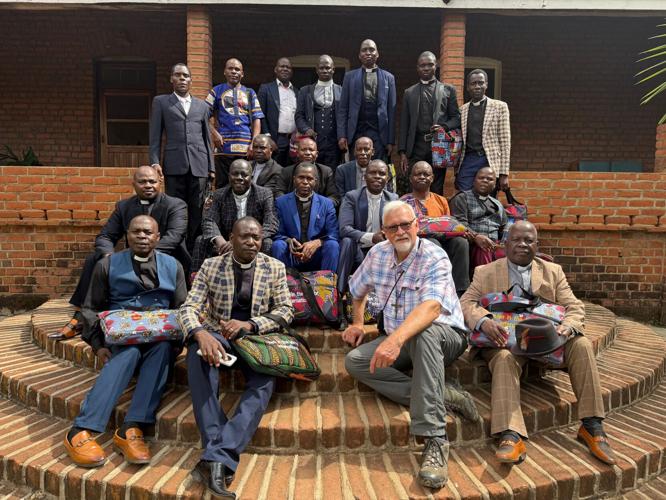
- And, as Frederick would learn, the rates of domestic violence are even high in developing nations such as Guatemala and Malawi.
As he and his interviewer push back their empty plates and settle in with cups of steaming black coffee, Frederick looks across the emptying dining room for a moment, gathers his thoughts, and recalls the day when battling domestic violence became a priority for him.
“It was the summer of 1994. I was deeply in love with my wife, Mary Jane, and we were expecting our first child,” he remembered. “And I asked myself, ‘How could anyone intentionally hurt his wife or his children?’”
Frederick made a pledge to God that day, a pledge he has been working for the last three decades to honor: to do all he could to remove the ugly stain of domestic violence from the earth.
Initially, he worked with a program of the Presbyterian Church USA called Support the Court in which trained volunteers went to court with domestic violence victims to support them and help make sure they were treated fairly.
This initial effort led to involvement with the Presbyterians Against Domestic Violence Network, a national organization, and to working with individual victims himself.
“I quickly learned that domestic violence crosses all boundaries and is found at all levels of society,” Frederick said. “The underlying issue, the underlying cause, is the desire for control.”
Domestic violence, he continued, “often moves in a predictable cycle. There is the honeymoon period, then increasing signs of aggression, then a major outburst that often leads to injury, and then an expression of regret and another honeymoon period.”
Breaking that cycle can be extremely difficult, Frederick said, noting that the average woman who is a perpetual victim of domestic violence attempts to leave her husband or partner seven times before actually succeeding.
As he continued speaking at workshops and ministering to victims, Frederick became convinced that his denomination needed training materials that could be used to stop domestic violence before it began.
The result was Men in the Mirror, a biblically based 13-week curriculum for men that asks them to examine their beliefs about what it means to be a man in relation to their families and their communities, and to learn to express their masculinity in a Christ-like manner, Frederick explained.
“This curriculum,” Frederick said, “challenges men to improve their relationship skills by studying and applying the dynamics of relationships that Jesus exhibited in situations with men, women, and children.”
Later, realizing that an increasing number of men are domestic violence victims and seeking to strengthen Christian marriages, Frederick developed the Couples in the Mirror curriculum, a devotional series for couples.
The idea is that couples can go through the studying of the materials together and talk about what they are learning. The goal, Frederick said, “is to deepen the concepts learned and to strengthen relationships between spouses.”
These programs are now being used in Presbyterian USA congregations across the United States and in foreign countries as well. (See accompanying sidebar.)
“Too many young men are buying into this notion of a ‘Macho Jesus,’” Frederick said. “We need to give them a more biblical understanding of who Christ is and how he treated all those he encountered.”
The goal of any effort to reduce domestic violence, Frederick concluded, is to “break the code of silence. Men and women must know that it is OK to speak out and OK to seek help.”















(0) comments
Welcome to the discussion.
Log In
Keep it Clean. Please avoid obscene, vulgar, lewd, racist or sexually-oriented language.
PLEASE TURN OFF YOUR CAPS LOCK.
Don't Threaten. Threats of harming another person will not be tolerated.
Be Truthful. Don't knowingly lie about anyone or anything.
Be Nice. No racism, sexism or any sort of -ism that is degrading to another person.
Be Proactive. Use the 'Report' link on each comment to let us know of abusive posts.
Share with Us. We'd love to hear eyewitness accounts, the history behind an article.