

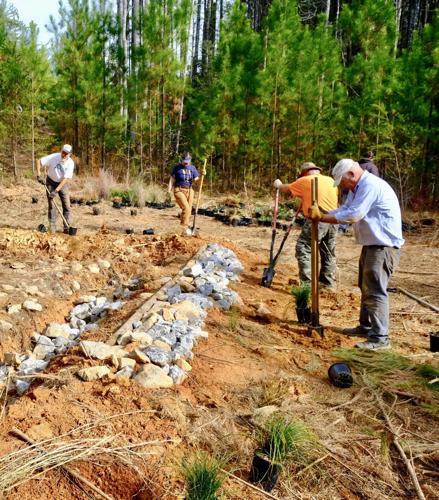

A project led by volunteers and NCSSM students has led to a grant from Duke Energy Habitat Enhancement Program to restore two eroded sections in the Fonta Flora Trail County Park in Burke County.
Both restoration sites face ecological stress from a dense Eastern white pine canopy, which limits the growth of younger, more diverse native plant species.
In June of 2023, students from the N.C. School of Science and Mathematics Morganton and volunteers from the Lake James Environmental Association (LJEA), conducted a watershed assessment of a basin contained in the Fonta Flora Trail County Park in Burke County.
The assessment included classifications of the streams in the watershed, mapping streamside and forest plants, identification of problematic erosion, presence and location of invasive plants, and the establishment of baseline water quality analysis of the stream just before it flows into Lake James.
The students identified 14 locations within the study area that were impaired and created a map of the area that shows the location of each impaired area.
Those areas were then prioritized based on level of impairment and threat to both the watershed and the cove on Lake James that the stream empties into.
The map was presented to the Burke County Recreation Department to be used as a guidance document for planning and management of the park’s natural resources.
As a result of the students’ study and documentation, county staff selected two severely eroded locations to focus restoration efforts and LJEA applied for grant funding from Duke Energy Habitat Enhancement Program.
$15,000 GRANT
In February 2025, the nonprofit was awarded $15,000 to restore the stream and cove habitats in the uppermost portion of the study area.
LJEA expects to use the sites as watershed restoration education examples in the coming years, and its board of directors provided an additional $5,000 for educational signage and the development of instructional materials.
Repair of the largest gullies will address the severe erosion of these sites, which has not only caused loss of forest habitat but has also contributed to the sedimentation and loss of aquatic habitats in the nearby Lake James tributary.
The project team grew to include LJEA student interns, Cadence Davis from N.C. State and Gillian Freeze from Davidson, who worked with LJEA members Lee Kiser and Marshall Taylor to do more extensive site surveys.
They mapped tree species, notable plants, and collected topographical data of the impaired areas. The Foothills Conservancy of North Carolina (FCNC) provided feedback throughout the process.
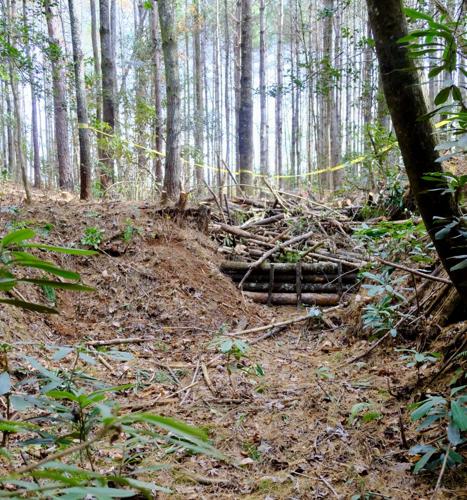
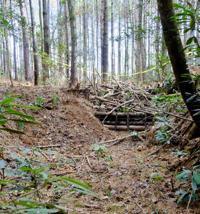
The team has since worked to cut standing dead trees and understory white pine saplings to improve access to the restoration site and open the forest. The cut saplings were repurposed by the team in the construction of two regenerative stormwater conveyance systems.
This is a method of managing stormwater utilizing natural materials including sand, rocks, woodchips, and vegetation. It works by slowing down water with gentle slopes and shallow pools where water can filter back into the ground instead of picking up more sediment as it rushes through the drainage. The stormwater conveyances not only improve water quality and slow down erosion but also create a new habitat for all kinds of animals.
Following the construction of the stormwater conveyances, nearly 400 native plants have been placed representing 40 different species at the two sites with the help of more than a dozen volunteers.
This diverse native plant community will help the ecosystem by providing key services such as foraging, erosion control, water filtration, and overall increase in biodiversity.
With the addition of brush shelters built for attracting wildlife, the native fruit-bearing plants and seasonal flowers will make these areas more vibrant and resilient than ever.
FUTURE STEPS
Erosion control measures and reintroducing native plants are just a few components of the Fonta Flora County Park Habitat Enhancement project, a multi-year effort to strengthen the watershed.
Future steps include expanding native plants through live staking in the spring, completing additional erosion control measures, and installing permanent educational signage for park visitors.
LJEA will also continue long-term ecological monitoring, including avian surveys, water flows, macroinvertebrate sampling, and tracking changes in vegetation establishment.
More than $15,000 worth of in-kind match is valued on this grant from multiple volunteer days, county staff member’s time, and expertise from project managers. Many volunteers from the members of the Mountain-to-Sea Trail maintenance crew, the American Adventure Service Corps, and community organizations came together to help make this restoration project possible.















(0) comments
Welcome to the discussion.
Log In
Keep it Clean. Please avoid obscene, vulgar, lewd, racist or sexually-oriented language.
PLEASE TURN OFF YOUR CAPS LOCK.
Don't Threaten. Threats of harming another person will not be tolerated.
Be Truthful. Don't knowingly lie about anyone or anything.
Be Nice. No racism, sexism or any sort of -ism that is degrading to another person.
Be Proactive. Use the 'Report' link on each comment to let us know of abusive posts.
Share with Us. We'd love to hear eyewitness accounts, the history behind an article.