

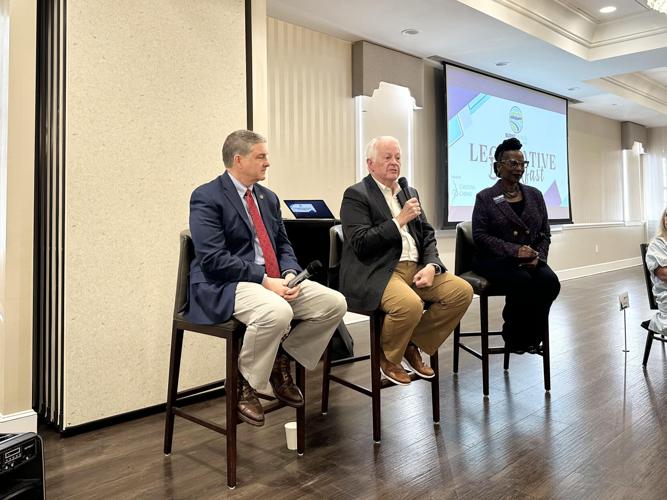

State lawmakers addressed rising taxes, economic development, and infrastructure during the Burke County Chamber of Commerce’s annual Legislative Breakfast, outlining priorities as the General Assembly prepares to reconvene.
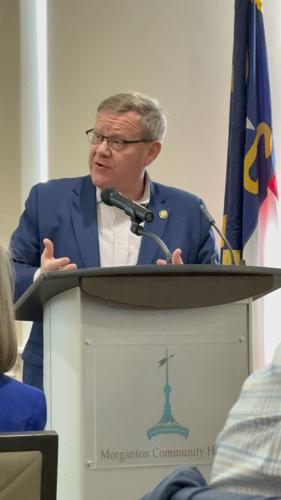
Sen. Warren Daniel and Rep. Hugh Blackwell took questions from local leaders and residents, while U.S. Rep. Tim Moore made a surprise appearance and shared updates on federal disaster recovery efforts.
Tonya Little from the North Carolina School of Science and Mathematics-Morganton fielded questions to the lawmakers, and took questions from the audience.
Q: North Carolina has faced delays in passing a comprehensive state budget in recent cycles. How is this uncertainty impacting economic development projects and funding commitments to communities like Burke County?
The state is currently operating under a continuation budget that’s about 3% larger than last year, with a full budget potentially adding another 3% along with funding for capital projects, economic development, and local grants, Daniel said.
“The state’s a big business, and I’m hopeful that Hugh and I can help push some other folks to an agreement,” Daniel said. “If it was up to us, I think we would already have a budget.”
Blackwell noted that most of the state’s $32.6 billion budget is already in place, with about $600 million still unresolved, meaning most operations have continued as normal. The remaining gap is largely affecting smaller local projects, including infrastructure investments, he said.
“What’s being held up is the smaller projects, such as the $10 million or $12 million that we might like to have here in Burke County to replace, upgrade, raise the Indian Hills pump station so that we don’t have a problem of having to potentially turn down housing permits because we don’t have the sewer and water capacity down there,” Blackwell said.
Q: The state has invested in the megasite development. Can you provide an update on the status of the Burke County megasite and what benchmarks still need to be met to attract a major employer?
The state has appropriated $37 million for the megasite, with $12 million designated for infrastructure and $25 million for purchase, according to Daniel. The appraisal for the property came in at over $25 million, so the state or local government will need to fund the remaining amount to purchase the site.
“As far as Hugh and I are concerned, it’s still a viable project,” Daniel said.
The state has identified the site as the only large site of its type in the western part of North Carolina, Blackwell noted, which has been on the radar at the Department of Commerce in Raleigh. He also pointed to the 100-acre industrial site in Drexel, which the state provided funds to clean up as it was home to the Drexel Furniture Company.
Q: Where do you stand on the General Assembly’s discussion on property tax levy limits?
Daniel said lawmakers are still reviewing proposals on property tax levy limits, but noted growing concern among constituents over rising property values and taxes. He emphasized the need to balance tax relief with local governments’ funding needs.
“When your grocery bill is going up, the county’s grocery bill is going up,” Daniel said.
Blackwell, who noted that he’s not on the House Select Committee on Property Tax Reduction and Reform, said that the state is also dealing with a burgeoning population, which creates the need for additional and more resilient infrastructure, which has to be paid for.
“I’m going to use a cliche, and say the devil is in the details,” Blackwell said. “I don’t know what the details of any specific proposal are going to be.”
Q: Access to health care is a critical issue for rural communities. How will recent or proposed state investments improve health care access in Burke County?
Blackwell, who is on the joint oversight committee on Medicaid, said he and his colleagues are spending untold hours talking to the Department of Health and Human Services. The federal government is looking to reduce funding based on the payment rate of error local and state governments have, he said.
“One of our big initiatives is working on what we can do at the state level to help counties decrease that error rate,” Blackwell said. “That’ll be a major factor in whether we can begin to bring things under control.
The legislature expanded Medicaid in its last session, which was an effort to expand health care opportunities to the working poor, Daniel noted.
“When Hugh and I were in our first terms, Medicaid was consuming every extra dollar we had,” Daniel said. “We’ve kind of come full circle to where that’s happening again.”
Q: Infrastructure remains critical to both quality of life and economic growth. What infrastructure projects, whether transportation, broadband, or water and sewer, affecting Burke County, are currently prioritized in Burke County?
The state went through a COVID-19 pandemic era where there was a lot of extra federal funding coming in to go toward local infrastructure projects, and most of that has been spent, Daniel said, but the needs haven’t stopped.
“We have aging infrastructure across the state,” Daniel said. “It doesn’t mean legislators are going to stop asking the counties and towns what their needs are. It just may mean there’s not the same type of dollars out there that can serve the needs of 100 counties.”
Some pots of money at the state and federal levels are being refreshed, Blackwell noted, including sewer and water, and broadband at the state level. He added that Foothills Broadband has been a recipient of some of those funds for Burke County. He said he hopes Burke County will get some of those funds for improvements at the Indian Hills pump station.
Daniel added that the state is short on transportation funds for the region, mostly because over a billion dollars was shifted for Hurricane Helene repairs. More rural transportation projects are also having to compete against projects in much more populated areas like the Triangle and Charlotte Metro.
“The challenges we’re facing in rural communities is the ability to kind of keep up with the infrastructure, so it’s sort of a two-edged sword,” Daniel said, pointing also to the state’s rapidly growing population.
The North Carolina General Assembly is scheduled to reconvene for the 2026 Short Session on April 21. The House Select Committee on Property Tax Reduction and Reform voted on Wednesday to formally recommend a state constitutional amendment to place limits on property tax hikes.






















(0) comments
Welcome to the discussion.
Log In
Keep it Clean. Please avoid obscene, vulgar, lewd, racist or sexually-oriented language.
PLEASE TURN OFF YOUR CAPS LOCK.
Don't Threaten. Threats of harming another person will not be tolerated.
Be Truthful. Don't knowingly lie about anyone or anything.
Be Nice. No racism, sexism or any sort of -ism that is degrading to another person.
Be Proactive. Use the 'Report' link on each comment to let us know of abusive posts.
Share with Us. We'd love to hear eyewitness accounts, the history behind an article.