

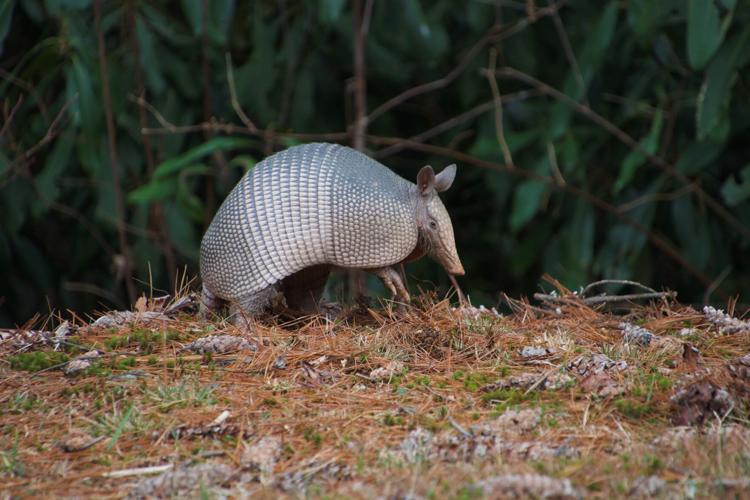
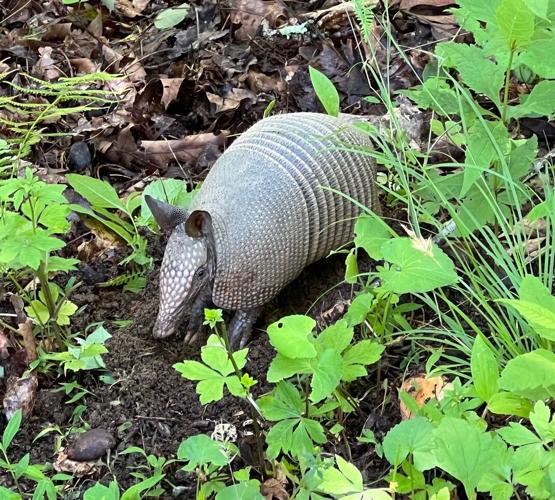

While it may feel like the Deep South with the heat and humidity outside, the last thing Burke residents expected to see this summer was Texas’s small state mammal, the armadillo, parading up the interstates and foraging in their gardens.
While social media chattered about the species popping up as roadkill along busy Burke roadways in late June, North Carolina Wildlife Resource Commission (NCWRC) experts say the nine-banded armadillo is nothing new in the state and is likely to become a staple in the ecosystem.
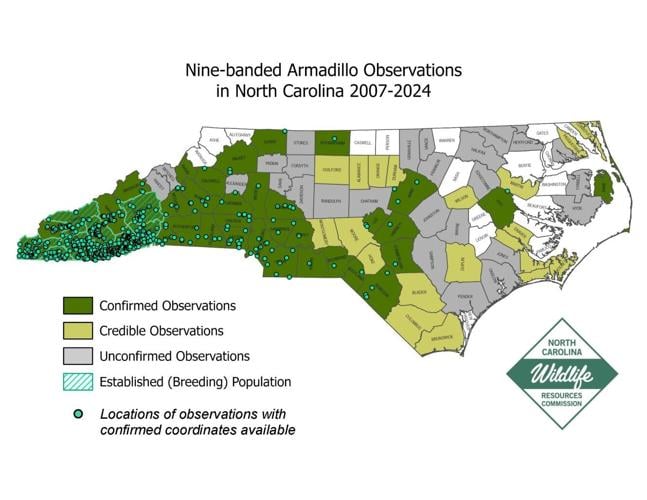
Since the late 2000s, there have been more than 1,500 observations across North Carolina.
“We have actually been able to document likely breeding activities,” said Caitlin Brett, the furbearer biologist for the NCWRC. “They’ve certainly got a foothold in the western part of the state.”
Brett explained that armadillos have been expanding across the Gulf Coast for centuries, first appearing in Texas in the mid-1800s, before eventually establishing source populations in North Carolina’s neighboring states like Tennessee, Georgia, and South Carolina.
Contrary to their desert-associated film credits, nine-banded armadillos thrive well in areas with high moisture availability, lots of bugs, and leaf litter for them to dig through.
Burke and the surrounding mountains pass those requirements with flying colors.
“That’s really what is likely driving their expansion,” Brett said, chuckling at the nature of the “bizarre critters.” “There’s a ton of resources, here in the Southeast, for them to feed on and take advantage of. They eat tons and tons of invertebrates, so the more habitat they have available that has a really good food source, the more they’re likely to continue to expand.”
Although the biologist acknowledged that some scientists point to climate change as the driving factor, Brett hypothesized it was the continuation of a natural expansion into areas where the species could burrow and thrive throughout the year.
The biologist was hesitant to call the spreading population “invasive.” Although the small mammals capitalize on manmade roadways for easy expansion — hence the roadkill — Brett said they’ve mostly got here on their own.
“Expanding is a better term for these guys,” Brett said. “We look to be really careful about throwing the term invasive around. There are tons of invasive species that can cause a lot of damage. I like to save that classification for introduced, invasive, damaging species,” like feral swine.
POPULATION COUNT
According to Brett, the first credible observation in Burke traces all the way back to 2014. The first confirmed observation was in 2022.
Biologists with the state separate sightings into three categories because residents sometimes misidentify “vehicle-killed snapping turtles and live opossums captured on Ring-type video cameras” as armadillos.
The three categories include unconfirmed, where no physical evidence — photographic or otherwise — is provided; credible, where photographic evidence or a carcass was not available, but a biologist or researcher was able to confidently identify the species; and confirmed, where a photograph, video, or carcass was available for an expert to identify.
Since the state began tracking the armadillo expansion, Brett said there have been nine observations in Burke, and half of them were roadkill.
Although Brett said she’s not come across any reported observations from Burke this year, the commission hasn’t done a comprehensive review of all emails and calls, so the correct number is uncertain.
WHAT TO DO IF YOU SEE ONE
Brett’s advice depends on whether it’s living or dead.
If dead less than a day, but in good condition, email the NCWRC at armadillo@ncwildlife.gov with the subject line, “CARCASS COLLECTION.” They are studying the animals for diseases, population expansion, and more.
If dead more than a day, it can still be reported via the email, through the Wildlife Helpline at 866-318-2401, or by uploading the photo to the NC Armadillo project on the nature app, iNaturalist.
Alive or dead, biologists advise against handling the animals with bare hands. Although less than 10% of armadillos carry the disease, the species is known to be infected with leprosy, and humans can contract it.
When working in a garden suspected to have a foraging armadillo, wear gloves for the same reason.
If alive, snap a photo or video and report it through the avenues above. Nine-banded armadillos are fairly oblivious to nearby humans, don’t ball up like other species of armadillo, and often give a frightened jump when startled — so, not really a threat to pets or people.
“For the most part, leave it alone,” Brett said, explaining that if it is causing damage, call a Wildlife Control Agent, which can be located at ncwildlife.gov/find-licensed-wildlife-control-agent, to navigate the process of removal. “They can definitely dig up horticultural arrangements and lawns and things, but unless one is documented causing damage, for the most part, you can enjoy getting to watch wildlife do their thing.”























(0) comments
Welcome to the discussion.
Log In
Keep it Clean. Please avoid obscene, vulgar, lewd, racist or sexually-oriented language.
PLEASE TURN OFF YOUR CAPS LOCK.
Don't Threaten. Threats of harming another person will not be tolerated.
Be Truthful. Don't knowingly lie about anyone or anything.
Be Nice. No racism, sexism or any sort of -ism that is degrading to another person.
Be Proactive. Use the 'Report' link on each comment to let us know of abusive posts.
Share with Us. We'd love to hear eyewitness accounts, the history behind an article.