
The tragic story of how the Linville River received its names


Did you ever wonder how the Linville River got its name? Well, here’s the story
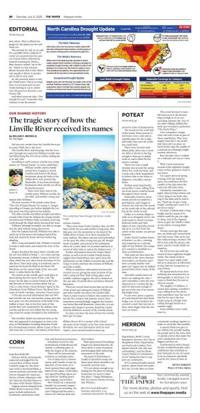
The Linville River and the gorge that the river runs through was named for William Linville who was killed along the river by an Indian raiding party in July 1766.
According to early sources, Linville was a long hunter (or “border hunter” as some called him). William Linville and his family moved from Virginia to North Carolina and lived in the Bryan Settlement along the forks of the Yadkin River near present-day Mocksville. It was from the Bryan Settlements that Linville set off on his fateful journey.
There were three men in the Linville party: William Linville, his son John, and another young man named John Williams.
The best account of the attack comes from “The Life of Daniel Boone” by Lyman C. Draper. According to Draper, just before daylight the Linville party was fired upon by the Indians.
The elder Linville was killed outright and with a second volley from the Indians the young Linville was killed and Williams badly wounded, receiving a ball through the thigh which fractured the bone.
Williams, although wounded, was able to escape into the dark without being discovered.
After the Indians had left, Williams was able to catch one of the horses the Indians had left behind and started for home with his broken leg dangling.
After a long and painful ride, Williams eventually made it back home and related the story of the attack.
Draper described the place where Linville and his son were killed as being “… on a clear and rapid mountain stream, in Burke County, North Carolina, which has ever since borne the name of Linville River. Their fatal camp, it is believed, was located not far from the bluff of the Short-Off Mountain, on the eastern bank of the river and about 10 miles below the Falls …”
The attack on the Linville party took place at dawn during the first week of July 1766. The source for the date is a letter found in the Colonial Records of North Carolina dated July 30, 1766, to John Stuart (Great Britain’s Agent to the Cherokees) from William Tryon (the Royal Governor of North Carolina). Governor Tryon wrote:
“I this day received information that one William Linville, his son, and another young man who were gone over the mountains at the head of the Yadkin to hunt, that in the first week of this month they were surprised by the Indians, that Linville and his son were killed that the young man made his escape wounded to his settlement …”
The Linvilles’ death was national news at the time and appeared in newspapers at least as far away as Philadelphia including Benjamin Franklin’s Pennsylvania Gazette. Below is part of the article from the 9 October 1766 edition of the Pennsylvania Gazette:
“They write from North-Carolina, that one William Linvill, his son, and another young man, who had gone over the mountains at the head of the Yadkin River to hunt, were there surprised by some Indians. The father and son were both killed on the spot; the other young man got off, though much wounded, and arrived at his settlement, where he is since dead. No accounts had been received of what tribe or nation the Indians were …”
Further information from the Draper Manuscripts, as well as from Linville Family history, suggest that Daniel Boone led a party from the settlements on the Yadkin to present-day Linville Gorge to locate and bury the remains of William and John Linville.
While no definitive information has been discovered (as yet) giving the exact location of Linville’s camp and their final resting place, most credible evidence suggests the site is located on the east side of Linville River and below Shortoff Mountain.
There are several local stories that say the site of the attack and subsequent burial of William and John Linville was above the Linville Falls. There is some reason to believe this could be true, but the fact remains that primary source documentation overwhelmingly suggests the location was below Shortoff Mountain. Given this, it is my opinion that Draper’s account should be considered the definitive account of the Linville attack.
So, there you have the story of how the Linville River got its name.
William Brown III is a member of the Colonel Alexander Erwin Chapter of the Sons of the American Revolution. For more information about the local chapter, check outcolalexandererwinsar.org.