Burke business is getting an international leg up in visibility.
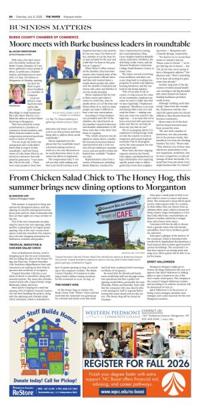
On Monday, July 6, Burke Development Incorporated (BDI) announced that Burke County has joined the Charlotte Regional Business Alliance (CLT Alliance), boosting the representation of the county on a transformative level, according to BDI.
The Charlotte Regional Business Alliance (CLT Alliance) represents different areas across the Charlotte region, with a goal of promoting economic growth through business recruitment, talent acquisition, and collaboration.
“The state used to run off business alliances,” said Brandon Ruppe, president and CEO of BDI, a public-private nonprofit organization focused on bringing capital investment jobs to Burke County and increasing the standard of living.
“We’ve been one of the few regional areas in the state that doesn’t have some sort of larger regional representation,” Ruppe continued. “The (CLT Alliance) helps meet that need for us in terms of collective marketing, branding, community awareness — those sorts of things.”
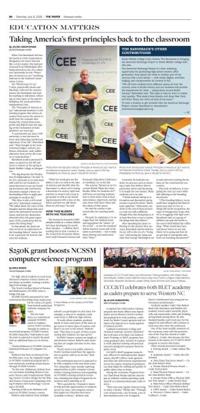
Ruppe explained that currently, Burke is surrounded by the Mountain West Partnership, covering the westernmost counties; NC Carolina Core, covering areas like Greensboro, Winston-Salem, and Fayetteville; and the CLT Alliance, covering 14 counties from Alexander County at Burke’s northeast edge down to Lancaster County in South Carolina.
According to Ruppe, site selection for major manufacturing industries isn’t as simple as cold-calling the front desk. More than a year of work often goes into narrowing down the options before a site selector even approaches an area.
“For years, Burke County has benefited from its unique position between the Charlotte metropolitan area and the mountains of Western North Carolina,” Burke County Manager Brian Epley said. “Joining the Alliance allows us to leverage that advantage more effectively by increasing our visibility among site selectors, business leaders, and investors evaluating locations across the Southeast.”
While it’s possible, with the right connections, to land a job-producing facility without the support of a regional group, the insertion of the county into the CLT Alliance now means that when site selectors determine they want to go to the Carolinas, they can call the alliance leaders, who start making suggestions on what fits the incoming company’s model best.
An opportunity like this takes the competition from Burke waving its arms for attention to Burke being on a global industrial billboard.
Businesses are particularly interested in locations with move-in ready buildings, making the job of starting from the ground up less of an obstacle.
Ruppe said that sites like the shell building project at the Burke Business Park — a building projected to take up a 100,000 square-foot footprint, with the capability of expanding to 180,000 square feet — are music to an industry’s ears.
The added benefit of the county’s proximity to the railway system, the county’s location on I-40, and the approximate hour drive to Charlotte Douglas International Airport and Asheville Regional Airport marks Burke as a prime location for incoming and outgoing goods and supplies.
WHAT INDUSTRIES ARE IN SCOPE?
The way Ruppe sees it, manufacturing is in the DNA of Burke locals, and bringing industry back to the area would give the residents jobs that they are equipped for and an industry their families could stick around for.
“Part of it is what are we competitive for?” Ruppe said, explaining that Burke County’s lack of metropolitan infrastructure doesn’t necessarily attract major software and IT companies or big banking businesses.
“There’s got to be some level of realism as to what we can attract and, again, leaning into our manufacturing legacy and heritage allows us to be very competitive for those projects. Those still have the highest economic multiplier effect.”
According to the National Association of Manufacturers, for every $1 invested in manufacturing, $2.69 is added back to the community.
“This is why pretty much everyone chases manufacturing companies,” he said. “This isn’t just a Burke County or North Carolina strategy. This is nationwide. Every state fights for these manufacturing companies.”
Manufacturing employees make up nearly a quarter of the people in Burke, according to BDI, and create approximately a third of the county’s gross domestic product.
The void left by the furniture and textile industry’s globalization created a swath of manufacturing skills with limited places to go, and this availability was a driving force for the CLT Alliance’s decision.
“Burke County brings tremendous assets to the Charlotte Region — most notably a manufacturing base with over 100 operating establishments and 7,000 jobs across food, furniture, and textile sectors,” said Tracy Dodson, Chief Operating Officer of the Charlotte Regional Business Alliance.
A few hours after the news broke, Ruppe’s phone started ringing with inquiries from site selectors. By Thursday afternoon, he’d “lost count of the calls.”
COMMUNITY INPUT
“Growth can be a scary word,” Ruppe said. “You have to have some level of growth.”
The goal for Ruppe isn’t necessarily bringing in new people. It’s giving the next generation a reason to stay --- including his two daughters, who one day will have to choose between Burke and other areas based on employment opportunities.
Burke’s place in the CLT Alliance won’t be completely directed by officials. Ruppe said there are plans for community input sessions to determine which route the county takes.
“Sometimes people worry that by joining the CLT Alliance, we start giving up some of our own identity and that’s not what we’re doing,” Ruppe explained. “What we’re doing is taking what is great about Burke County, putting it on a higher platform, and communicating it to the world.”