

Catawba Riverkeeper pushing for passage of 'Parking Lot Bill'

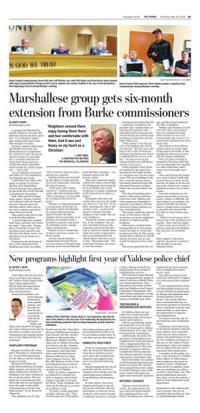
Catawba Riverkeeper volunteers removed a large amount of trash washed downstream on Mill Creek in Old Fort back in March. Old Fort, the nexus of several major waterways, was hit especially hard by flooding from Hurricane Helene.

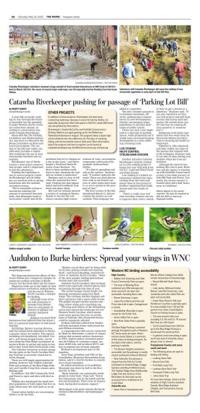
Volunteers with Catawba Riverkeeper plant live stakes beside a creek at Oak Hill Community Park and Forest in early April. Live staking helps control erosion along stream banks. It’s just one of several initiatives for the organization.

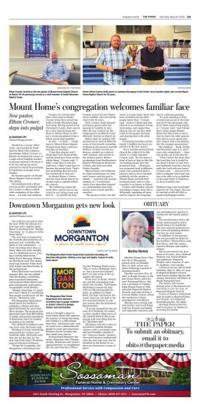
Volunteers with Catawba Riverkeeper did some live staking of new streamside vegetation in early April at Oak Hill Park.
A state bill currently working its way through the General Assembly has the potential to make Western North Carolina’s waterways cleaner, according to conservation nonprofit Catawba Riverkeeper.
House Bill 369, The Parking Lot Reform and Modernization Act, has been re-referred to the House Committee on State and Local Government. The version of the bill now under consideration includes a statute that would ban the use of environmentally harmful coal tar sealants.
Riverkeeper, one of Burke County’s most active conservation groups, said it’s important to ban the substances.
Pushing the legislation is one of several projects Catawba Riverkeeper and its lobbyists are involved with as spring transitions into the summer recreation season.
“We’re essentially trying to incentivize reducing the amount of pavement that gets built, that ultimately leads to stormwater runoff and all the problems that we’re chasing on a day-to-day basis,” said Riverkeeper’s Northern Basin Director Grant Buckner. “So, they’ve been working really hard on that. Banning the coal-ash tar sealant is important.”
Buckner said it’s easy to tell when the material has been used. Parking lots that appear faded and tired suddenly look fresh and shiny black.
But coal-tar sealants present a variety of ecological threats, thanks to the fact the substance contains high concentrations of toxic, carcinogenic compounds called polycyclic aromatic hydrocarbons (PAHs).
“It’s akin to spreading coal ash on the surface,” Buckner said. “It washes right into the water. There are good alternatives with no increased cost. Lots of other states have done it, so we’re excited at the prospect of that.”
The first version of the bill, introduced March 11, did not contain the section on coal sealants. That language was added in committee.
The law’s broader purpose is to eliminate minimum, off-street, parking-space requirements on new developments, thereby encouraging urban populations to increase their usage of public transit.
Critics say such a law might lead to a shortage of parking spaces, while proponents say it would mean increased housing development in a state suffering a housing crisis.
LIVE-STAKING HELPS CONTROL STREAM-BANK EROSIONAnother initiative Catawba Riverkeeper recently worked on is a live-staking project it began last year with help from the N.C. Land and Water Fund and Duke Energy.
Live staking is a habitat enhancement method that takes cuttings from live trees and plants them in the ground to produce vegetation that holds stream and river banks in place.
“That’s a really easy tool that everyday citizens can use to improve their rivers, whether they’ve got a stream or a lakefront,” Buckner said. “If you put vegetation on that, you will protect yourself from erosion and losing land and protect the stream from runoff that may be coming off your property or someone else’s.”
Replacing creek bank vegetation that was swept away by Hurricane Helene last fall is vital to ensuring the health of waterways.
Elderberry, silky dogwood, and silky willow are some of the species that respond well to the technique, Buckner said. It can only be done during cool weather when the trees are dormant.
Although the time for live staking this year is past, Buckner said the agency is teaming up with Foothills Conservancy to start a live-stake nursery at Oak Hill Park and Forest. Currently, the closest nursery is located three and a half hours away in Goldsboro.
Marty Queen is the senior reporter. He may be reached at 828-445-8595 or marty@thepaper.media.