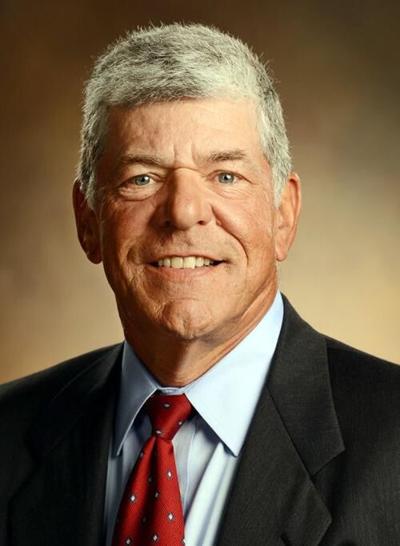
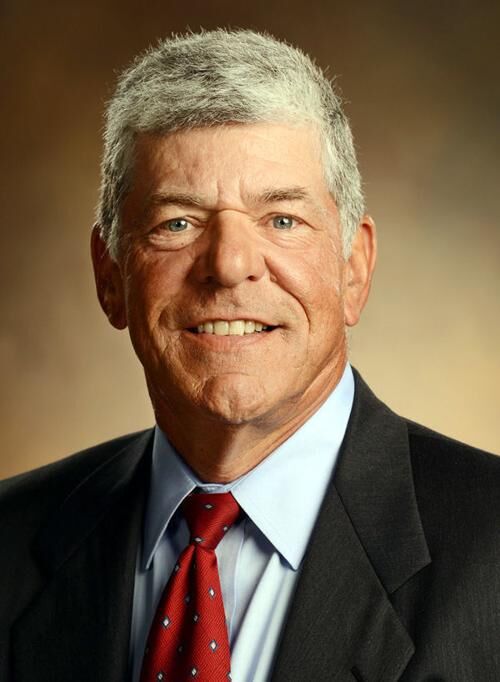
Chip Black, 71, founder of 42-year-old Black & Associates, a Morganton-based provider of estate planning and financial services, is quick to tell you: “I don’t know anything about tariffs.”
Black
FOR THE PAPER
Which caught his recent visitor by surprise, since, from the visitor’s perspective a seasoned financial pro such as Black would be totally up to speed on the topsy-turvy Tariff Turmoil.
But Black was quick to add with a smile and glint in his eye, “I know something about investing.”
Sitting at a round conference table in his office on 205 N. King St., with the stock market tanking historically due to the wild, changing-by-the-hour tariff threats, Black wove the current scenario into historical perspective.
On the day of the conversation, Monday, stocks briefly turned positive midmorning following a report that the U.S. was considering delaying tariffs by 90 days. However, reports later surfaced that these claims weren’t factual, and U.S. equity markets responded by finishing lower, with the exception of the tech-heavy Nasdaq, which edged out a modest gain.
On Tuesday, equity markets closed lower reversing gains at the open as investors continued to digest the latest tariff headlines.
On Wednesday, markets rallied across the board with the Dow popping 2,600 points on the news that new tariff rates would be paused for 90 days.
On Thursday, the markets plunged giving back one-third of its gains from Wednesday as China tariffs hit 145%.
Up and down. Back and forth.
Don’t panic, Black said. “Since 1957 the average annual return of the S&P 500 has been more than 10% per year, and it was not a straight-up ride. We had recessions, we had corrections, we had the financial crisis, we had COVID, we had all of these things that decimated (the market). We had Black Friday. You remember that? Oh, I do remember that.”
Black Friday, also called Black Monday, was the first contemporary global financial crisis and unfolded on Oct. 19, 1987. A chain reaction of market distress sent global stock exchanges plummeting in a matter of hours. The Dow Jones Industrial Average dropped 22.6% that day.
“And here we look back and we say, well, since 1957 (the S&P 500) averaged more than 10% per year compound return,” he said. “That’s because it goes up more than it goes down.”
With the current environment, Black said there are several concerns at play. First, consumers are already feeling stretched. They are spending most of what they earn and saving very little. If prices continue to rise, as many expect, that will only increase financial stress.
“They’re spending what they make, and if they think about having to spend more for the same things that they’re buying today, that gives them some heartburn,” Black said. “So, I think you’ve got the consumers on one side. I think you’ve got the workers on the other side who are concerned that the demand for products that perhaps they make, or they’re involved with, will go down and they will lose their job.”
Manufacturer managers and owners share that anxiety, Black said. They worry that if a recession hits and people stop buying as much, demand for the goods they help produce will drop. That could lead to job losses, especially in manufacturing.
“If I had a manufacturing firm, I would have concerns that in order to make my products competitive, I might need to expand my factories, because I won’t be able to get those same products from other countries as cheaply,” he said of the tariff impact. “I would be forced to make my own. That does not happen overnight.”
The challenging dilemma in Burke County, he said, is there is zero inventory of available, usable manufacturing buildings and sites. “And so, when you start thinking about it, well, we’re going to have to change the way that we make or create our products, that’s going to cause some heartburn. So, I think there are lots of issues that are probably making some people anxious.”
Some financial analysts have labeled the decline in the markets as a long overdue correction, albeit accelerated by the tariff war.
Market corrections, defined as a drop of more than 10% but less than 20% from a recent high, occur on average every 15 months, Black said. More often than that if you’re in small-cap stocks.
“So, when it happens, it shouldn’t be a surprise. It’s just a normal part of the market,” Black said. “It happens with regularity, and it will continue to happen. And if it had not been for tariffs, it would have been something else.”
He compares the stock market to a pendulum: constantly swinging, always seeking equilibrium. “Whether it’s the grocery store, the car lot, or the stock exchange, when supply and demand get out of balance, something’s gotta give. The market will always correct itself.”
“There are lots of reasons to be concerned about what is going on in the economy and in economics today but just remember that it’s short term. It’s on the surface. This is not going to change who we are or how we do business over the next decade. It is short term, and it will change. It always changes. So, I wouldn’t waste a lot of energy on it at this point.”
Allen VanNoppen is the publisher. He may be reached at 828-445-8595 orallen@thepaper.media.
Keep it Clean. Please avoid obscene, vulgar, lewd,
racist or sexually-oriented language. PLEASE TURN OFF YOUR CAPS LOCK. Don't Threaten. Threats of harming another
person will not be tolerated. Be Truthful. Don't knowingly lie about anyone
or anything. Be Nice. No racism, sexism or any sort of -ism
that is degrading to another person. Be Proactive. Use the 'Report' link on
each comment to let us know of abusive posts. Share with Us. We'd love to hear eyewitness
accounts, the history behind an article.














(0) comments
Welcome to the discussion.
Log In
Keep it Clean. Please avoid obscene, vulgar, lewd, racist or sexually-oriented language.
PLEASE TURN OFF YOUR CAPS LOCK.
Don't Threaten. Threats of harming another person will not be tolerated.
Be Truthful. Don't knowingly lie about anyone or anything.
Be Nice. No racism, sexism or any sort of -ism that is degrading to another person.
Be Proactive. Use the 'Report' link on each comment to let us know of abusive posts.
Share with Us. We'd love to hear eyewitness accounts, the history behind an article.