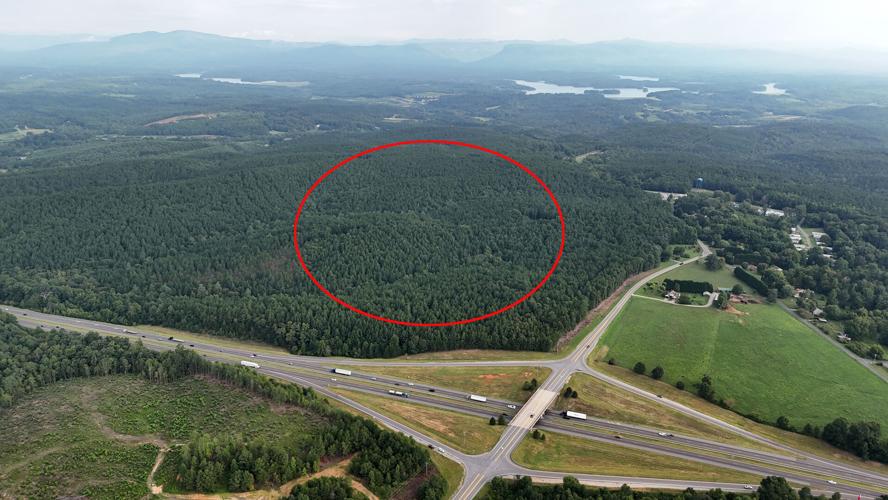
The proposed Great Meadows site is near Exit 94 (Dysartsville Road) on Interstate 40. The circled area identifies a portion of the largest developable tract.
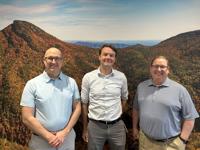
Three local conservation groups came together to develop a conservation site plan for Burke County's proposed Great Meadows industrial megasite. Shown here at the county's recent public meeting about the conditional zoning that could be applied to the site are, from left, Catawba Riverkeeper's Brandon Jones and Grant Buckner, and Foothills Conservancy's Tom Kenney and Michael Gaffney.
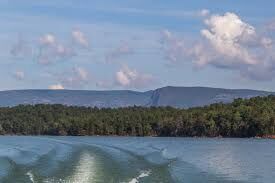
The Lake James Environmental Association, Foothills Conservancy, and the Catawba River all contributed to the plan for development of the Great Meadows industrial megasite in western Burke County near Lake James.
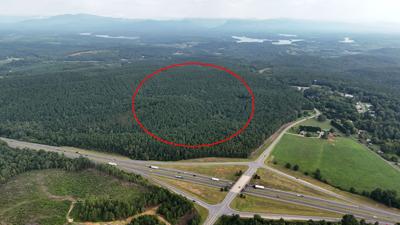
The proposed Great Meadows site is near Exit 94 (Dysartsville Road) on Interstate 40. The circled area identifies a portion of the largest developable tract.
In all likelihood, the Burke County Board of Commissioners will approve conditional zoning for the proposed Great Meadows industrial megasite at its next meeting Sept. 17.
That approval would set in motion a process that could turn a 1,353-acre property in western Burke County into — depending upon whether you’re talking to the site’s proponents or detractors — either a generational economic opportunity for the county or the beginning of an environmental apocalypse.
Thanks to a long list of stringent conditions any future occupant of the site must adhere to, the former seems much more likely than the latter.
The restrictions, which include perimeter and riparian buffers far in excess of what the state requires, are largely the result of a site plan developed by the county’s three most prominent nonprofit conservation organizations, Foothills Conservancy, Catawba Riverkeeper, and Lake James Environmental Association.
Those three groups had worked together before but had never produced a document as important as the Great Meadows site plan promises to be in the years to come.
Its evolution over the course of a few weeks last winter is a study in cooperation between agencies.
The county’s willingness to listen to the experts and put their suggestions into practice represents something of a rarity in today’s divisive political climate.
Taken together, those two factors could turn the plan into a guidepost for future collaborations between all the entities involved.
SETTING THE STAGE
Burke Development, Inc. (BDI) hopes to purchase land owned by Great Meadows LLC at the Burke/McDowell line, near I-40, Exit 96, for industrial development. The project is partially funded by $36 million from the state.
Alan Wood, BDI president and CEO, and Burke County Manager Brian Epley have speculated landing a client large enough to seek such a site would boost the local tax base by as much as 25% and provide hundreds of high-paying jobs.
Opponents of the development are fearful BDI has plans to recruit an industry — lithium-ion battery manufacturing is the one most often mentioned — whose presence might damage ecosystems and adversely affect property values.
To satisfy these concerns, BDI will request conditional zoning — an option only recently reinstated by the board of commissioners — on the parcels, which will restrict the types of acceptable industry and how the land is developed.
JOINING FORCES
Epley wanted to involve environmental groups in the planning process from the outset. When the General Assembly’s initial $36 million allocation was announced to great fanfare last October, he specifically mentioned a desire to bring Foothills Conservancy in on the planning.
The conservancy beat him to the punch.
When Foothills Executive Director Andrew Kota learned about the megasite from a newspaper article someone forwarded to him, he contacted Wood and asked for a meeting.
Foothills eventually pulled Catawba Riverkeeper and LJEA into the fold, and the group met with Wood and Epley at BDI. Kota said the three organizations came away feeling they needed to formalize their interest in helping develop protective measures for the property.
Kota said both the county and BDI were receptive to hearing the group’s input.
That level of trust constitutes a rarity, Kota explained. Typically, conservation organizations only get to make recommendations after a developer already has a site plan in place. By then, it’s too late to make substantive changes.
Three local conservation groups came together to develop a conservation site plan for Burke County's proposed Great Meadows industrial megasite. Shown here at the county's recent public meeting about the conditional zoning that could be applied to the site are, from left, Catawba Riverkeeper's Brandon Jones and Grant Buckner, and Foothills Conservancy's Tom Kenney and Michael Gaffney.
MARTY QUEEN / THE PAPER
Kota said a member of FHC’s Board of Directors is a former landscape designer who has worked with megasites in other locations. She told Kota it was “basically unheard of that a county would reach out to environmental groups and be receptive to this type of input while the concepts (for sites) are still being considered.”
In early December, BDI’s request to rezone the land to Industrial (unconditional) was included on the county planning board’s agenda. Opponents of the site packed the board room, only to find out the request had been withdrawn, “out of an abundance of caution,” Epley said.
At that point, the conservation groups “really buckled down and started working on that proposed site conservation,” according to Grant Buckner, Catawba Riverkeeper’s Northern Basin Director.
Joanne Deyo, President of the LJEA, said the three organizations worked together seamlessly, with Riverkeeper and the Lake James contingent focusing on water quality and Foothills doing what it does best — preserving land for future generations.
“Partnering up with these guys is a wonderful thing to do, and we’ve done it on some other things,” Deyo said. “It’s the trifecta,” she added with a laugh.
The trifecta then got to work.
SCOPING THINGS OUT
Kota and FHC Land Protection Director Tom Kenney already knew the area well, especially the sections between U.S. 70 and the Old Catawba River channel.
Utilizing GIS mapping software — and the skills of staff GIS specialist Michael Gaffney — and aerial photos, they surveyed the property, which is divided into 14 parcels, assessing it section by section.
To their trained and experienced eyes, it quickly became apparent there were large tracts that would never be suitable for industrial development.
Some adjoined the river. One contained a wetland spanning 3.5 acres. Others had steep slopes that would make runoff a problem.
Buckner, meanwhile, launched his kayak at the Muddy Creek Access Area and floated the stream to its confluence with the Catawba.
Along the way, he took notice of the wetland area that needed protection. He also took into account things like the sightline of paddlers. The stretch of the Catawba below Bridgewater is a popular recreation area and a promising brown trout fishery, and as Buckner observed, “no one wants to look up and see that (a factory).”
Other concerns cropped up as well.
A large impervious surface — the parking lots and roadways that would be necessary to accommodate a major industry — make stormwater runoff a problem and require catchment ponds to diffuse pollutants.
The waterways would be at their most vulnerable during the construction phase, so restrictions on sediment runoff for that phase of the development would need to be especially tight.
The LJEA expressed its desire to retain the integrity of the area’s rural heritage, particularly along U.S. 70 and Snowhill Church Road, where some Burke families have lived and farmed for generations.
Both the nonprofits and the county agreed certain potential uses for the property would need to come off the table right away, including mining and quarry operations, asphalt and concrete production, metal plating, and raw ore or mineral processing.
Early on, BDI had touted the presence of Norfolk Southern rail service in the vicinity as one of the site’s most attractive features. But Foothills discovered extending a spur line to the interior of the property would almost certainly result in profound ecological damage and strongly advised against it.
It was a lot to digest, but by the time February rolled around, the site plan was ready.
The Lake James Environmental Association, Foothills Conservancy, and the Catawba River all contributed to the plan for development of the Great Meadows industrial megasite in western Burke County near Lake James.
FOR THE PAPER
SUITABLE COMPROMISES
And when Epley outlined the conditions that would be placed on prospective clients at a public meeting earlier this month, many of them came straight from the conservation plan.
Not every recommendation was followed to the letter. Instead of the 300-foot stream buffers the groups advocated for, there will instead be a 75-foot minimum with a 150-foot average property-wide. The state requires 25 feet.
The plan called for 300-foot natural buffers along all public roadways bordering the site. The county’s restrictions were slightly downsized, but must be at least 200 feet in most sections, with a minimum of 150 feet. The portion that runs alongside I-40 will have 300-foot buffers.
Numerous retention ponds will catch the first 1.5 inches of storm runoff instead of the 1 inch required by the state. Possible negative effects of the construction process will be similarly restricted.
The idea of rail service isn’t specifically excluded. But — perhaps due to the conservancy’s input — BDI and the county are no longer touting that as a feature when marketing the site.
Likewise, lithium-ion battery production isn’t specifically mentioned on the list of outlawed industries. But remarks by Wood and Epley in recent months would lead observers to believe the chances such a facility would ever occupy the site are slim to none.
LOOKING FORWARD
Although there are discrepancies between the recommendations and the proposed restrictions, the environmental groups found the county’s open-minded response refreshing.
“They were highly receptive to our input,” Kota said. “They didn’t push back at all. They really wanted to hear from us.”
Deyo dubbed the zoning conditions the county put forth as “overwhelmingly positive.”
There is good reason to think even more conservation measures are in the cards for the future. In July, Foothills sent another proposal to the county requesting a permanent conservation outcome for the parcels that won’t be developed.
The conservancy hopes the county will deed some of the tracts to Foothills so they can be protected in perpetuity.
Foothills envisions connectors for the county’s popular and extensive trails system, which snakes across Burke’s western boundary. “They’ve (the county) indicated their willingness to explore that with us going forward,” Kenney said.
Catawba Riverkeeper’s goals include increased accessibility to the river and a commitment to the area’s recreational potential on the part of the county and the eventual property owners.
All three groups are confident their work will pay dividends in the long run. They’re also optimistic Burke County will be a good environmental partner in the future.
“If it’s going to be developed, it’s not going to be a free-for-all,” Deyo said. “There are conditions there that are going to make it environmentally responsible, and people should feel good about that.”
Marty Queen is the senior reporter for The Paper. He may be reached at 828-445-8595 or marty@thepaper.media.
Keep it Clean. Please avoid obscene, vulgar, lewd,
racist or sexually-oriented language. PLEASE TURN OFF YOUR CAPS LOCK. Don't Threaten. Threats of harming another
person will not be tolerated. Be Truthful. Don't knowingly lie about anyone
or anything. Be Nice. No racism, sexism or any sort of -ism
that is degrading to another person. Be Proactive. Use the 'Report' link on
each comment to let us know of abusive posts. Share with Us. We'd love to hear eyewitness
accounts, the history behind an article.











(0) comments
Welcome to the discussion.
Log In
Keep it Clean. Please avoid obscene, vulgar, lewd, racist or sexually-oriented language.
PLEASE TURN OFF YOUR CAPS LOCK.
Don't Threaten. Threats of harming another person will not be tolerated.
Be Truthful. Don't knowingly lie about anyone or anything.
Be Nice. No racism, sexism or any sort of -ism that is degrading to another person.
Be Proactive. Use the 'Report' link on each comment to let us know of abusive posts.
Share with Us. We'd love to hear eyewitness accounts, the history behind an article.