

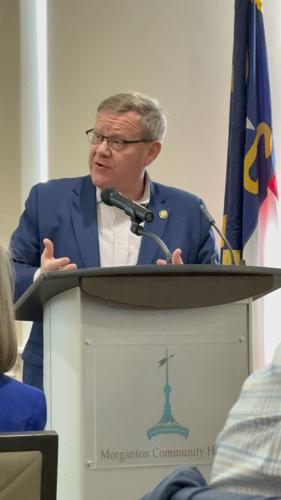


With only a few days’ notice over the holiday weekend, the Burke County Chamber of Commerce gathered a select group of about 20 politicians, Chamber leaders, and businesses to meet with U.S. Rep. Tim Moore in Morganton on Monday, opening the door for them to give direct feedback to a member of Congress.
Local employers, ranging from mammoths like UNC Health Blue Ridge to small businesses like Lake James Electric, LLC, filled the tables at Leviton Manufacturing in Morganton.
They were joined by county commissioners, Chamber of Commerce board members, and fellow business leaders as the congressman answered questions across a variety of topics.
“For me to get the invite was unexpected and I really didn’t know what to expect in that roundtable,” said Neil Farris, owner of Lake James Electric, an electrical contractor that sells stand-by generators. “I was more like a fly on the wall. … There were some people in there that had some real issues, so it was cool to see that process and them being able to address those needs individually.”
Moore explained over the phone that the roundtable wasn’t a decision-making session as much as a two-way discussion so he could determine where to prioritize his efforts in legislation.
The congressman said, “I can tell you that really making sure that rural North Carolina is not forgotten has been a key priority for me ever since I’ve been in office, whether it’s at the state level, and certainly for the year and a half that I’ve been in this position in Congress.”
When Moore’s office contacted the chamber, they had some caveats: they wanted some of the local government officials there and they only wanted about a couple dozen people, but otherwise the chamber could pick and choose who came and whether or not the media attended.
Moore explained that he tries to find a sweet spot when it comes to crowd size, since he speaks about 20% of the time and listens about 80%, and too many people can make it difficult to have a two-way conversation.
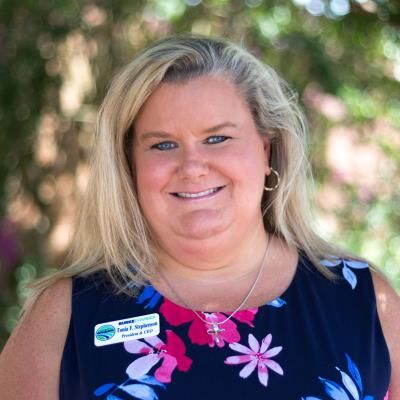
According to Tonia Stephenson, president and CEO of the chamber, she relied heavily on the chamber’s board of directors and chamber ambassadors to fill those seats due to the short time frame to organize.
“The (small) structure was designed to ensure direct, roundtable interaction between federal representation and a cross-section of local employers, manufacturers, and non-profits within the limited time available,” Stephenson said.
Representation came from a variety of businesses, including Bimbo Bakeries, Carolina Premier Construction & Coating, the Good Samaritan Clinic, Grace Heights Health & Rehabilitation, Innovative Outfitters, the Self-Help Credit Union, and the Western Piedmont Community College Small Business Center, to name a few.
The topics covered everything from workforce and labor concerns tying back to working visa programs to postal code logistics, housing initiatives, and the outlook for the hemp industry.
“The (H-2A and) H-2B, of course, is a big concern for some of our community employers because we want to make sure that we have legal help,” Stephenson explained. “Workforce is an issue and having folks come over and work the farms — making sure they can come over and do it the legal way — is an issue that we’ve been concerned with and want to make sure that we can help address any way that we can.”
The H-2A program allows U.S. employers to bring foreign workers into the country to work in temporary and seasonal agricultural jobs. The H-2B program serves the same purpose for nonagricultural jobs.
There have also been ongoing requests raised in the Drexel, Glen Alpine, and Rutherford College communities over acquiring specific postal codes to distinguish them from their neighboring towns — Morganton and Connelly Springs, respectively.
“It’s hard to try to recruit businesses or industry and say, ‘Please come to Drexel’ — we’ve got that big site in Drexel — but ‘Oh, by the way, you’re going to have a Morganton address,’” Stephenson said. “That’s something we’ve been advocating for quite some time already.”
Another large part of the discussion revolved around healthcare wording in the Big Beautiful Bill, which limited the federal funding healthcare providers could receive.
Although “nothing earth-shattering” came from the roundtable, Stephenson said she cherished the opportunity for elected officials to hear directly from the business community.
Moore said a lot of the feedback he heard mirrored issues from around the state.
“We met with a number of businesses, not only yesterday, but in the previous weeks, who benefited a lot from the Working Families Tax Cuts,” Moore said. “That allowed a lot of these manufacturers, particularly, to buy new equipment, modernize, and be more competitive, to take advantage of those tax breaks. I’ve heard that from just about every single business that I’ve visited.”


















(0) comments
Welcome to the discussion.
Log In
Keep it Clean. Please avoid obscene, vulgar, lewd, racist or sexually-oriented language.
PLEASE TURN OFF YOUR CAPS LOCK.
Don't Threaten. Threats of harming another person will not be tolerated.
Be Truthful. Don't knowingly lie about anyone or anything.
Be Nice. No racism, sexism or any sort of -ism that is degrading to another person.
Be Proactive. Use the 'Report' link on each comment to let us know of abusive posts.
Share with Us. We'd love to hear eyewitness accounts, the history behind an article.