


More than a quarter-century ago, in the spring of 2000, a young Hmong woman rose tentatively from her desk and walked to the front of her sophomore English classroom to make a presentation.
The assignment had been a simple one: find a topic you’re interested in, do some research, write a 5-page MLA-style paper, and then present your findings in an 8-minute speech to your peers.
Most students had chosen “safe” topics – a sports hero they admired; a career they might want to pursue; a hobby that brought them enjoyment.
Young Thea Yang was different. She had chosen a topic that she was passionate about, a topic that had profoundly shaped her life and impacted her future — “The Secret War” in Southeast Asia.
She recounted the story of “The Secret War,” which involved the CIA recruiting Hmong and Laotian fighters in Laos — technically a neutral country — to aid the Americans in disrupting the North Vietnamese Army’s supply lines through the Ho Chi Minh Trails during the Vietnam War.
The outcome of the war — the fall of South Vietnam and Laos, and the Communist Pathet Lao’s desire to take revenge on those who had aided the Americans — forced Thea’s family to flee their country.
As U.S. allies, the Hmong became targets for retribution. Many families, including Thea’s, spent years in refugee camps before the U.S. State Department began accepting them through sponsorship programs, with initial resettlements concentrated in California, Minnesota, and Wisconsin. After two years in three refugee camps, Thea’s family immigrated to the United States in 1989.
As she told the story to her classmates, speaking both of the horrors she experienced and of her parents’ courage and sacrifice, her voice began to quiver and the tears began to flow, first in a quiet trickle and then in a raging waterfall.
Comforted and encouraged by her teacher, Thea regained her composure, completed her presentation, and received an A+ for her efforts.
More important than that academic achievement, however, was the passion born in Thea to not only work to preserve the history and culture of the Hmong — the ethnic group of which she is a member — but also to help others to learn their stories, to proudly share those stories with others, and to demonstrate that all cultures have far more that unites them than what sets them apart.
Wanting to Know More
Thea was very young when her family had to leave their home forever and flee to Thailand. Her memories of the journey out of Laos, she said, were but flashes of particular incidents not joined in a complete story.
“When I was young, I was ashamed of being a refugee and our economic situation,” she remembered. “I truly did not understand what my parents went through, the sacrifice they made so that we could survive.”
Presented with the research assignment in her Communication Skills class, Thea decided to talk to her parents and other relatives about that time and to study the written history of “The Secret War.”
“As I went through that process,” she recalled, “it completely changed my perspective. Rather than being ashamed of my heritage, I developed a sense of pride about being Hmong.”
A memory which that process of discovery awakened:
“It was part of our journey out of Laos,” she recalled. “We had run completely out of food. Our only hope of survival was to find food in the jungle. I remember my dad carrying me under one arm and an animal that he had killed under the other as we moved forward. And I remember that no matter how meager the food, the children always ate first.
“I know that if my parents could go through that,” she continued, “and still smile, and still maintain their humanity, their love for others, there was no reason for me to be ashamed. I wanted to tell our story and I wanted to help others tell their stories as well.”
Talking about her family’s story and the story of how the Hmong came to America is basically a form of “writing love letters to my parents.” It was her parents, Thea said, “who gave me just the right amount of security and just the right amount of freedom.”
An untraditional route
Twenty-five years later, in her position as Values and Culture Director for The Industrial Commons, Thea is doing exactly what she dedicated herself to in high school — helping Burke County’s different cultures learn more about themselves, about each other, and about ways they can connect.
After her high school graduation in the spring of 2002, Thea attended one semester at a university.
Family economic issues forced her “to put my goals on hold” for a while and she ended up working in manufacturing in Burke County for the next 16 years — years when she was also striving to receive her associate’s and bachelor’s degrees.
“It’s exhausting,” she said, “when you work a 12-hour night shift and then walk into an 8 a.m. class with blood-shot eyes. But I would think of my parents, and what they endured, and I would push ahead. I also had a lot of great mentors in the education system that helped me pull through.”
Over the years, Thea worked for the battery company Saft America in Valdese and for Meridian Automotives in Lenoir, as well as Continental and a small, now defunct, company called AMP RTI.
Her final 10 years in manufacturing were spent in quality control at Gerresheimer Glass in Morganton.
“I didn’t always realize it at the time,” Thea said of those years, “but I was gaining skills and experience from each of those jobs. Mine was not a normal trajectory, but I gained the expertise of ‘working on the floor’ and I’m very proud of that experience. I learned what it meant to be a front-line worker and have a deep respect for our manufacturing workforce.”
Having pursued her academic goals even while working often brutal production schedules, Thea received her associate’s degree in English from Western Piedmont Community College in 2011 and her bachelor’s degree in communications from UNC-Chapel Hill in 2014.
Hometown Walkabout
After her time at WPCC, one of Thea’s champions was the school’s president, Dr. Michael S. Hemlick. It was Hemlick who urged her to seek a seat on the college’s board of trustees.
“He believed in me,” said Thea of Hemlick, “and he first introduced me to Sara Chester, one of the co-founders of The Industrial Commons who was then working for Burke Development Inc.”
It was Chester who recruited Thea to join the staff of the Work in Burke program which encourages young people to continue their education after high school, to join the workforce, or do both.
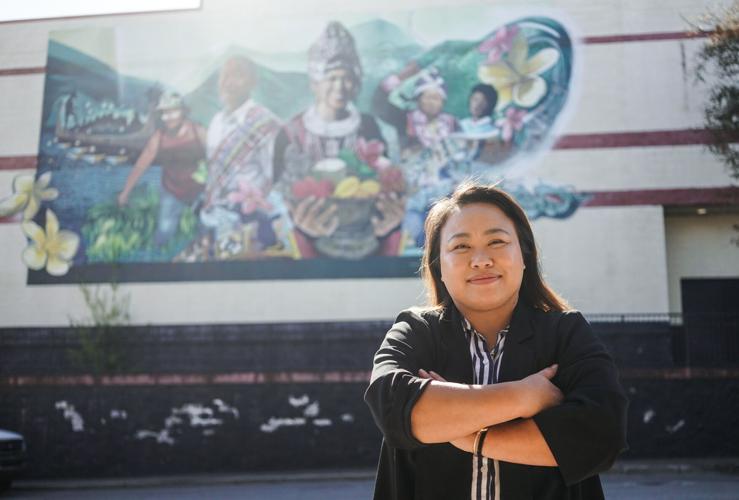
Later, Thea became Values and Culture Director for the Industrial Commons and since 2021 has worked full time on TIC’s Hometown Walkabout program which presents diverse stories in the community and celebrates its different cultural elements.
“I have such a cool job and love what I do so much,” said Thea of her work with this program. “I get to learn about other people’s cultures and history. I get to pull history out of the text books and turn it into living, breathing examples.”
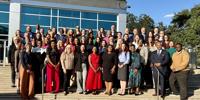
Over the past four years, Hometown Walkabout has hosted the staff and new students of the N.C. School of Science and Math-Morganton, medical students and staff from UNC Health Blue Ridge, members of the Burke County Sheriff’s Department, school principals, nonprofit staff, and members of private industry.
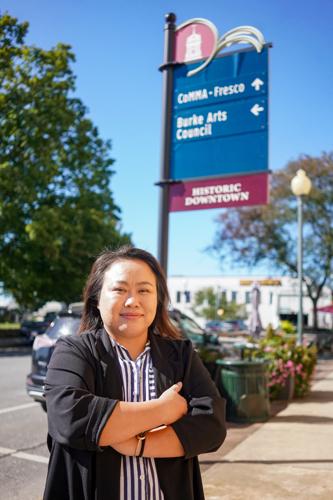
During a “walkabout,” TIC staff and community members literally lead participants around downtown Morganton, stopping primarily at the city’s murals to talk about what each one represents and share their own lived experiences as citizens of Burke County.
“What we’re providing is a chance for people to learn about their co-workers and their neighbors and what their heritage and history are,” Thea said. “We’re providing a space for and an opportunity for civil dialogue.
“We’re asking people to look deeper,” she continued. “We’re asking them to hear, really hear, the history of the Hmong, of the Guatemalans, of the Blacks who came here involuntarily, and of the other groups who make up this county, including our Scots-Irish, Waldensians, German, French, and English ancestries. We have an amazing tapestry of diverse cultures to share with one another.”
Harkening back to that long ago day in her high school English class when she first stood up to tell the story of her own people, Thea said, “No one wants to be defined by stereotypes. Everyone wants to be acknowledged for the worth and experience they bring to our community. I believe that we all want the same things: to be happy, stable, fed, sheltered, loved, and heard.”
Learn more about The Industrial Commons’ work at www.theindustrialcommons.org. If you are interested in attending a Hometown Walkabout tour, contact Thea at thea@theindustrialcommons.org.







(0) comments
Welcome to the discussion.
Log In
Keep it Clean. Please avoid obscene, vulgar, lewd, racist or sexually-oriented language.
PLEASE TURN OFF YOUR CAPS LOCK.
Don't Threaten. Threats of harming another person will not be tolerated.
Be Truthful. Don't knowingly lie about anyone or anything.
Be Nice. No racism, sexism or any sort of -ism that is degrading to another person.
Be Proactive. Use the 'Report' link on each comment to let us know of abusive posts.
Share with Us. We'd love to hear eyewitness accounts, the history behind an article.