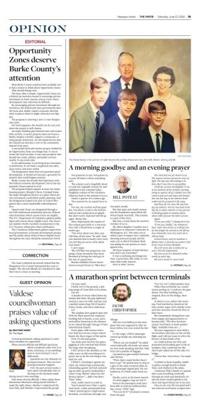
Not gonna lie to you. Not gonna try to pass off what is old as something new.
The column you’re hopefully about to read was originally written for and published in the Catawba Valley Neighbors edition of The Charlotte Observer back in the autumn of 2002.
Nearly a quarter of a century ago.
Two reasons for its reprint here today.
For one, my creative well has gone dry. You throw a rock to the bottom and you ain’t gonna hear no splash. But don’t worry. Said well will fill up again. Always has.
More importantly, the reprint of this column goes back to a conversation with a friend from a couple of weeks ago.
“You write about your dad, your Old Man, all the time,” he said. “And you mention him in nearly every story you tell. But you never write about your mom.”
I can’t argue.
The Old Man was gregarious, outgoing, a born raconteur who never dreamed of letting the truth get in the way of a good yarn.
Beatrice Robbins Poteat, better known around Drexel as “Miss Bea,” was quiet, steady.
But that quiet and steady woman was the foundation upon which the Poteat family was built. This column is a part of her story.
But first, a word about the world in October of 2002:
My eldest daughter Caroline was a sophomore at American University in Washington, D.C. The same city in which a pair of snipers were randomly shooting innocent people and the same city in which President Bush was asking for war powers to move against Iraq.
All those weapons of mass destruction, don’t you remember?
It was a confusing and dangerous time. A good time, like today, to consider what really matters.
Here is what I wrote:
The clock had not yet struck 6 a.m. The eastern horizon showed no trace of light. The day was still waiting to be born. But it was time to say goodbye.
I held my 19-year-old daughter to me in the darkness of the October morning, trying to squeeze all of a daddy’s love and concern and care and hopes and dreams into one last hug as her autumn break ended and she prepared to fly away.
And then, far too soon, she was leaving my embrace. On her way back to the big city in whose suburbs a crazy person is shooting people at random and in whose halls of power the talk is of war.
Again.
“I love you, baby,” I whispered to her.
“I love you, Daddy,” she whispered back. And I was struck, as I always am, by how fragile she seemed as she left me, how vulnerable, how very much she is still my baby.
A dozen hours, and yet somehow a lifetime later, I stood by my mother’s bed in her room at Grace Hospital.
She is 87 years old. A widow for 15 years. Fiercely independent.
She lost an eye to a detached retina nearly 30 years ago.
She lost a breast to cancer back in ’93.
A knee had to be replaced in 2000.
The other one followed suit in 2001.
Her balance isn’t what it used to be.
But she still insists on getting her own groceries.
Driving to church.
Walking her laps in the street in front of her home.
Even volunteering at Autumn Care in Drexel an afternoon or two a week.
At age 87.
Often it seems the Energizer Bunny has nothing on her.
Until lately.
Lately, she hasn’t been so steady on her feet.
Lately, she’s had a close call or two with falls in her house.
Lately, she’s started to, dare I say it, act her age.
So the frantic telephone call, when it came to my classroom at East Burke High School, wasn’t really unexpected.
And yet it was.
A fall at home.
A broken hip.
Ambulance ride.
Emergency room.
Admission.
Surgery scheduled for late the following day.
As the promise of a gray October morning was fulfilled with the last dying gasp of a bleak October afternoon, I stood by her bedside. Quiet and alone. Her youngest son. Her baby.
The powerful drugs flowing through her system had eased the pain and relaxed the tension from her muscles. In the contours of her face, I could see not only the beautiful young woman who she once had been, but also the beautiful young woman that her granddaughter is today.
And I was struck by how very fragile she too seemed and how very, very vulnerable.
While I knew that she could not hear me, I whispered, “I love you, Mama,” trying to distill into that single phrase all of the love and care and thankfulness that a son can feel for the woman who brought him into this world and whose gentle spirit has guided him since that day.
My daughter, I pray, has a rich and full and challenging life ahead of her.
My mama, I pray, will rise from her surgical bed and keep “going and going” for as long as she is able.
But a lesson from this gray day in October is that life is fragile for each of us.
A lesson from this gray day in October is that each of us is so very, very vulnerable.
And the most important lesson from this gray day in October is that other than the love we give to others, and the sustaining love we receive in return, not much else really matters, whether we are at the beginning of our life or nearing its end.
My mother did indeed recover from her surgery, although her pace slowed afterward. She was pushing 91 when she died, and let the record show that she left this world with the same quiet grace and dignity with which she lived her life.