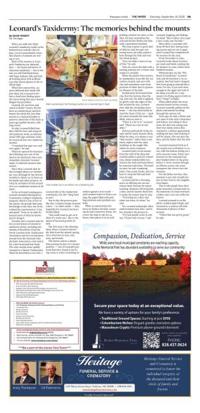

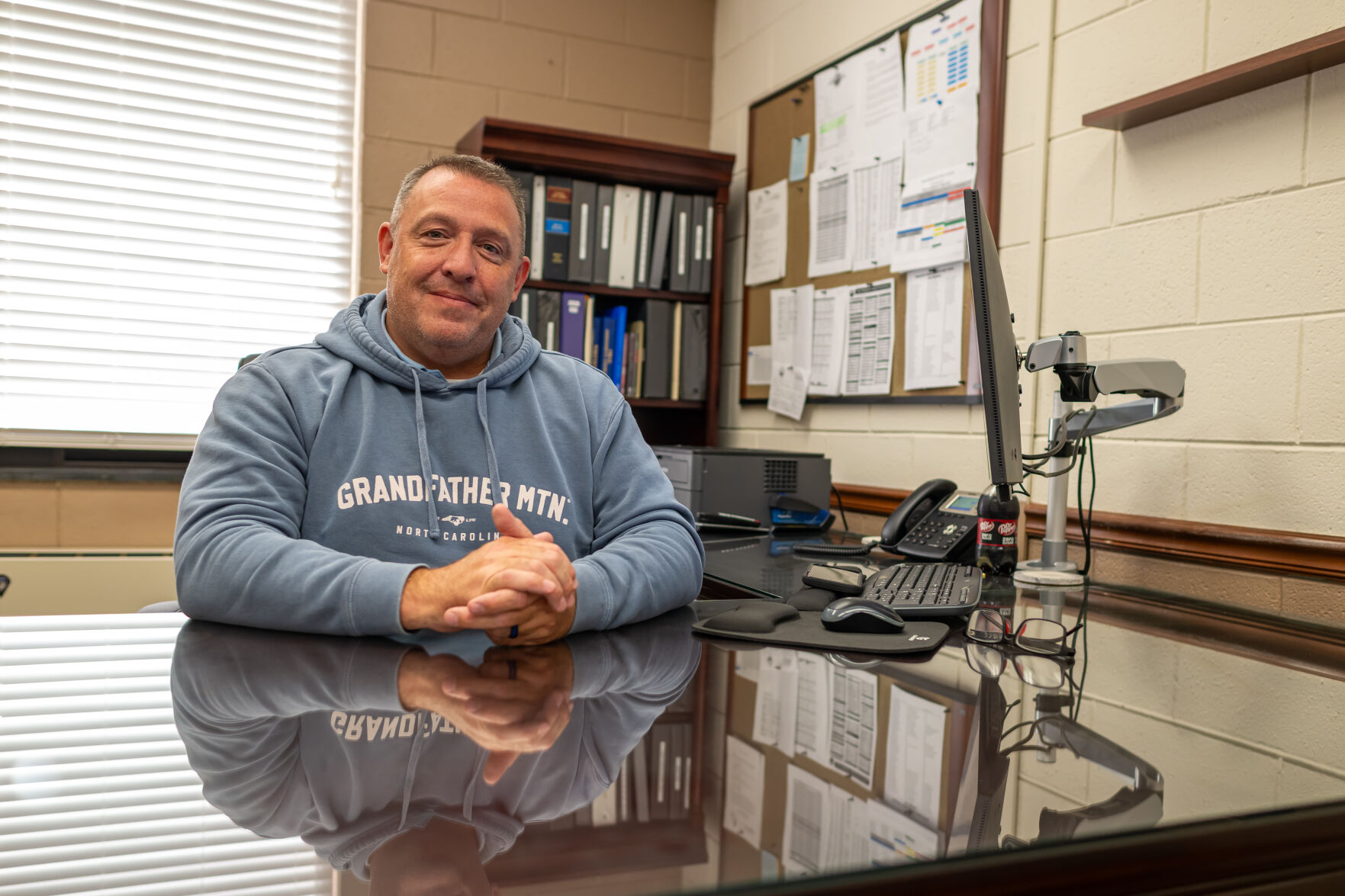
The retiring captain sits comfortably at an empty desk, enjoying his final working day. Brown at desk
Brown at desk
The retiring captain sits comfortably at an empty desk, enjoying his final working day. Brown at desk
Brown at desk
The retiring captain sits comfortably at an empty desk, enjoying his final working day. Brown at desk
Brown at desk
The retiring captain sits comfortably at an empty desk, enjoying his final working day. Brown at desk
Brown at desk
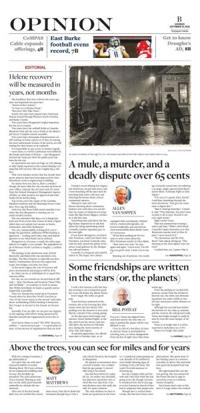
An artist recreation of the night Dr. E.A. Hennessee was killed at the Glen Alpine train station back in 1913.
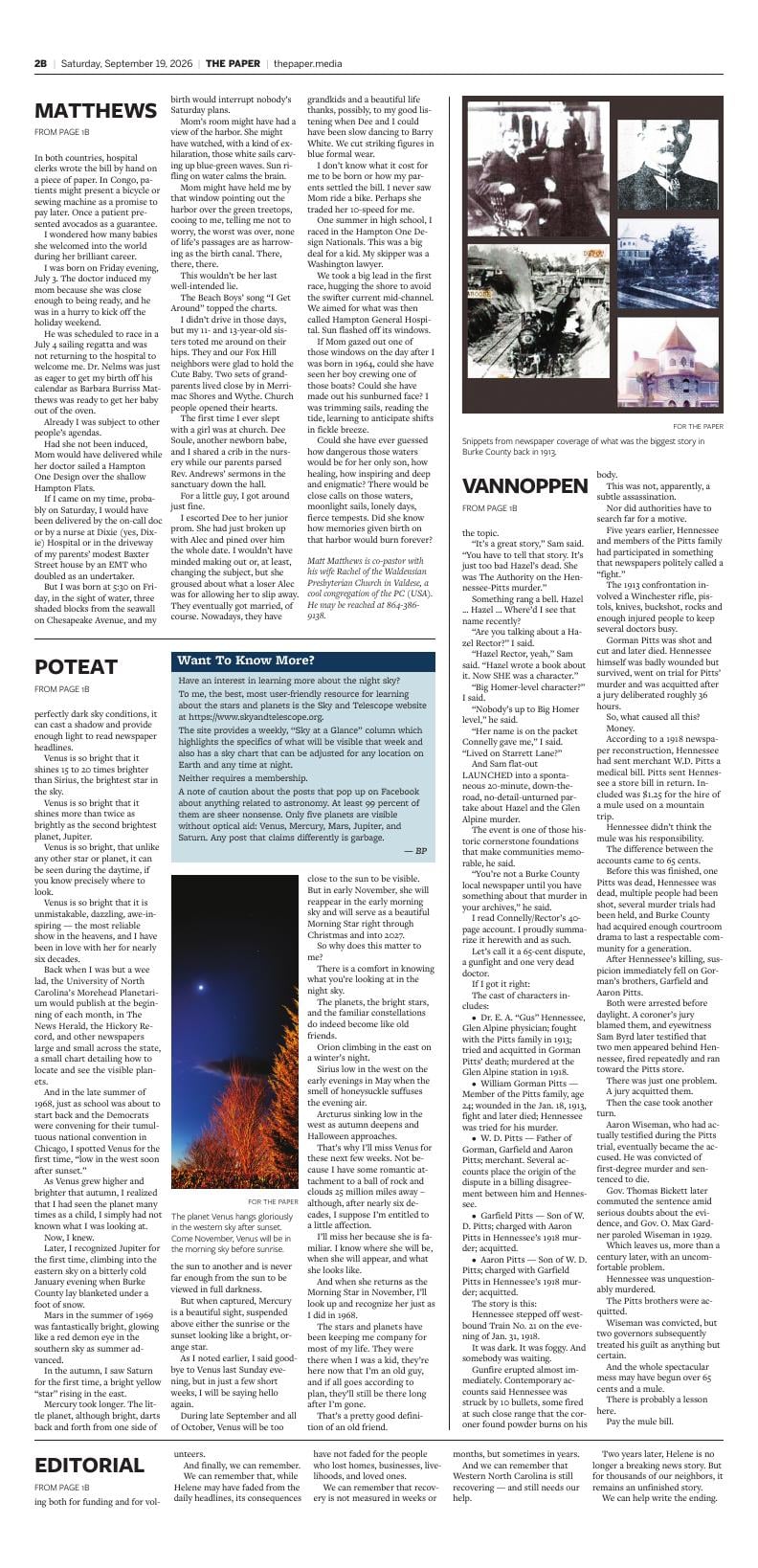
Snippets from newspaper coverage of what was the biggest story in Burke County back in 1913.
During a recent blazing-hot August late afternoon, my pal Sam Avery and I were knocking off the day’s dust by knocking back some cold ones and shooting the breeze about critical community matters.
Whenever Sam and I are breeze-shooting about community matters over cold ones, you can bet that the names of infamous local legends, like Big Homer Biggers, surface. As it did this time.
Something Sam said about the late Big Homer inspired me to ask him about the living-and-kicking David Connelly, another legendary guy, in his own right.
If you know Morganton, you know Nite Furniture. And if you know Nite Furniture, you know Connelly, who, with his dad, owned the galaxy of furniture retail galleries by the Morganton railroad station.
Connelly is a frequent and colorful visitor to The Paper. He’s always equipped with scratchpads, crinkled letters, cracked photographs, yellowed scrapbooks, and assorted ancient memorabilia about Burke County’s yesteryear.
He has been pushing me for two years to write a story about the Pitts-Hennessee murder in Glen Alpine.
“Best story ever was,” he says, again and again. “Great story. I’m telling you, great story. I want you to run it.”
Running out of patience, two weeks ago Connelly tossed onto my tabletop a 40-page, single-spaced typed dissertation titled, “A Bloody Fight at Glen Alpine.”
“I’m sure it’s a great story, David,” I told him, thumbing through the worn document. “Just give me some time to digest this.”
“Run it starting Saturday,” Connelly said. “This Saturday. You don’t have to print it all at once. Stretch it out over eight weeks.”
Eight weeks? Jeeze.
That hot summertime evening I said to pal Sam, “What’s with David Connelly’s damn obsession over this Hennessee murder deal in Glen Alpine? I never heard of it.”
“Dr. Hennessee and the Pitts Boys?” Sam asked, sitting up. “The shooting at the Glen Alpine train station?”
I replied that, yes, I guess, that is the topic.
“It’s a great story,” Sam said. “You have to tell that story. It’s just too bad Hazel’s dead. She was The Authority on the Hennessee-Pitts murder.”
Something rang a bell. Hazel ... Hazel ... Where’d I see that name recently?
“Are you talking about a Hazel Rector?” I said.
“Hazel Rector, yeah,” Sam said. “Hazel wrote a book about it. Now SHE was a character.”
“Big Homer-level character?” I said.
“Nobody’s up to Big Homer level,” he said.
“Her name is on the packet Connelly gave me,” I said. “Lived on Starrett Lane?”
And Sam flat-out LAUNCHED into a spontaneous 20-minute, down-the-road, no-detail-unturned partake about Hazel and the Glen Alpine murder.
The event is one of those historic cornerstone foundations that make communities memorable, he said.
“You’re not a Burke County local newspaper until you have something about that murder in your archives,” he said.
I read Connelly/Rector’s 40-page account. I proudly summarize it herewith and as such.
Let’s call it a 65-cent dispute, a gunfight and one very dead doctor.
If I got it right:
The cast of characters includes:
The story is this:
Hennessee stepped off westbound Train No. 21 on the evening of Jan. 31, 1918.
It was dark. It was foggy. And somebody was waiting.
Gunfire erupted almost immediately. Contemporary accounts said Hennessee was struck by 10 bullets, some fired at such close range that the coroner found powder burns on his body.
This was not, apparently, a subtle assassination.
Nor did authorities have to search far for a motive.
Five years earlier, Hennessee and members of the Pitts family had participated in something that newspapers politely called a “fight.”
The 1913 confrontation involved a Winchester rifle, pistols, knives, buckshot, rocks and enough injured people to keep several doctors busy.
Gorman Pitts was shot and cut and later died. Hennessee himself was badly wounded but survived, went on trial for Pitts' murder and was acquitted after a jury deliberated roughly 36 hours.
So, what caused all this?
Money.
According to a 1918 newspaper reconstruction, Hennessee had sent merchant W.D. Pitts a medical bill. Pitts sent Hennessee a store bill in return. Included was $1.25 for the hire of a mule used on a mountain trip.
Hennessee didn't think the mule was his responsibility.
The difference between the accounts came to 65 cents.
Before this was finished, one Pitts was dead, Hennessee was dead, multiple people had been shot, several murder trials had been held, and Burke County had acquired enough courtroom drama to last a respectable community for a generation.
After Hennessee's killing, suspicion immediately fell on Gorman's brothers, Garfield and Aaron Pitts.
Both were arrested before daylight. A coroner's jury blamed them, and eyewitness Sam Byrd later testified that two men appeared behind Hennessee, fired repeatedly and ran toward the Pitts store.
There was just one problem.
A jury acquitted them.
Then the case took another turn.
Aaron Wiseman, who had actually testified during the Pitts trial, eventually became the accused. He was convicted of first-degree murder and sentenced to die.
Gov. Thomas Bickett later commuted the sentence amid serious doubts about the evidence, and Gov. O. Max Gardner paroled Wiseman in 1929.
Which leaves us, more than a century later, with an uncomfortable problem.
Hennessee was unquestionably murdered.
The Pitts brothers were acquitted.
Wiseman was convicted, but two governors subsequently treated his guilt as anything but certain.
And the whole spectacular mess may have begun over 65 cents and a mule.
There is probably a lesson here.
Pay the mule bill.
Allen VanNoppen is the publisher. He may be reached at 828-445-8595 or allen@thepaper.media.
M. Matthews
With the coming of autumn, I get philosophical.
On Labor Day, my wife and I enjoyed breakfast in nearby Blowing Rock. We’d just celebrated our umpteenth wedding anniversary. Her birthday approached. The 25th anniversary of 9/11 loomed. Waiting 30 minutes on the chilly patio beneath umbrellas in a drizzle felt momentous.
After one of the best breakfasts ever, we strolled the resorty main street, then drove down the mountain through fog to visit a sick church friend at the hospital in Morganton.
We passed a convenience store covered in kudzu. You couldn’t find the gas pumps. It doesn’t take long to be erased.
Sue had been bitten by a playful cat. No malice was intended, but infection caused her arm to swell like over-ripe fruit. Cats and chickens carry this stuff, she said. It’s quite common.
The only chickens we have at home are quartered in the freezer. I considered emancipating our cats. Rounds of IV antibiotics were finally showing signs of working in the 37th hour. She wasn’t feverish anymore or throwing up.
Sue has a happy smile and my wife and I felt such relief she was going to be OK, though I privately wondered how she’d turn pages in her hymnal at church if they had to amputate that purple arm.
Though she’s a retired obstetrician, she had never been a hospital patient. She spent most of her healing career as a mission coworker in Africa. She marveled how good the hospital food was here.
She appreciated the care she was getting. She was amused by the forms she had to sign incurred by a stay in a modern, western hospital.
Such forms don’t exist in Malawi or Congo where she worked. In both countries, hospital clerks wrote the bill by hand on a piece of paper. In Congo, patients might present a bicycle or sewing machine as a promise to pay later. Once a patient presented avocados as a guarantee.
I wondered how many babies she welcomed into the world during her brilliant career.
I was born on Friday evening, July 3. The doctor induced my mom because she was close enough to being ready, and he was in a hurry to kick off the holiday weekend.
He was scheduled to race in a July 4 sailing regatta and was not returning to the hospital to welcome me. Dr. Nelms was just as eager to get my birth off his calendar as Barbara Burriss Matthews was ready to get her baby out of the oven.
Already I was subject to other people’s agendas.
Had she not been induced, Mom would have delivered while her doctor sailed a Hampton One Design over the shallow Hampton Flats.
If I came on my time, probably on Saturday, I would have been delivered by the on-call doc or by a nurse at Dixie (yes, Dixie) Hospital or in the driveway of my parents’ modest Baxter Street house by an EMT who doubled as an undertaker.
But I was born at 5:30 on Friday, in the sight of water, three shaded blocks from the seawall on Chesapeake Avenue, and my birth would interrupt nobody’s Saturday plans.
Mom’s room might have had a view of the harbor. She might have watched, with a kind of exhilaration, those white sails carving up blue-green waves. Sun rifling on water calms the brain.
Mom might have held me by that window pointing out the harbor over the green treetops, cooing to me, telling me not to worry, the worst was over, none of life’s passages are as harrowing as the birth canal. There, there, there.
This wouldn’t be her last well-intended lie.
The Beach Boys’ song “I Get Around” topped the charts.
I didn’t drive in those days, but my 11- and 13-year-old sisters toted me around on their hips. They and our Fox Hill neighbors were glad to hold the Cute Baby. Two sets of grandparents lived close by in Merrimac Shores and Wythe. Church people opened their hearts.
The first time I ever slept with a girl was at church. Dee Soule, another newborn babe, and I shared a crib in the nursery while our parents parsed Rev. Andrews’ sermons in the sanctuary down the hall.
For a little guy, I got around just fine.
I escorted Dee to her junior prom. She had just broken up with Alec and pined over him the whole date. I wouldn’t have minded making out or, at least, changing the subject, but she groused about what a loser Alec was for allowing her to slip away. They eventually got married, of course. Nowadays, they have grandkids and a beautiful life thanks, possibly, to my good listening when Dee and I could have been slow dancing to Barry White. We cut striking figures in blue formal wear.
I don’t know what it cost for me to be born or how my parents settled the bill. I never saw Mom ride a bike. Perhaps she traded her 10-speed for me.
One summer in high school, I raced in the Hampton One Design Nationals. This was a big deal for a kid. My skipper was a Washington lawyer.
We took a big lead in the first race, hugging the shore to avoid the swifter current mid-channel. We aimed for what was then called Hampton General Hospital. Sun flashed off its windows.
If Mom gazed out one of those windows on the day after I was born in 1964, could she have seen her boy crewing one of those boats? Could she have made out his sunburned face? I was trimming sails, reading the tide, learning to anticipate shifts in fickle breeze.
Could she have ever guessed how dangerous those waters would be for her only son, how healing, how inspiring and deep and enigmatic? There would be close calls on those waters, moonlight sails, lonely days, fierce tempests. Did she know how memories given birth on that harbor would burn forever?
Matt Matthews is co-pastor with his wife Rachel of the Waldensian Presbyterian Church in Valdese, a cool congregation of the PC (USA). He may be reached at 864-386-9138.
The headlines that were written two years ago were not hyperbole but pure fact.
“Storm of the Century.”
“A Once in a Lifetime Event.”
“Recovery May Take Years.”
Nearly two years have passed since Hurricane Helene roared through Western North Carolina and Burke County.
Two years later, Morganton’s Ingles Supermarket has yet to reopen.
Two years later, the softball fields at Catawba Meadows Park and the soccer fields at the Municipal Soccer Complex remain unusable.
Two years later, thousands of homeowners are still waiting on home repairs or, if they are among the most unfortunate victims of the storm, are still waiting for their homes to be replaced.
It is impossible to put a cost on human tragedy — more than 100 North Carolinians were killed by the floods and winds of Helene — but Morganton learned last week just what the public price has been for the city.
As reported in our story on Page 1A, City Manager Sally Sandy reported to the council Monday evening that full recovery will cost roughly $54.5 million.
That total includes money that has already been spent, projects that have been approved for reimbursement, work in engineering or bidding.
No matter how you slice it, that’s a chunk o’ change, far more than the city can ante up from its own coffers. Instead, the city must wait for word from the Federal Emergency Management Agency (FEMA) on what projects are approved and what funds will be forthcoming.
Top on the city’s list: repair of the Catawba Meadows facilities and the Municipal Soccer Complex. Price tag: $33 million.
And every day those fields stand unusable is another day that Morganton is missing out on much-needed revenue.
The city estimates that $350,000 is being lost each year from events that cannot be held, a figure which does not include lost income at hotels, restaurants, and other businesses.
The city, commendably, is doing all it can to bridge the gap before additional FEMA funding is approved — working with other state and federal agencies to see what funds can be utilized.
Morganton is, of course, a small city with a population of roughly 17,000 people. The population of all of Western North Carolina is roughly 1.2 million people.
The damage in the downtown areas of both Burnsville and Bakersville was absolutely catastrophic. The River District in Asheville was decimated. Communities all across the region lost roads, lost bridges, lost jobs, lost lives.
In the entire region, the cost of recovery will prove astronomical and progress will be slow.
So, what can we, as individuals do to speed this recovery effort.
For one, we can remind our elected federal officials — Rep. Tim Moore and Senators Thom Tillis and Ted Budd — to continue to work to ensure that FEMA distributes its funds as quickly and as impartially as possible.
That trio should also stand up to President Trump when he describes North Carolina as “one of the worst states in the nation” and jokes about withholding FEMA funding if Democrat Roy Cooper is elected to the Senate in November.
Secondly, if we are able, we can give our support to the ongoing relief efforts being sponsored by churches and private organizations across the region.
Don’t know where to start? The WNC Recovery website — uncrecovery.nc.gov — is a great place to start. It lists dozens of organizations that are looking both for funding and for volunteers.
And finally, we can remember.
We can remember that, while Helene may have faded from the daily headlines, its consequences have not faded for the people who lost homes, businesses, livelihoods, and loved ones.
We can remember that recovery is not measured in weeks or months, but sometimes in years.
And we can remember that Western North Carolina is still recovering — and still needs our help.
Two years later, Helene is no longer a breaking news story. But for thousands of our neighbors, it remains an unfinished story.
We can help write the ending.