

Burke County could be next for feral swine invasion

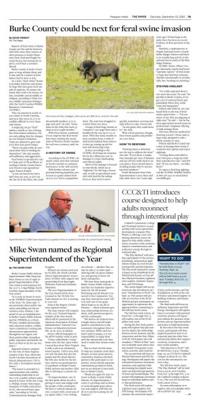
Feral swine are fast, intelligent, destructive, and difficult to control in the wild.
Reports of feral swine in Burke County are few and far between, with little more than rumors of their presence in South Mountains State Park and Pisgah National Forest, but among the experts, you’ll hear a common thread:
Burke County is lucky to have gone so long without them, and it may only be a matter of time before they’re here to stay.
As a term, “feral swine” broadly includes wild boar and domestic hogs that have gone feral outside of captivity. No matter the breed, they tend to be messy, violent, insatiable and incredibly intelligent, according to Falyn Owens, wildlife extension biologist with the North Carolina Wildlife Resources Commission (NCWRC).
They are present in nearly every county in North Carolina, and once they move in, it is incredibly difficult to evict them, said Owens.
A single pig can go “feral” within a month or two of being free from human influence, Owens said, adding that the changes are not limited to behavior: Tusks are allowed to grow and even their hair grows longer.
“There are genes that are activated when they’re fending for themselves,” she said, namely, self-sufficiency and aggression.
Feral swine’s reproductive rate is a large part of the problem, according to Burke County Extension Director and Agriculture Agent Damon Pollard.
“A sow can breed two and a half times per year, so let’s say she has six in her litter, she could theoretically produce 12 to 15 pigs each year,” he said. “Sometimes in the wild, they start cycling at six to eight months.”
With these factors combined, it’s no surprise that feral swine have been roaming the mountains of Western North Carolina for well over a century, said Owens.
A HISTORY OF SWINE
According to the NCWRC, domestic swine were first released in North Carolina as a primary food source in the 16th century.
With further releases and growing hunting popularity, protection as a game animal from 1979 to 2011 led to a population burst. The state has struggled to control them ever since.
Groups of feral hogs, known as “sounders” can range from only a handful all the way up to 100 or more. With that many mouths to feed, sounders leave a wake of destruction behind them wherever they go, tearing up soil for nuts and destroying crops.
In fact, according to the NCWRC, feral hogs are responsible for $1.5 billion per year in damages to crops, landscaping and cultural sights.
Much of the damage is focused in watersheds, which act as “highways” for the hogs, Owens said, as well as agricultural areas rich with food for the taking. Even so, they tend to move quickly, sometimes covering multiple miles in a day, Owens said.
“At any point, they could move in,” she said.
With a little pressure, though, they retreat quickly and proliferate even faster.
HOW TO RESPOND
“Hunting them is definitely not the way to address the issue,” she said. “If you shoot a couple, they basically get wary of humans and run off into really hard-to-access places. Every month they’re avoiding people; they’re increasing their numbers.”
South Mountains State Park Superintendent Lance Huss said that while there was “some sign years ago” of feral hogs in the park, there has been no recent evidence of their presence in the park.
Similarly, a spokesperson at Pisgah National Forest’s Grandfather Ranger Station said there is no notable hog activity in the national forest south of the Blue Ridge Parkway.
NCWRC Senior Officer Cooper Abernathy said he had heard “sporadic reports” of feral swine or hogs that had been released, whether intentionally or accidentally, but “nothing too alarming.”
STAYING VIGILANT
“I’m really surprised there’s not more here now,” he said. “Especially in Burke County, we’ve got a lot of national forest and gamelands where they could roam and repopulate.”
Pollard said while he, too, has heard little in the way of feral swine reports here — “I’m not aware of any that are plaguing us right now,” he said — but he has been approached several times by professional companies offering to help manage them.
The most effective method for feral hog control, Owens said, is large traps designed to nab a whole sounder at once.
Pollard said Burke County has a shot at keeping them at bay if residents stay vigilant and report sightings.
“Getting them controlled to start with goes a long way with their reproductive rate,” said Pollard. “If you see them … let folks know.”
To report a feral hog sighting, call the NCWRC Wildlife Hotline at 866-318-2401 or email hwi@ncwildlife.gov.