

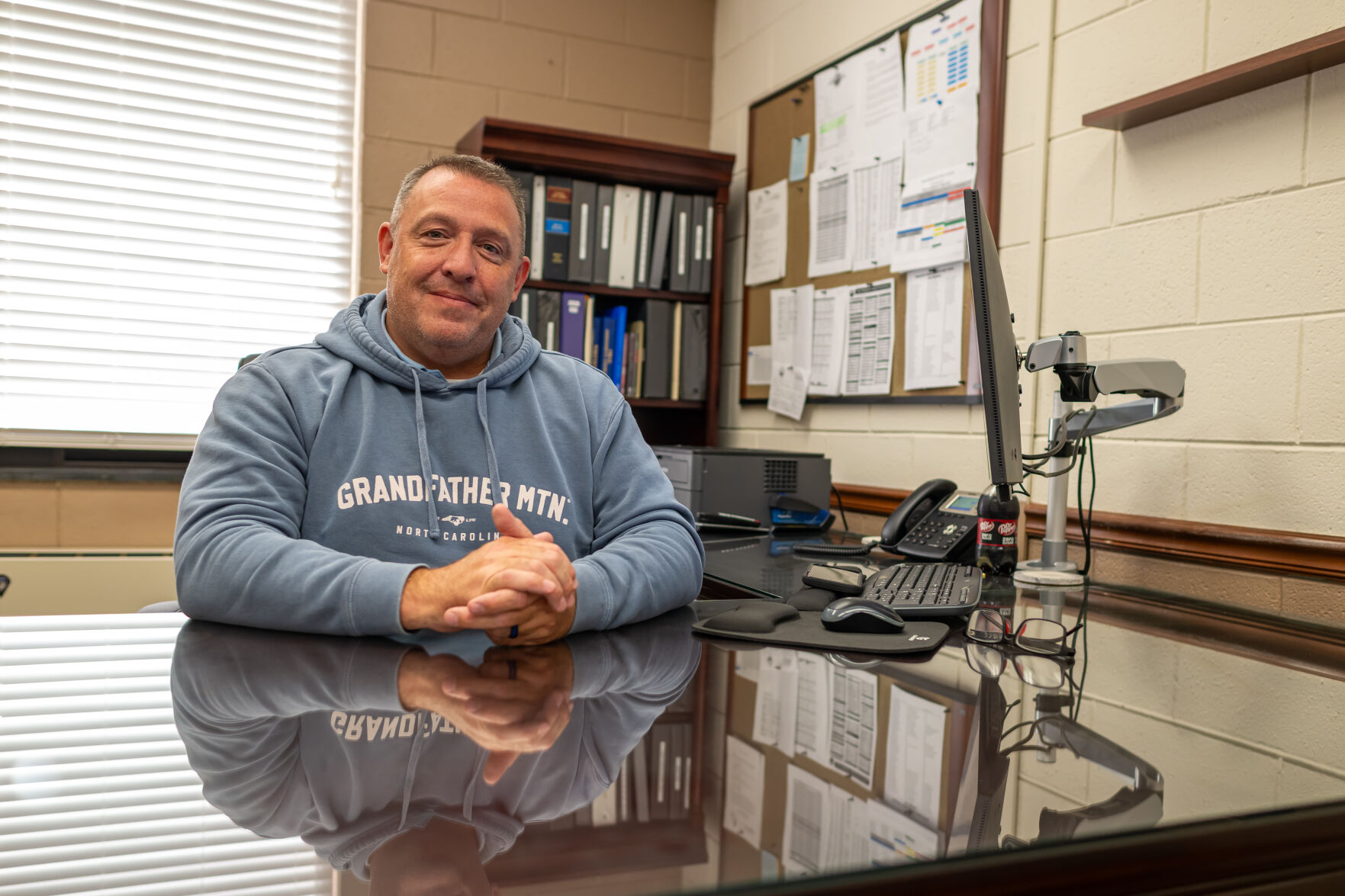
The retiring captain sits comfortably at an empty desk, enjoying his final working day. Brown at desk
Brown at desk
The retiring captain sits comfortably at an empty desk, enjoying his final working day. Brown at desk
Brown at desk
The retiring captain sits comfortably at an empty desk, enjoying his final working day. Brown at desk
Brown at desk
The retiring captain sits comfortably at an empty desk, enjoying his final working day. Brown at desk
Brown at desk
Sandy
Nearly two years after Hurricane Helene devastated parts of Morganton, the city is managing 26 recovery projects now estimated at a cost of about $54.5 million, with its largest reconstruction effort still awaiting decisions from the Federal Emergency Management Agency (FEMA).
City Manager Sally Sandy gave the City Council a status report near the end of Monday’s monthly meeting, warning that the long recovery timeline sometimes cited for Western North Carolina may not be far-fetched.
“A couple weeks ago, there was a headline that said official Helene recovery could take 25 years,” Sandy said. “In a lot of ways, that’s probably very, very true.”
She said the city’s $54.5 million estimate includes money already spent, projects approved for reimbursement, work in engineering or bidding, and estimates for projects yet to be constructed.
The biggest unresolved issue remains the city’s parks.
Engineering estimates put reconstruction of the Catawba Meadows and soccer complex facilities at nearly $33 million, but FEMA has not yet told the city how much of that cost it considers eligible.
“We ask the question every week,” Sandy said. “Every week we’re told it’s still in review.”
The delay is also costing Morganton revenue.
Mayor Pro-Tem Wendy Cato noted that the fields served regional tournaments as well as local athletes, bringing visitors who stayed in hotels, ate at restaurants, and spent money throughout the city.
City officials estimate Morganton is losing about $350,000 annually in direct recreation revenue from events that can no longer be held at the damaged facilities. That figure does not include lost spending at hotels, restaurants and other businesses.
“These fields weren’t just used by local athletes,” Cato said. “These fields were used by regional athletes that came in and spent money in our town.”
Rather than wait indefinitely, the city has decided to separate about $5 million in buildings from the larger fields project. That includes bathrooms, concession areas, maintenance and storage buildings, and offices.
“We cannot really accept a $33 million exposure without answers as to what sources of funding, we’re going to have other than ourselves to pay for that,” Sandy said.
The city hopes to seek bids for the buildings within the next several months and award a contract during the winter.
Morganton is also looking elsewhere for money.
On Wednesday, the city applied for the maximum $15 million available through North Carolina’s Community Development Block Grant Disaster Recovery program. The money could help fill whatever gap remains between FEMA reimbursement and the eventual cost of rebuilding the parks.
There is a catch: The grant program prefers applicants to demonstrate a FEMA funding gap, and FEMA hasn’t yet told Morganton what it will pay.
“We may end up with a funding gap,” Sandy said. “We may be lucky, and we may not. But we may.”
The challenge, she said, is timing: The disaster-recovery grant program prefers applicants to demonstrate a FEMA funding gap, while Morganton is still waiting for FEMA to determine what it will pay.
“We are told by our FEMA friends that sometimes we push very hard, and that our expectation of getting back up and running, especially when you’ve got new buildings from destroyed buildings and new facilities, that we ask an awful lot,” Sandy said, reflecting the frustration throughout the city.
“That the average time to see that start is six years, and we’re like, ‘That’s just absolutely unacceptable. That answer does not compute and cannot be.’ And so, we continue to push, and I hope in six years, you know, we’re back.”
Elsewhere, the recovery is further along.
Sandy said that Morganton has received about $5.2 million in FEMA reimbursements for 19 projects, most involving emergency work immediately after the storm.
Those projects included sewer lift stations, the wastewater treatment plant, street clearing, debris removal, electric restoration and emergency work at the city’s water and sewer facilities.
“That’s $5.2 million, and this is just FEMA — not insurance, not any of the other stuff,” Sandy said.
Four additional projects totaling about $9.05 million have been obligated by FEMA and approved by the state, meaning reimbursement is available after the city incurs the costs and submits documentation.
“Remember, we’ve got to spend the money first,” Sandy said. “Then we turn it in, and then they send us the money back.”
Two projects, the Rocky Ford Greenway near Grace Ridge and the city’s raw-water intake, are in final engineering. Three others, the Silver Creek Lift Station, the Recreation Maintenance Building, and the Boardwalk, are under construction.
The Watershed Weir/Dam project is approaching the bidding stage. FEMA has preliminarily agreed to provide slightly more than $500,000 toward an estimated $600,000 to $700,000 project. Bids are expected later this month, with a possible construction contract coming before the council in October.
Sandy said FEMA officials have cautioned the city that reconstruction involving destroyed buildings and new facilities can take years.
That helps explain why Sandy said a recent headline suggesting Western North Carolina’s broader Helene recovery could take 25 years may not be as extraordinary as it sounds.
The region’s tourism numbers initially masked some of the storm’s economic damage, she said, as emergency crews, utility workers, FEMA personnel and others filled available hotel rooms.
As those workers leave, the underlying weakness is becoming more apparent.
“I think now we’re starting to see as a region where we really are not back,” Sandy said, “and how much work there is to be done.”

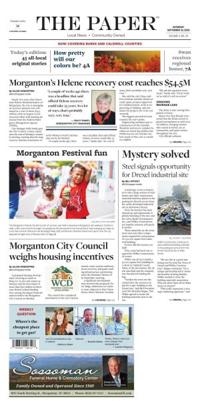
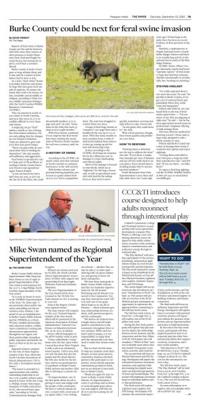
The Morganton Festival, the last hurrah of summer, was held in downtown Morganton last weekend. Children’s rides, crafts, and concerts brought out people by the thousands to the annual event, which first began in 1982. Seen enjoying icy treats on a hot, late-summer afternoon are Brynleigh Neely (left) and Roman Shambre.
Morganton Festival fun
The Morganton Festival, the last hurrah of summer, was held in downtown Morganton last weekend. Children’s rides, crafts, and concerts brought out people by the thousands to the annual event, which first began in 1982. Seen enjoying icy treats on a hot, late-summer afternoon are Brynleigh Neely (left) and Roman Shambre.
Morganton Festival fun
A proposed housing development receiving as much as $625,000 in city and county assistance and the movement of more than $3.6 million in Hurricane Helene-related funding were among the largest financial matters before the Morganton City Council on Monday.
The council also considered investments in the city’s electric system, water-system resiliency, storm recovery, and parks, making infrastructure and development the dominant themes of its September meeting.
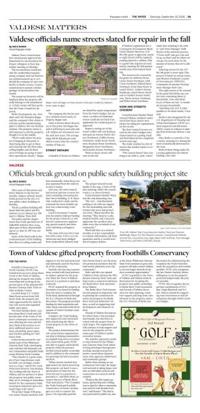
A significant development item involved the proposed Clover Ridge subdivision on Latimer Lane, adjacent to East Union Street, where Western Carolina Developers LLC plans a single-family development on about 15 acres.
The property is near the Henry’s Glenn neighborhood and is proposed to be divided into 30 lots, with plans calling for at least 25 and potentially as many as 30 single-family houses.
Under Morganton’s Single-Family Housing Stimulus Program, the developer requested up to $125,000 for water infrastructure, $125,000 for sewer work, and $75,000 for street improvements — a total of as much as $325,000 in city assistance.
The assistance initially would be structured as zero-interest loans secured by the property. Portions of the loans could later be converted to grants under terms of the city’s program.
Before the unanimous vote supporting the project, Morganton City Attorney Keith Rigsby presented the formal development agreement to council.
“The structure of the documentation incorporates accountability through a security interest for the city in the property, and through lot-by-lot repayment of obligations that they are required to meet,” he said. “Obviously, this will address a real need in the city of Morganton for housing. We’ll gain at least 25, potentially up to 30 homes and corresponding utilities and street improvements.”
Michael Brown with Western Carolina Developers outlined the project for the council.
“We’ve built spec houses here for the past seven years, so we’re very familiar with the needs and what people are looking for,” he said. “These particular homes will be targeting upper $300s, lower $400s, … single-family, three-bedroom, two-bath.”
Answering a question about timelines from Morganton Mayor Pro-Tem Wendy Cato, Brown said the project will begin as soon as the development firm receives approval from the Burke County Commissioners for infrastructure funding.
Burke County is proposing to contribute $300,000 toward infrastructure at Clover Ridge using money from a repurposed $2.5 million state appropriation for housing infrastructure.
The county’s proposed agreement includes performance requirements. At least 25 single-family houses would have to be completed within three years, with each completed house having an estimated taxable assessed value of at least $300,000. The agreement calls for the developer to pay Burke County $12,000 for each house fewer than 25 completed by the deadline.
Taken together, the city and county assistance could reach $625,000.
Council also took up a package of Hurricane Helene financial adjustments.
A supplemental agenda item proposed two budget amendments totaling $3,600,012 associated with Federal Emergency Management Agency reimbursements and Helene-related city accounts.
One amendment involves $2,280,012 in FEMA project reimbursement proceeds. A second involves $1.32 million in FEMA reimbursement and transfers involving Helene-related funds.
The amendments largely represent reimbursements and movement of money among project accounts rather than $3.6 million in new city spending.
Near the end of the hourlong meeting, City Manager Sally Sandy provided an update to council on the status of projects for park restoration that are awaiting FEMA’s approval. See related story on Page 1A.
The council also considered several utility and infrastructure projects.
Among them was a $166,127.60 contract with River City Construction LLC for foundation work at the city’s Delivery No. 4 electric substation. The work includes foundations for two circuit switchers and a transformer. Four proposals were received, with River City submitting the lowest bid.
Council approved a contract of up to $55,000 with Osmose Utilities Services Inc. to inspect and test underground portions of city utility poles.
Together, those projects continue a recent emphasis on the reliability of Morganton’s electric system. In August, council adopted an Emergency Electric Grid Alert Plan establishing procedures for responding to regional electric-grid emergencies.
Council considered taking the first step toward seeking Community Development Block Grant Disaster Recovery funding for a Parks and Recreation Restoration Project. A public hearing on that application would be scheduled for Sept. 28.
With housing incentives, storm recovery, and utility investments accounting for millions of dollars in public and private infrastructure, the meeting offered a clear view of where Morganton’s attention — and increasingly its outside funding — is being directed.
Editor Emeritus
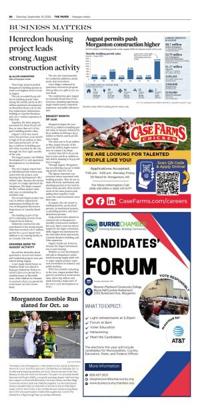
Wilkie Construction continues to place additional building materials in the parking lot across from the Drexel industrial site on Main Street.
A week ago, it was a mystery as to why a large section of steel beams and other construction materials had been placed in the parking lot directly across from the newly developed industrial site in downtown Drexel.
Now, the mystery has been cleared up, and opportunity is plainly knocking at the site, and the town, Burke Development Inc., and Wilkie Construction are hopeful someone will quickly answer.
Those materials are the structural steel and other components required for construction of a 50,000 square foot industrial building.
So how did this mystery unfold?
First, some bad luck was required for Wilkie Construction of Lenoir.
Wilkie was all set to build a 50,000 square foot building for a client in Caldwell County when, at the last minute, the client cancelled and the company was literally left holding the bag.
“Neither the town nor the county have the resources to pay for a spec building on the Drexel site,” said BDI President and CEO Brandon Ruppe, “but Wilkie agreed to locate the building materials next to the site.
“We see this as a great marketing tool for both the Town of Drexel and Wilkie Construction,” Ruppe continued. “It’s a unique partnership and it shows the benefits of being flexible. Wilkie needed to store the building materials somewhere. Why not show them off on Main Street in Drexel?”
“This really represents a strategic marketing approach,” said Josh Wilkie, president of Wilkie Construction. “The Drexel site is an absolutely fabulous site, and people are realizing that constructing a new building often makes better financial sense than trying to restore an old one.”
Wilkie also said the materials represent a big bargain for potential buyers.
“That steel was purchased before steel prices shot up sharply,” he said. “That could represent a substantial savings.”
Drexel Town Manager Bill Carroll is pleased that the town could provide the space for the Wilkie materials and is excited about what may now happen on the site.
“Certainly, it makes for quick accessibility if someone is interested in the building,” Carroll said. “It’s a great partnership and it provides us with another option as we move forward.”
The industrial site was home to Drexel Furniture Company from the time it was launched in the early 1900s until its final closure in the early 2000s.
At one time, the site held not only a large furniture factory and a sprawling lumberyard to support it, but also the corporate headquarters for Drexel Furniture and a showroom to display new products in the spring and fall furniture markets.
The cleanup and grading of the site have cost more than $6 million, the bulk of which has been supplied by state and federal grant funding. The effort to get the site ready for use again has taken well over a decade.
Both Carroll and Ruppe have previously noted that the site is appealing due to its proximity to the railroad and needed utilities.
Unlike many industrial parks built farther outside of downtown areas, Drexel’s site sits directly across the train tracks from the downtown business district, something both Carroll and Ruppe believe could create ripple effects for local businesses.
“When you’re investing in this site, you’re investing in the whole town,” Carroll said.
This is a developing story, and The Paper will update it as more information becomes available.
Bill Poteat is editor emeritus. He may be reached at 828-445-8595 or bill@thepaper.media.