
New, high-tech facility and workplace culture have kept Meridian Specialty Yarn Group going in Valdese

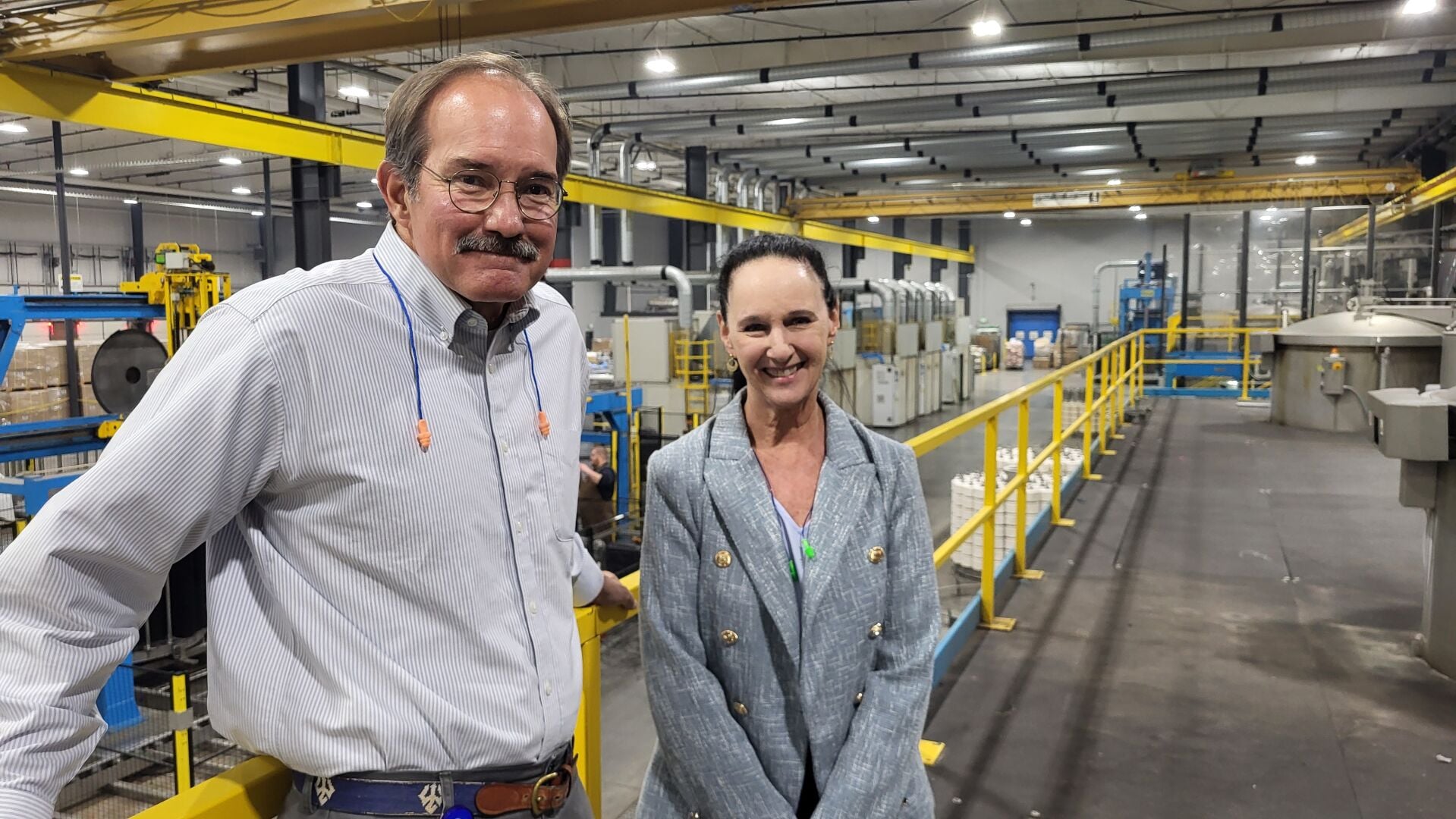
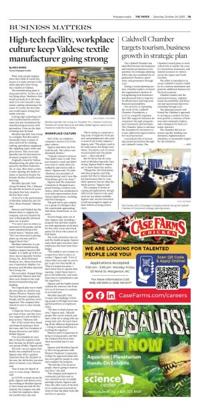
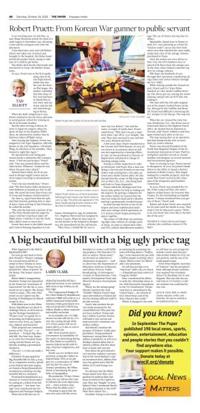
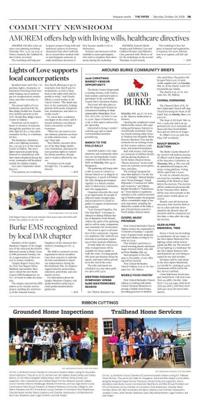
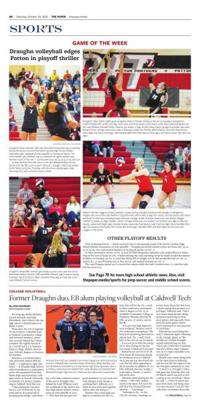
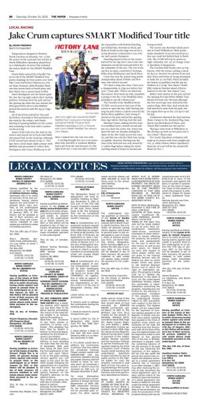
Meridian Specialty Yarn Group, Inc. President Tim J. Manson III and Vice President of Human Resources and Safety Debbie Sigmon stand on the mezzanine inside the new facility.
What most people imagine when they think of textile dye houses is a stark contrast to Meridian Specialty Yarn Group, Inc.’s facility in Valdese.
The manufacturing plant is clean and well-lit. No bits of cotton flying about. Machinery that would normally be in the basement is in view beneath a mezzanine, making maintenance far easier. It’s noisy, but less than one would expect setting foot inside a factory.
Cutting-edge technology not only transformed the environment, but also streamlined the manufacturing processes with automation. Gone are the days of mixing dyes by hand.
Meridian Specialty Yarn Group is a company that dyes and/or chemically treats a variety of yarns and wool for clothing, crafting, and military equipment like rappelling ropes, socks, and glove inserts. They even treat specialty yarn for percussion instrument company Vic Firth.
Originally owned by Valdese Manufacturing, the plant was acquired by Meridian Industries Inc. in 1994. More than a century after opening, the facility remains in operation despite the broader decline of textile manufacturing.
Meridian Specialty Yarn Group President Tim J. Manson III said that he knows of 44 textile plants that have closed in the last three years.
“A lot of it is the perseverance of Meridian Industries and (its CEO) Bruce Pindyck,” Manson said.
Manson said Pindyck has the balance sheet to support the company, and even funded the new, technologically advanced plant out of pocket.
“I’ve never seen an owner as interested in his people, and he wants manufacturing in the United States,” Manson said. “He’s not interested in putting plants up overseas and he’s dogged about that.”
Meridian Industries is a privately owned manufacturing holding company based in Milwaukee. It is made up of five entities: Aurora Specialty Textiles Group, Inc., Kent Elastomer Products, Inc., Kleen Test Products Corporation, Majilite Corporation, and Meridian Specialty Yarn Group, Inc.
The new plant changed things considerably, Manson said, but there were bumps in the road between brainstorming and building.
The original plan was to build the new plant at a facility near Valdese Weavers, Manson said. The deal became complicated, though, and the purchase never happened. The company then turned its eyes to sites outside Valdese.
“I think the Town of Valdese got wind of that, and they were very supportive and worked to keep us here,” Manson said.
Part of the reason they stayed was financial assistance from the town, said Vice President of Human Resources and Safety Debbie Sigmon.
“I’m very thankful we were able to keep the employee base here, because we do have a good core group of folks,” Sigmon said.
The new, 116,000 square-foot facility was completed in 2019, Sigmon said. After a gradual transition from the old plant to the new, the old facility was shut down in January 2020, Manson said.
“Just in time for March of 2020 to come along,” Manson said.
As COVID-19 swept across the globe, Sigmon said almost everyone working at Meridian Specialty Yarn Group was laid off. Fortunately, the company was able to rehire the employees about two months later, she said.
WORKPLACE CULTURE
Part of the 130-employee company’s success is its workplace culture.
Sigmon said when she first took the job, “the culture was absolutely broken.”
“Nobody wanted to interact. They didn’t want to talk. They just wanted to work and didn’t even want to smile when you walked by and tried to talk to them,” Sigmon said. “So John (Marlowe, vice president of manufacturing) and I were like, ‘Something’s got to be done.’”
Sigmon said The Industrial Commons in Morganton proposed forming a workers committee, which was established in 2018 with representatives from various departments, including mid-level managers.
The goal was to give employees a group of colleagues they felt comfortable approaching with ideas, frustrations, or concerns.
Several things came out of that, Sigmon said, including a program that provides employees with appropriate work shoes for free once a year and a food pantry for those who cannot afford lunch.
The work committee also created the buddy program, Sigmon said, which pairs new hires with employees who have been there longer.
“The buddy is not a trainer or a supervisor; they’re just a coworker,” Sigmon said. “A lot of times when you come in, you’ve got to get over that hurdle of, ‘This is a brand new place. I don’t know how to operate that machine. I don’t know how to get to the bathroom,’ and sometimes they’re intimidated to ask the supervisor.”
Sigmon said the buddy system reduced the turnover rate from 61% to 9% between its creation in 2018 and now.
Meridian Specialty Yarn Group’s next challenge is finding people to fill high-level managerial positions as employees retire.
“We have to kind of grow our own,” Sigmon said. “Identify people who can be trained, and that’s what we’re doing with one young man now. He’s just learning all the different departments … trying to understand how everything fits together.”
Manson said it’s important to bring in young people, and that the company has been somewhat successful, but it’s not easy.
Sigmon said Meridian Specialty Yarn Group partners with Western Piedmont Community College for apprenticeships and has even paid for people to enter and complete the program.
“We feel like if we invest in people, they’re going to want to stay here,” she said.
The company participates in community job fairs and career-oriented events in middle and high schools, Sigmon said. They also offer tours of the facility to combat preconceived notions of what the plant looks like and how it operates.
“We’re trying to counteract a long time of negativity from parents and grandparents who used to work in the textile industry,” Sigmon said. “The plants used to be really messy, lint flying everywhere. You know, a lot of cotton was processed and (the plants were) … dirty and dark.”
But for those that do come work at Meridian Specialty Yarn Group, Sigmon finds it important to show them they matter.
“Things like (the food pantry and shoe program) just help people feel they’re valued, and not just because they’re a machine operator, but we value the whole person,” Sigmon said.
The company is always accepting job applications, though with its low turnover rate, positions are not always available, Sigmon said. Anyone interested is still encouraged to apply on their website at msyg.com/careers.