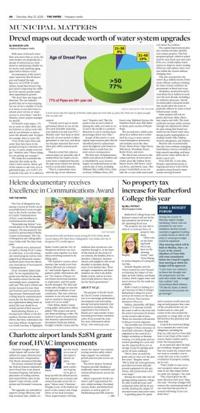



A chart shows that the majority of Drexel’s water pipes are more than 50 years old. There are no pipes younger than 20 years old.
With most of Drexel’s water lines now more than 50 years old, town leaders are preparing for a decade of infrastructure work aimed at maintaining reliable water service and replacing aging pipes before failures occur.
An assessment of the town’s water system by McGill Associates and funded through $350,000 of COVID-19 relief money, found that Drexel’s biggest need is improving the viability of its current system rather than expanding for growth.
“We don’t have any large subdivisions. The one industry growth that we’ve been keeping our eye on for a number of years is in town, so you don’t have to extend sewer service or water service to serve them,” said R.J. Mozeley, senior project manager for McGill.
Of Drexel’s water pipes, 77% are 50 years or older, while 19% are between 31 and 40 years old, and 4% are between 21 and 30 years old, Mozeley said. No pipes are younger than 20 years old.
“A lot of the water lines and sewer lines have been in the ground serving its customers for 50, 60, 70 years, maybe even longer,” Mozeley said. “Those things are not getting any younger.”
The study also examined the materials that make up the town’s water system. About 43% of the system is cast iron, 22% is galvanized pipe, 20% is PVC, 8% is ductile iron, and 7% is asbestos cement.
“Overall, you’ve got as much galvanized almost as you do the two most desirable materials, your ductile iron and your PVC,” Mozeley said. “Just keep in mind that 65% of your system is either galvanized or cast iron, and those are the pipe materials that most often give utility systems problems.”
Mozeley noted that asbestos cement pipes are generally safe if undisturbed, but repairs can become more complicated because the pipe must remain wet during work to avoid safety hazards.
“This is a nationwide issue with the age of our infrastructure,” Mozeley said. “But the point is that as you’re kind of playing the odds, you want to try to move the needle in a positive direction so you’re cutting those percentages down over time.”
As part of the town’s 10-year capital improvement plan, McGill identified priority replacement areas throughout town based on where failures could have the most severe consequences.
The first wave of replacements, which costs about $1.8 million and is scheduled for 2030, focuses largely on residential areas on the eastern side of town, including Williams Way, Griffin Drive, Helena Street, Williams Drive, Williams Loop, Highland Avenue, the Dearborn Street area, WR Anthony Road, and a section of Bryant Road.
The second wave, which costs about $1.9 million and is scheduled for 2034, is more concentrated throughout downtown, and includes areas like Abee Street, Burns Street, Page Street, Mill Street, Woodman Street, Burke Street, and more.
The third wave returns to the eastern portion of town and includes areas like Valdese Drive, Baxter Street, Hill Street, Garrison Drive, and Myrtle Lane. This project would likely occur outside the 10-year mark and would cost about $2.3 million.
The capital improvement plan also includes broader distribution system projects. The first proposed project, which is scheduled for next fiscal year and costs $780,000, would replace water meters to improve meter reading efficiency and capture more revenue within the system without changing rates.
This also incorporates the town’s $5.9 million worth of Hurricane Helene resiliency funding for water system resiliency improvements in fiscal year 2029.
Altogether, proposed projects total about $15.8 million in work over the next decade, including a 3% inflation allowance. McGill recommended a financial model that would allow the town to gradually address its most critical infrastructure needs.
Some projects will rely on grants and loans, while others may require new debt. The town could also increase utility revenue through rate adjustments, Mozeley said, noting that Drexel currently has the lowest water rates among nearby municipalities, including Granite Falls, Valdese, Newton, Morganton, and Hickory.
Mozeley also recommended that the town continue managing fund balance reserves carefully to help smooth spending, and keep debt service ratios below the industry cap of 25%.
Even with the 10-year plan, Mozeley said infrastructure is ongoing and more work will be needed to keep Drexel’s water system moving forward.