

Congressman Moore highlights impact of tax package at visit to Morganton manufacturer


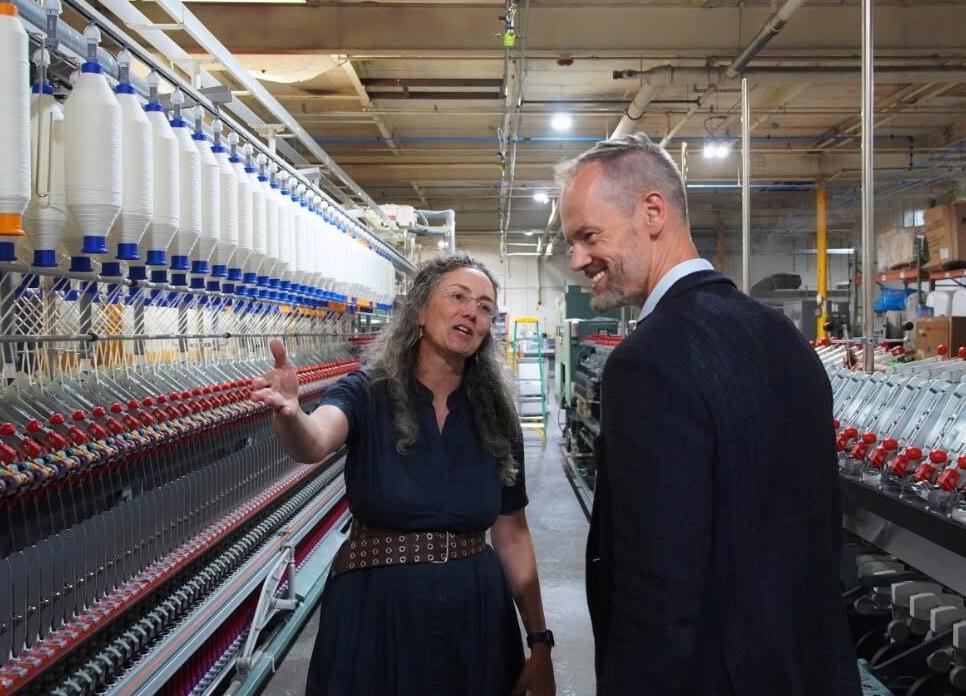
Seiren North America Executive Vice President Jeff Kale (left) leads Congressman Tim Moore (middle) and Erin Streeter (right), National Association of Manufacturers executive vice president, through the manufacturing facility in Morganton.
U.S. Congressman Tim Moore paid a visit to Morganton’s Seiren North America to see firsthand how the Working Families Tax Cuts are aiding the manufacturer as it continues its over two decades of producing a wide variety of automotive upholstery materials.
The Working Families Tax Cuts, also known as the One Big Beautiful Bill Act, made permanent most of the expiring individual income tax cuts from the 2017 Tax Cuts and Jobs Act. The law provides long-term tax certainty, supporting the capital-intensive investments and innovation that drive manufacturing within America, according to the National Association of Manufacturers (NAM).
In the 14th District alone, which includes all of Burke, Cleveland, Gaston, and Rutherford counties, along with portions of Mecklenburg and Polk counties, the tax package has already saved 31,000 jobs, according to Erin Streeter, executive vice president of NAM. The bill has also saved $3.1 billion in manufacturing wages for over 772 establishments.
Moore’s Monday tour also included visits to Jim Myers & Sons and Okuma America, both located in Charlotte.
“It’s great when I can come to a manufacturer who can say, ‘Here’s what’s benefited, we’ve been able to expand our production. We’ve been able to buy equipment,’ Moore said. “Usually, that also means producing more jobs. That was the biggest reason for the Working Families Tax Cuts.”
Jeff Kale, Seiren North America executive vice president, pointed to the research and development policy within the bill, which permanently restored immediate R&D expensing. NAM said the provision will accelerate research investment and help U.S. manufacturers continue to lead the world in innovation.
“It reduced our tax burden, and it freed up a substantial amount of money for additional investment opportunities,” Kale said. “So, we get that money back quicker. Now we can take that and put it into the next investment plan for further expansion and improvement and automation.”
For nearly 70 years, manufacturers were able to fully deduct their research and development expenses in the year incurred, but first-year expensing expired in 2022, making manufacturers spread their research and development deductions over several years, according to NAM.
The change made research and development investments more expensive, especially for small and medium-sized manufacturers, and increased the cost at a time when global competitors were offering robust research and development incentives — like China’s 200% super deduction.
The Working Families Tax Cuts also ensure that manufacturers can immediately expense 100% of the cost of capital equipment purchases. This allows companies, especially smaller ones, to purchase new equipment and expand their shop floors, leading to increased productivity and job creation, according to NAM.
“When companies are allowed to have that capital that’s freed up, they can then buy additional equipment or hire additional employees, or expand production,” Moore said. “The other thing is, the more modern the equipment, the more competitive a company is. If you’re trying to compete with China or somewhere else where labor is cheap, the way you do it is to increase automation and productivity.”
As the country grapples with keeping up with energy demands, Moore said another focus has been streamlining and permitting when it comes to expansion. The goal is to make it easier for manufacturers who want to undertake a new venture, he said.
“We’ve got some archaic rules that have been in place that have slowed down that process, so we now have bills and executive actions that have taken place to make that easier,” Moore said.
He added that more energy production could mean more natural gas pipelines and development of small modular reactors, or SMRs, which make way for nuclear power to expand. Streeter also added that supporting energy production and streamlining permitting is at the top of NAM’s efforts.
Kale thanked both Moore for his vote and the NAM for its extensive advocacy to Congress, helping make sure manufacturer voices were heard and that the pro-growth tax provisions were signed into law.
“NAM was on the front lines throughout this debate, bringing manufacturer stories directly to lawmakers, making the case for policies that gave companies like ours the certainty to invest, grow, and create jobs here in North Carolina,” Kale said. “It’s our goal to be here long-term for the future.”