There was a time when Saturday mornings in Morganton were interrupted by the unmistakable sound of a radial engine.
Those who know that sound do not easily forget it. A starter turns, cylinders cough to life, smoke rolls from the exhaust, and finally the great engine settles into a deep, uneven rumble you can feel as much as hear.
For a period of time, that sound was part of life at a little grass airport here. But our community’s aviation history stretches back much farther.
Flying was still in its infancy in October 1934 when one of Morganton’s earliest aviation tragedies occurred. John Frederick “Fred” Kistler and his young wife, Elizabeth, were killed while landing his airplane at a local airfield near present-day Catawba Meadows Park and the former site of Judge’s Riverside Barbeque.
Only seven years had passed since Charles Lindbergh crossed the Atlantic alone in the Spirit of St. Louis. Airplanes were becoming more capable and more common but flying still carried an element of danger and adventure difficult to appreciate today.
Fifty years later, Morganton witnessed another aviation tragedy that many longtime residents still remember.
Around 6 p.m. on Oct. 11, 1984, two airplanes collided in midair near Silver Creek Airport. One was a Piper Warrior flown by Morganton businessman Jim Casey. The other was a Piper Tomahawk flown by Richard Williams of Granite Falls.
Investigators determined that Williams had been performing touch-and-go landings in the Silver Creek traffic pattern. Casey’s Warrior was maneuvering below the pattern and was seen climbing toward the Tomahawk.
Investigators also noted a factor any pilot can immediately understand: the Warrior was flying westward into the setting sun.
The airplanes collided. Casey’s Warrior fell into Shuey Field. Williams’s Tomahawk struck a high-voltage power line before crashing into a nearby creek, knocking out electrical power across Morganton. Both men were killed.
Considering where the airplanes came down, it is extraordinary that no one on the ground was killed. My grandfather was co-owner of one of the planes involved and remembered walking to the wreckage afterward. He also remembered children playing ball at Shuey Field that evening.
Family recollection is that the only injury on the ground was a little girl who was slightly hurt after falling from the bleachers in the commotion.
But accidents are only a small part of Morganton’s aviation story. The one I love is about all the airplanes that went up.
SILVER CREEK AIRPORT
A few miles west of Downtown Morganton lies Silver Creek Airport, a privately owned grass airfield officially dating to 1959. Today it is generally quiet. It wasn’t always.
Silver Creek was created largely through the efforts of several local aviation enthusiasts, including two men who would become inseparable from its history: Paul Cash and Hank Avery.
Cash had flown B-24 Liberator bombers during World War II. Avery had served as a captain and pilot in the United States Marine Corps during the war. Both later became prominent Morganton businessmen — Cash with Mimosa Insurance Agency and Avery with A.P. Causby Concrete & Stone — but neither left his love of aviation behind.
Hank eventually assembled an extraordinary collection of vintage aircraft. There was a Grumman TBM Avenger, the enormous carrier-based torpedo bomber of World War II; a North American Harvard, the Canadian variant of the famous T-6 Texan — an advanced trainer nicknamed “The Pilot Maker” because it served as a critical final step for thousands of young military aviators before they moved on to high-performance combat aircraft like the P-51 Mustang and F4U Corsair; a North American Yale; a Fairchild PT-26 called “Shug,” the same affectionate nickname Hank used for his wife, Margie; and a Stinson L-5.
There was also a 1930 Waco RNF biplane with a remarkable history. Its early owners included Phil “Red” Love, a close friend and fellow airmail pilot of Charles Lindbergh; Harry H. Knight, one of the principal financial backers of Lindbergh’s Spirit of St. Louis flight; and Frank Robertson of Robertson Aircraft Corporation, Lindbergh’s former employer.
Given those connections, it is entirely possible that Lindbergh himself once flew this very airplane. According to its aircraft logs, he reportedly did, although that tantalizing piece of history is difficult to independently document nearly a century later. Whatever the truth of that story, the Waco eventually found its way to Morganton and remained at Silver Creek for more than 40 years.
Hank also owned a Douglas EA-1E Skyraider, an enormous single-engine military aircraft developed near the end of World War II and used extensively in Korea and Vietnam.
Because of its size, it was kept at Hickory Regional Airport rather than Silver Creek. Even then, a flying example of that particular Skyraider variant was extraordinarily rare.
And Hank wasn’t alone.
Paul Cash owned a North American SNJ-5, the Navy version of the T-6. Morganton orthodontist Dr. John Shell owned several vintage aircraft over the years, including aStearman, an SNJ, a rare North American NA-50 and a reproduction Fokker Dr.I triplane — the unmistakable type forever associated with Manfred von Richthofen, Germany’s famous “Red Baron” of World War I.
At times there were even more T-6s at Silver Creek, along with a Stinson AT-19 belonging to the organization then known as the Confederate Air Force, today’s Commemorative Air Force.
SATURDAY AVIATION
There were Saturdays when a visitor looking across the ramp at Silver Creek might have thought he had somehow wandered onto a military training field in 1944.
But airplanes, no matter how magnificent, do not create an aviation community by themselves. People do.
For me, Silver Creek was never just a place to watch airplanes. My grandfather, Roy Walters, who spent his career as the purchasing agent at Henredon Furniture, flew there and was good friends with Paul Cash and Hank Avery.
Some of my earliest aviation memories are of flying with him in a Piper Warrior. Through him, Silver Creek became part of my childhood long before I ever took the controls myself.
When I eventually began learning to fly at age 15, I was given opportunities that seem almost unbelievable to me now. I didn’t merely stand beside those old airplanes and admire them. I got to fly them — the T-6s, the Fairchild, the TBM and others that made Silver Creek such a special place.
One of the men who made those experiences possible was W.A. “Doc” Sinden.
Doc had been a Naval aviator and was one of those pilots who seemed capable of flying almost anything with wings. That is easy to say about a good pilot. In Doc’s case, it was quite literal. He flew the trainers, the antiques and the warbirds. And when it came time to operate two of the largest and most demanding airplanes in Hank’s collection — the TBM Avenger and the Douglas Skyraider — Doc was the man entrusted to serve as pilot in command. He was also my first flight instructor.
In 2003, I had the extraordinary opportunity to fly the Skyraider with Doc from Hickory to Lakeland, Florida, for Sun ‘n Fun, one of the country’s great aviation gatherings. Later that year, we flew it to the Winston-Salem Airshow at Smith Reynolds Airport.
My grandfather went with us on that trip. That memory means more to me with each passing year. The man who first introduced me to flying was there with me, riding in that enormous old warbird with the man who taught me to fly. At the time, it was another great aviation adventure. Today, I understand it was something much more.
The years passed, and eventually the Silver Creek I knew began to change. The warbirds departed one by one, and the men who had filled the airport with life were gone as well.
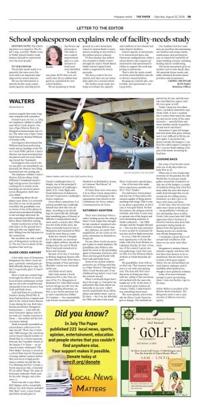
Today, I keep my own plane there, a polished-aluminum 1946 Globe Swift. It isn’t a warbird, but it comes from much the same era and carries some of the same character — graceful lines and those familiar smells of gasoline, oil and warm machinery.
Sometimes I open the hangar and look down that grass runway, and it isn’t difficult to fill the airport again. I can picture the planes outside the hangars. I can hear the radial engines coming to life. I can see Hank making a low pass with smoke streaming behind him.
LOOKING BACK
But some of my favorite memories are of the days when nobody flew at all.
When rain or low clouds kept everyone on the ground, the old World War II veterans would gather around the woodstove inside one of the hangars. A couple of warbirds sitting only a few feet away while the men who had actually lived through that era sat around the fire telling stories. Somehow, as a kid, I got to sit there with them and listen.
At the time, they were just the older men I knew at the airport — my grandfather’s friends, pilots and familiar faces at Silver Creek. Only years later did I fully appreciate what I had been allowed to witness: men from that generation sitting beside airplanes from that generation, sharing stories of a world that was already disappearing.
I would give a great deal to sit around that woodstove with them on one more rainy afternoon.
Morganton’s aviation history includes tragedy, and those who lost their lives deserve to be remembered. But the better story is about a little grass airport where, for one extraordinary period, historic airplanes and remarkable pilots gathered as though it were perfectly ordinary.
Some of us were fortunate enough to grow up watching them. I was even luckier. I got to fly them.