

Parking reform could reshape development in Burke

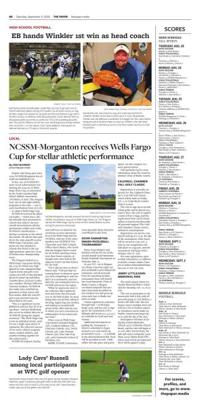
Beth Heile, executive director of the Burke River Trail Association, and Ryan Carter, policy director for the Catawba Riverkeeper, at the North Carolina General Assembly. The two have worked together on Catawba River access points and supported the legislation that ended minimum parking spaces in developments.
Beginning next year, developers rather than local governments will largely decide how much parking most commercial or residential developments need under a new North Carolina law.
Last month, Gov. Josh Stein signed the Parking Lot Reform and Modernization Act, or North Carolina House Bill 369, into law. It’s one that has gained support from both sides of the aisle and from both developers and environmental advocates. The new law will go into effect on Jan. 1, 2027, but will not include coastal counties.
The law removes parking minimum requirements for developments and allows local governments to offer incentives, including tax breaks, to developers who add stormwater controls beyond those required by statute.
“This is a huge win for our river and for the environment by reducing unnecessary impervious surface and improving water quality,” Ryan Carter, policy director for the Catawba Riverkeeper, announced on social media when the bill passed.
Beth Heile, executive director for the Burke River Trail Association, has been a supporter of the bill since it gained traction in 2025. She said it started out as a water quality issue but quickly became clear that smarter parking policy also supports small businesses, housing, historic preservation, and redevelopment.
In Valdese, she has seen several projects, including the redevelopment of an old mill, become costly when use changed and a developer had to purchase extra property to fit parking requirements.
“Sometimes building stronger communities means removing a barrier rather than building something new,” Heile said.
Valdese Planner Michael Rapp noted that lack of parking is one of the more common reasons the town may deny a set of plans. Much of the time, the property owner has a good argument against why they chose not to require the parking.
The town had already been considering some level of parking reform, but staff wanted to wait for the outcome of the bill. Now that it’s passed, the planning board recently approved the changes outlined in the new law, but they will also need to be approved by the town council.
Municipalities will still be able to regulate other standards associated with parking, including landscaping, ingress and egress, and certain safety requirements, he said.
“What we cannot require is the parking lot itself,” Rapp said. “If someone wanted to construct a business and have no parking lots, and they think there’s adequate infrastructure around to serve, that individual could make that decision now.”
Currently, municipalities have schedules for parking spaces based on types of uses. For example, a single-family home in Valdese is typically required to have two parking spaces, while commercial properties are required to have a parking spot for every 500 square feet.
Wendy Smith, Morganton’s director of development and design services, has remained largely neutral on the changes but worries about unintended consequences for small business owners who may struggle to anticipate how much parking customer demand will require. Not having enough could pose a major risk, she said.
“It could be a detriment,” Smith said. “Because now you’ve invested in either a lease or a purchase of a property, and you had no idea how much parking you might need. There’s a book you can buy with national parking standards to try to help people with that, but a lot of businesses, they don’t even think about that.”
“I’ve lost track of the number of people that have told me, ‘I’m not going there because I can’t get in that parking space,’ and that’s unfortunate for them because I don’t want them to lose business because they don’t have enough parking in that lot,” Smith said.
Parking reform is one of the many topics Morganton is working to address during its process of creating a Unified Development Ordinance. With the new law, Smith said the planning and zoning commission, along with the city council, still have to sign off on the changes.
However, she is going to recommend that the city keep its maximums for the amount of parking a developer can pave. The city’s current parking ordinance states that once parking lot paving hits a certain limit, the rest of the spaces have to be pervious, meaning water and more can soak through. The new law does not include language regarding maximums.
“One of the reasons why we don’t want asphalt everywhere is because we’re nature’s playground,” Smith said. “We’re trying to keep the benefits for the stormwater infiltration and to have some of that landscaped area.”