
Mama Jeter's legacy and the art of seeing again


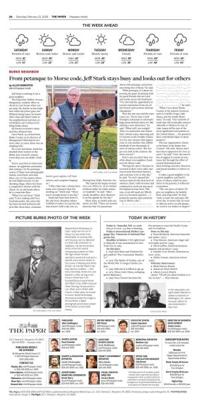
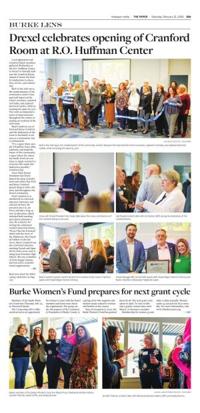
Grandma Jeter with daughter Jan Jeter.

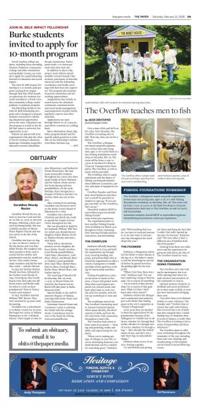
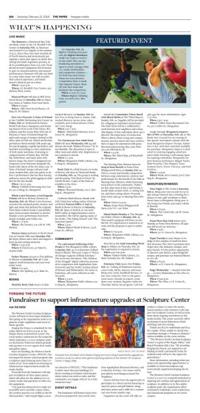
Judy Teele, right, on a fishing trip in Montana.
Pentimento is the reappearance of an original drawn or painted element in a painting that was eventually painted over by the artist. Hidden compositional, or outline, strokes become visible through the top layer of paint as it turns transparent with age. — Merriam-Webster
Storms can be disorienting. Fern, our first storm, included predictions of debilitating, accumulating ice. Then a reprieve. A big plummet of lovely white, picturesque snow. But a bomb cyclone nonetheless. Cyclones and storms are, by their nature, disorienting things.
As these storms swirled around me, I thought of this quote by poet Emily Dickinson. Taken from a letter written to her sister-in-law. “I am out with lanterns, looking for myself.” Dickinson had originally intended the line to be humorous. But for some, it symbolizes the search for oneself.
That image, of walking, a bright lantern held high in the dark of a storm, resonates with me. I think of the times when I have been out with lanterns, looking for myself.
This was especially true in early 2025, after the loss of my spouse of 57 years and a move to a house other than my own. A lovely place, but not the home that I had lived in for 39 years.
After an upheaval like this in her own life, writer Joan Didion said, “I have already lost touch with a couple of people that I used to be.” I, too, had lost touch with the people that I used to be. The ground beneath my feet had shifted. Who was I to be now, in this new chapter that was unfolding?
That summer, I visited my daughter and her family in Montana. Would I like to join them on a fly-fishing float trip down the Madison River? I was quick to say yes. But then, as an afterthought, I said, do our guides know that they are dealing with an 80-year-old Granny?
When my first grandchild was born, I begged to be called Granny. After my own beloved grandmother. But I was overruled. The name was considered too unsophisticated. So, I became Mama J.
On the day of the trip, I was the first to climb into my boat. While my guide and I floated nearby, I practiced casting. The rest of the family was waiting to load.
Suddenly, a big trout hit my line, and my very amazed guide and I reeled him in. A chorus of surprise from the riverbank. Granny caught a big one, my son-in-law shouted across the water. My more restrained name of Mama J was forgotten in the joy of the moment.
As we floated down the river, our boat was ahead of the rest. My guide suggested we pull over at our lunch stop to wait for the others. I sat on top of the cooler holding sandwiches and drinks.
There, instead of remembering my big catch, my thoughts suddenly turned to my grandmother. Who she was. What she was doing in 1955 when she was 80 years old.
My age now. Exactly.
She had never flown in a plane, never driven a car. She usually dressed in one of her black dresses with white polka dots, a brooch pinned to her bosom.
She would joke and say, “Look for me in heaven, I will be wearing a red plaid skirt.” She wasn’t a fashion maven; her current clothing choices had to do with her ample size. She loved Ritz crackers with mayonnaise. A good pound cake with whipping cream. Figs, preferably right off the tree.
She offered up magic, delight, and tenderness to all creatures, except mice. There was always a place at her table. Regardless. She enjoyed stories and literature. Many a cat and dog in her household were named after characters in a Robert Browning poem. At 80, she suffered from arthritis and macular degeneration but never let either define her.
She was a teacher, an exceptional teacher. Many said she was a “born teacher”.
She taught for 38 years. Nine years as a teacher at the North Carolina School for the Deaf and 29 years as third-grade teacher in the Morganton city schools. She began as a teacher at NCSD. Then left to raise her daughters.
During World War I, there was a shortage of teachers, and she was asked to teach in the Morganton schools. Only for a year or so, they said. Then she would return to her previous life. Those few years turned into 29 years.
By all accounts, she was adored by her pupils. They called her Mama Jeter.
On her 80th birthday, the Morganton News Herald ran a two-page spread. The headlines were: Mama Jeter Celebrates Her 80th Birthday. There she is, in a head-and-shoulders shot, her hair pulled back into a tight bun, looking for all the world like a plump Georgia O’Keeffe.
Spread around her were images of letters and greeting cards. In the body of the article were quotes from her previous students about how she had influenced and inspired them.
Sometimes my Aunt Nan would drive her 1950 blue Dodge from Avery Avenue to West Union Street. She parked in front of the downtown stores. Granny sat in the front passenger seat. I would be told to wait in the car with her. If the weather were warm, the window would be rolled down.
I watched as, gradually, one or two previous students would stop to speak to Mama Jeter. Then more and more would gather around to pay their respects, talking excitedly. These same students often came to Avery Avenue. Their own children in tow, for a visit. Just to see Mama Jeter.
I didn’t grasp then how extraordinary this was. I thought simply that all older people were treated with this level of admiration.
In remembering the arc of her life, I see her uniqueness. In this seeing and then seeing again, I was given a glimpse of the subtle things that I had overlooked.
This unlikely string of events, my being 80, a flyfishing trip, a Montana riverbank, and an Igloo cooler created for me my own pentimento. I saw beneath my older layers, those rigid and fixed roles, that I was certain defined me. I could see the original painting.
There was an image underneath after all. I found my own roots.
Looking back, I see forward.
Judith Teele is a Morganton resident and freelance writer who contributes occasional columns to The Paper. She may be reached at teelejudith@gmail.com.