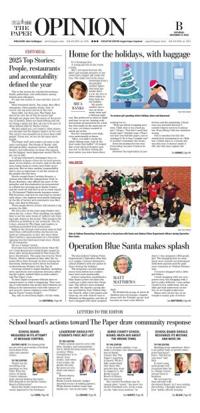



It’s Christmas Eve.
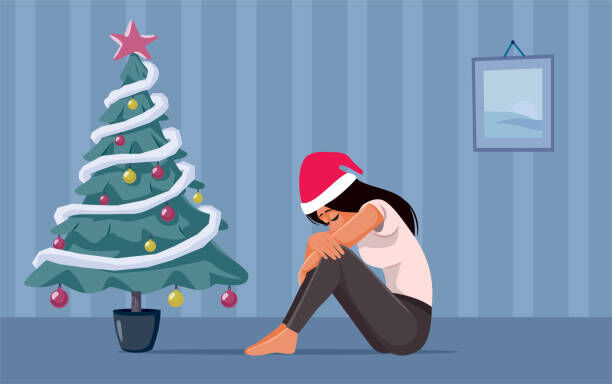
A young girl sits in her room crying.
She’s not upset because she didn’t get enough presents or her sister had a bigger gift under the tree. The child cries from stress, stemming from a dissatisfied mother figure who kept her awake until 3 a.m. for two or three nights to help clean for the holiday.
My grandmother was a stay-at-home mom/nana and a lifelong night owl. She preferred to clean at night and kept us up too, helping with last-minute preparations for a holiday that lands on the same day every year, yet always seemed to sneak up on her.
But her standards were high, even unattainable at times.
“Mica, you didn’t sweep the whole dining room, look at the dust under that buffet!” (It looked like a teal chest of drawers and was low to the floor, hiding the dust unless you were down there looking for it.)
“Help me finish wrapping presents. Child, that is too much paper!” (Oops.) “You don’t need that much tape!” (Double oops.) That’s not how you fold the paper, you’re wasting it! Do it how I taught you!” (I couldn’t remember the steps.)
Even decorating the tree was frustrating, because it had to be flawless.
Between the expectation of perfection and the nitpicking, Christmas was stressful because I couldn’t figure out how to please her. Everything I did was somehow wrong.
Not to mention the fact she would start screaming at us. (Sidebar: I think there is a reason she was this way. It doesn’t make it OK, but that may explain the behavior, and it compels me to give her grace.)
That’s how I remember quite a few Christmases growing up. Eventually I accepted that I was going to end up crying every Christmas Eve, the day we always chose to celebrate, and the mood would only lighten after guests arrived … mostly.
The cherry on top is actually the fact someone or another always found a way to cause a scene. What a holly, jolly Christmas indeed.
Those early memories make the holiday complicated, even now that I’m grown, married, and living two states away.
It starts around Thanksgiving. My irritability ramps up, and I become more anxious and can’t pinpoint why. By Christmas, there’s a pervasive sadness in the mix.
I am not there anymore, nor am I a child. But something in me remembers the crying, the feelings of inadequacy, and how draining it all was.
Don’t get me wrong. I love my grandparents dearly. They stepped up and raised me from infancy when one parent left and the other developed substance abuse disorder.
I needed them, and they were there. But my grandmother was — still is — an unpredictable individual.
I decided to visit them for a holiday get-together this weekend anyway. This is the first Christmas I’ve had with them in four years, and the decision baffled my loved ones here in North Carolina, but it felt important.
My grandparents are getting older, and I won’t have them forever. And anyway, it’s just a couple of hours at their house. The rest of my time will be spent gleefully spoiling my nearly 3-year-old nephew while I stay with my sister and her husband.
As you read this, odds are I’ll be enduring/celebrating Christmas in Georgia, questioning my life choices but hopefully happy to be there. I can’t tell you yet how it’s going, but I can tell you this: Christmas is complicated.
One thing that has helped, though, is creating family traditions with my supportive and understanding spouse.
Our traditions are simple. Most nights, we have a simmer pot that fills the kitchen with the scent of cinnamon, cloves, and nutmeg. We have Christmas coffee mugs we only bring out in December. I’ve started drinking hot chocolate with a candy cane, which I never tried as a child and only do around the holiday now.
And our Christmas tree? It’s beautifully imperfect. There’s no pressure to make it look like something out of a magazine, so decorating it is stress-free, except for the cats.
Making our own traditions has been healing. The past still weighs me down, yes, but this is a start, and I think in time I’ll have a scar rather than an open wound.
Mica Banks is the County Government reporter for The Paper. She can be reached at 828-445-8595 or mica@thepaper.media.