Tucked away in the innards of Western Piedmont Community College, the energetic Jonathan Crumpler bounces from project to project, guiding students through the modern age of technology.
For Crumpler, his new role as assistant dean of business and technology means moving students closer to real-world skills through real-world application.
“We really want to create an open space for creative people with ideas, who could be writers or could be storytellers who just don’t have a resource to do something like this,” Crumpler said when discussing a podcast and audiobook studio his students operate and rent out for $100 a day in one of the lower buildings in the college.
![]()
An audio mixer used by students in the audiobook and podcast
studio.
JACOB CHRISTOPHER / THE PAPER
“We want to promote that we are a resource,” he said. “I’ve always thought that what we do here with our production studios, that we’re a resource for the community.”
Crumpler, the former coordinator of digital effects and animation technology, began his career at WPCC as an adjunct professor in 2001.
Following a master’s degree in studio photography from the University of Arizona, the college brought him on to teach computer-based media courses due to his computer experience with installation artwork using video and sound.
He still teaches a digital photography course amidst the balancing act of roles he plays in the institution.
“That’s one of my passions,” he said. “In the class, I definitely do my own photography as a way to share with students. If I assign them an art assignment, I’ll generally do it myself. … I tell students all the time, when I retire, I’m going to get back out my chemical vats, if I can.”
Just as he joins in on projects with his students in photography, he leads the team in the development of an extended reality interface where end-users can see their surroundings with 3-D visual overlay utilized through equipment like Apple Vision Pro headsets.
According to Project Manager Charles Barnes, The Industrial Commons received a National Science Foundation (NSF) grant in February 2024. As a sub-awardee of the grant, WPCC received $800,000, leading to the creation of the virtual training program for local textile partners that utilizes the Apple technology.
Crumpler became team leader of the project in January of 2025.
“This NSF grant targets training and tools and resources to engage new hires [and] existing employees in new functions of training,” Crumpler said. “We are really looking at the next generation of workers that are going to be coming into these plants that have been here for ages. Textile industry has been here for a very long time, and we’re getting a kind of rebirth of the textile industry, but many of those trainings on looms and textiles are still pretty traditional.”
![]()
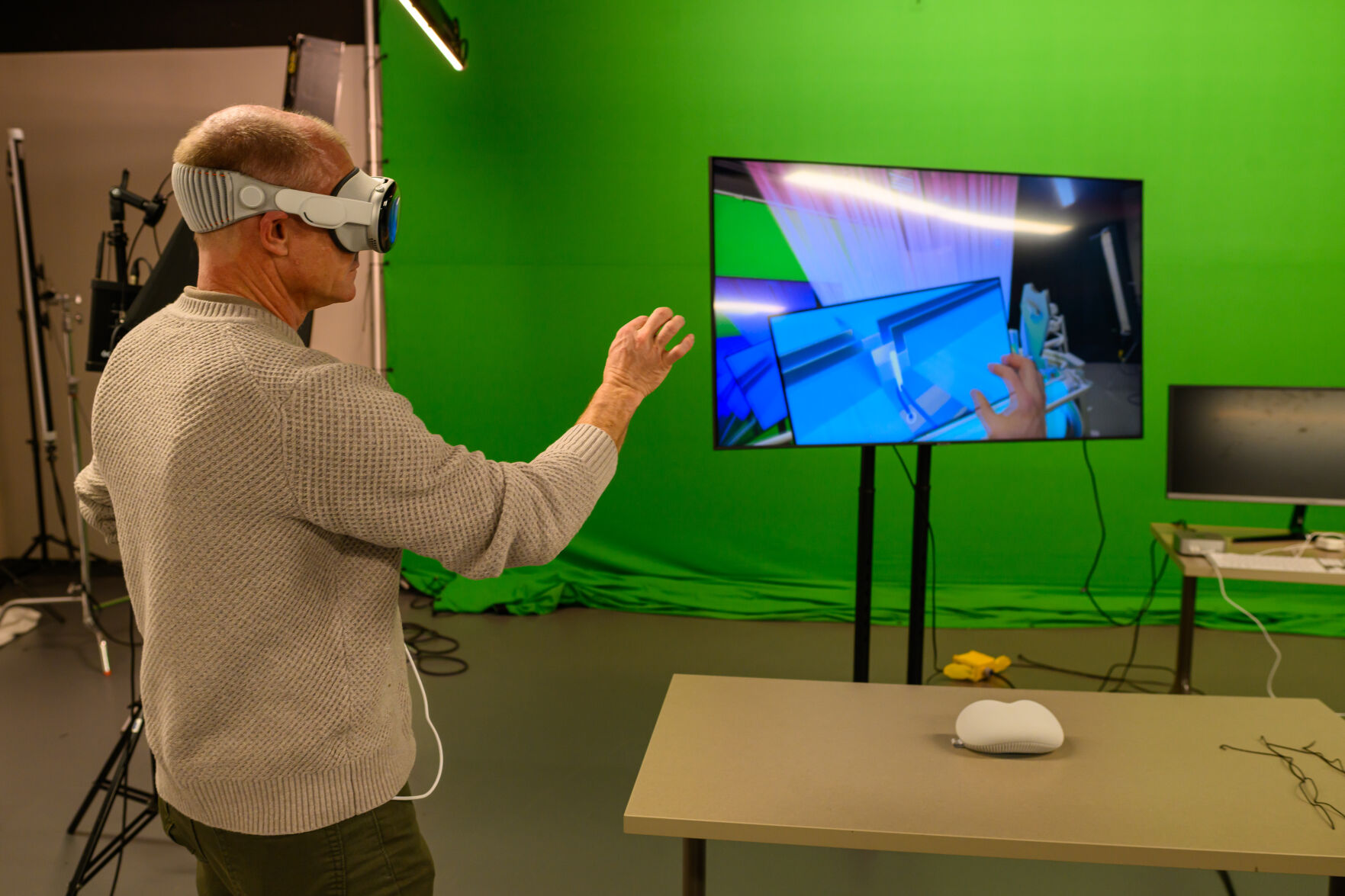
Crumpler presents the extended reality interface.
JACOB CHRISTOPHER / THE PAPER
To demonstrate the headsets in action, Crumpler donned an Apple Vision Pro and mirrored his vision on a nearby screen. Using a 3-D overlay slightly smaller than a 1:1 model, users can follow a series of steps examining possible errors in operating a textile loom.
“Because of all this emergence, I just feel like we’re embarking on this new kind of way in which people interact with their environments,” Crumpler said. “The whole idea behind doing any of this work is that it merges into some other uses.”
“We are an educational facility,” he said. “You betcha, we’re going to take whatever it is we’re doing for the textile industry here — we’re gleaning all this knowledge, getting new toolsets — we want to implement that for other areas.”
He demonstrated the functions of the program his team created by going through one of the learning modules.
In the example, the 3-D model presented an issue on the underside of the virtual equipment. The program guides learners to the specific error, walks them through how to check the space, and shows a virtual demonstration of the fix through simulated rethreading, knotting, and so on.
Other facets of the simulation offer walk-through videos on how to repair a machine in the field. If a user has an issue with their loom, they can pop on the headset and view the real-world equipment while a tutorial leads them through the repair on a small window integrated into their view — like using YouTube to fix a car.
The final pathway a user can take is through the gamification of knot tying.
Using 3-D modeled hands and motion tracking technology in the headsets, wearers can test their abilities in tying weaver’s knots, even landing on a leaderboard among their colleagues if they can master the speed of the skill.
A weaver’s knot is a simple knot used in the textile industry to fix broken thread or attach yarn with low impact to the overall stitching.
While being on the precipice of workplace training technology seemed to get Crumpler excited about the capabilities of the programs under his watch, he pointed to his students as the real benefactors.
“I really want to specify that we do this because we want it to be available for our students,” Crumpler said. “In doing all of this work, the benefit for the college being a part of this is that we can expose students and train students on how to make this, so that they can sustain this. … This opens up a new form of interactive training for [Associate of Applied Science] students.”