
Burke County navigates a budget with $3.9 million more in expenses in 2026-27

Source: Burke County
With expenses about $3.9 million higher this year, Burke County staff proposed a $120.7 million budget for fiscal year 2026-27 that leaves the property tax rate unchanged, but raises fees for water, sewer, and trash services by several dollars.
“Strategic adjustments” were made to address the county’s growing expenses, County Manager Brian Epley wrote in the 2026-27 budget message, including the continuation of in-house EMS billing, in-sourced trash transportation, and reducing part-time and overtime labor expenses.
Higher health insurance premiums, state-mandated raises in pension and retirement contributions, and changes related to the Big Beautiful Bill are just a few things driving expenses up. Epley called them “financial disruptions,” and said they are not unique to Burke County.
In the budget message, Epley said many of the cost increases — including those three factors — are outside Burke’s control.
“We don’t want to be the plane that took off, hit a patch of turbulence, and turned around to land,” Epley said. “We want to fly through the turbulence.”
Epley presented the budget proposal at the commissioners’ May 18 meeting, which recommends maintaining the 55.5 cents per $100 valuation property tax rate in 2026-27.
The next step is a public hearing scheduled for June 15.
Residents will have an opportunity to share their thoughts on the budget proposal during the public hearing. When the hearing closes, commissioners will vote on whether to pass the budget in its current form.
IMPACT ON RESIDENTS
Basic monthly fees for water and sewer services will remain flat at $30, but consumption fees will be higher. Water will go from $6.50 per 1,000 gallons to $7.25.
The municipal sewer consumption rate would increase from $5 per 1,000 gallons to $7.25. For those outside municipalities, the sewer consumption fee would go from $6.50 per 1,000 gallons to $7.25.
For years, the county’s water/sewer and trash funds had operated at a loss. Commissioners made it a goal to turn those metrics around. Those funds have maintained positive balances since 2024.
Burke County residents pay a $92 fee for trash services each year. The charge is part of residents’ property tax bills.
That fee is going up to $97.
There will also be a base fee of $5 for residents who use the landfill, Epley said. This is a starting point, and heavy loads of trash will cost more based on weight.
The base fee appeared in the budget as a new “miscellaneous disposal fee.”
CHALLENGES
Health insurance premiums are on the rise because of market trends and medical inflation, but also due to the number of high-cost claimants.
About 36% of all claims are large claimants, according to county data. The data showed that, in 2025-26, the county paid $2.6 million in large claimants alone.
Overall healthcare claims increased by 20% last year despite higher employee participation in biometric screening to identify health risks early on. Because of this, Epley wrote in the 2026-27 budget message that the county will transition from generalized wellness programming to more precise, data-informed health interventions.
A $45 employee contribution to PPO coverage will also be introduced in 2026-27 to curb some of the county’s employee wellness expenses. This represents 5% of PPO premium costs.
HSA plans remain 100% funded by the county.
The state has also mandated higher employer contributions to employee pension and retirement funds. Epley said that, combined, this will cost the county about $800,000 more per year.
At the federal level, H.R. 1 — commonly called the Big Beautiful Bill — will shift all financial responsibility for food and nutrition services to the county starting in October. The lack of federal funding will cost Burke $550,000 more each year.
The county addressed these challenges by continuing the effort to cut expenses and building on the efforts of previous years, such as shifting EMS billing to an in-house operation, according to budget documents.
The county also focused on reworking its processes to eliminate waste and manage its finances and other resources responsibly.
REVENUE
One of the county’s ongoing goals is to diversify its revenue streams — in other words, create more sources of revenue rather than depending on taxes.
Next year’s revenue projection shows property taxes accounting for 52.4% of Burke County’s revenue. Those taxes are expected to bring in about $63 million.
In the 2025-26 fiscal year, Burke’s property taxes totaled about $61.5 million.
The second biggest revenue stream is other taxes such as sales taxes. The other taxes category projects about $21.3 million — an increase over 2025-26’s $20.4 million.
Intergovernmental revenues from state and federal funding sources is the third largest source of funds projected to reach $19.5 million next year. That is slightly less than 2025-26’s $19.8 million.
EXPENSES
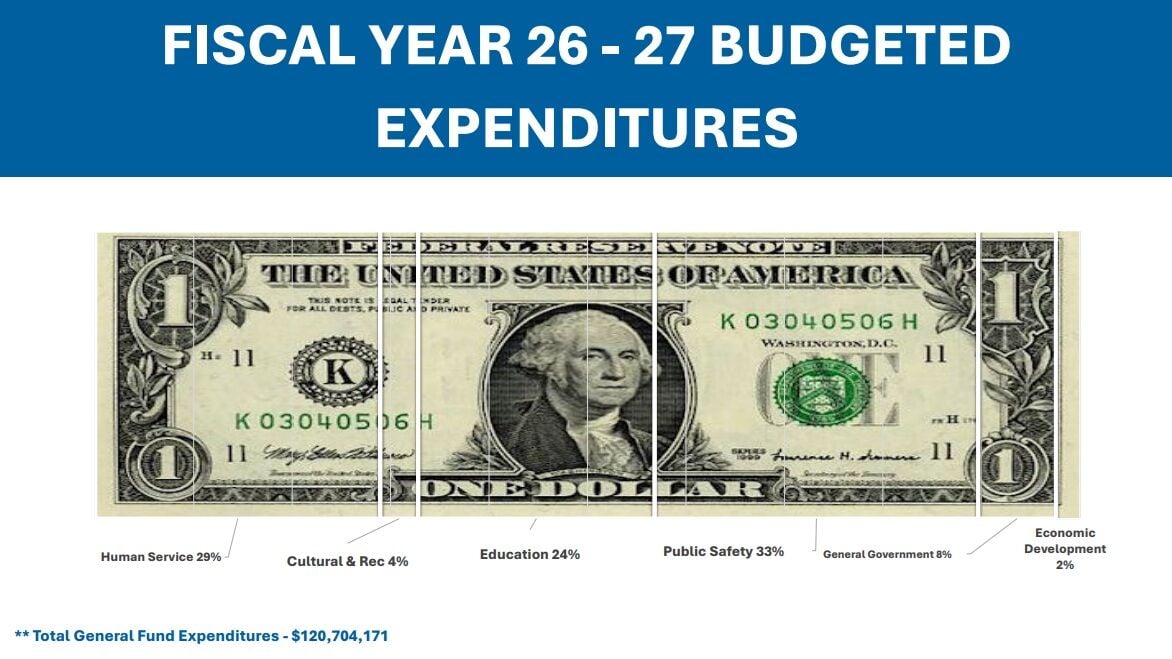
Public safety is the county’s highest expense category at $37.4 million. It accounts for 33% of Burke’s expenses.
Human service is the second highest, coming in at $30.9 million, or 29% of expenses.
The third highest is education. It is 24% of the county’s expenses at $24.7 million.