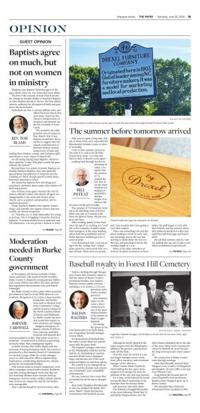



Poteat
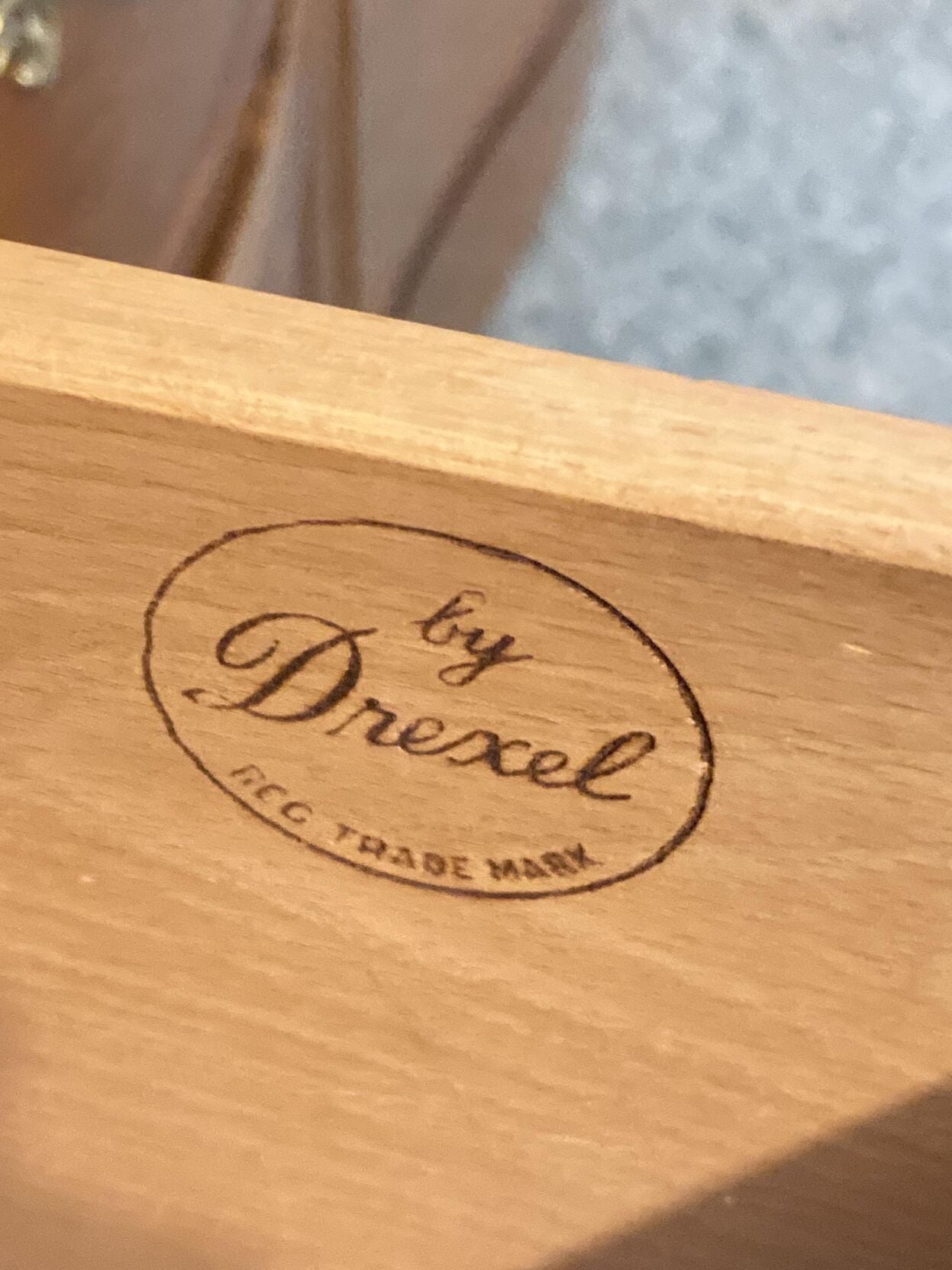
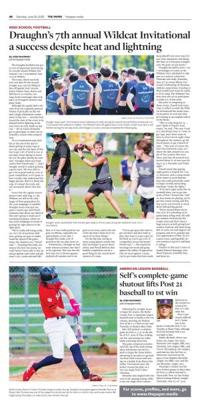
Drexel’s trademark logo was stamped into drawers.

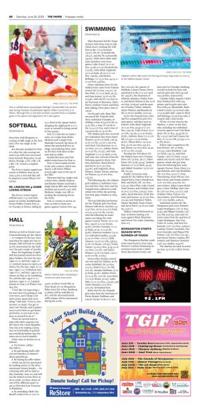
This state historic marker was put up last year to mark the spot where the original Drexel Furniture Plant stood.
Fifty years is quite a long time, and yet, in many ways, 1976, especially the Bicentennial Summer, seems as close as yesterday.
I was 20 that summer, poised on the cusp of 21, and as an old John Denver lyric reads, “20’s fast, but hard as nails. It doesn’t come again.”
Looking back through the five intervening decades, I recognize that the summer of ’76 marked the last time in my life when freedom outweighed responsibility and the weight of tomorrow did not press on the joys of today.
The summer of ’76 found me working in the finishing room of Drexel Plant One, just an 8-minute walk from my parents’ home. My pay was $2.50 per hour.
After working mainly in fast food since the age of 16, working at a “real” job, in the company of adults rather than teenagers, in the same building where both my grandfather and my father had once worked, gave me a sense of pride.
I was determined that I was not going to be the “college boy,” looked down upon for a poor work ethic or a bad attitude. These were my people, and I was resolute that I was going to earn their respect.
There was something rich and fine about walking to work on early summer mornings, just as the sun was starting to climb above the trees in the east, and punching in before the workday began at 7 a.m.
Many of my older coworkers arrived at the plant as much as an hour before the shift began to visit with their friends, and the canteen where they gathered smelled of coffee and cigarettes and fried eggs and honest work.
My job that summer, and no, I am not making this up, was to take a tool which resembled a looped bicycle chain with a handle on it and beat the crap out of the furniture pieces that rolled by me on the assembly line.
In the furniture business, they call that antiquing.
I called it a way to get into great physical shape, as I leapt from one side of the line to the other, flailing away with my bike chain for eight hours a day.
One morning, a straw boss decided that I could fill in for a sick employee who drove the forklift which moved finished, boxed furniture from one spot to another.
I warned him and anyone else who might listen (no one did) that I had the mechanical aptitude of a flea and had no idea how to drive that looming monster that was the forklift.
The first box I attempted to lift crashed off the forklift to one side. The second box crashed to the other side. I was cautiously maneuvering to pick up box number three when the straw boss decided he had seen quite enough.
Back to antiquing I went.
Spring had come early that year and the summer was especially hot. Don’t know exactly what the temperature climbed to in that old brick building with few windows and no air conditioning. But it was hot.
For a few weeks that summer I worked next to the bleaching booth. I wore neither mask nor protective clothing. My hair turned blonde as did my scraggly beard. Probably the inside of my lungs did also.
As noted, the morning shift began at 7. Lunch came at high noon. As I was trying to save every nickel that summer to help pay for my senior year at Chapel Hill, I carried my lunch to work each day.
Most folks carried lunch outside and ate under the shade of trees that had blessedly not been cut down when the factory was built. I listened a lot and said very little as I ate, but I loved the dirty jokes, the tales of local characters, and the raucous laughter that followed.
It was under those trees at lunch that I also learned how some of my coworkers got through the afternoon.
These folks would open their Thermos bottle, pour a liquid into the cup which functioned as a lid, blow on it as if it were too hot to drink, and then sip on it slowly, as if enjoying a fine cup of Joe.
Couple of problems with the charade. No steam rose from the supposedly hot beverage. And, anyone with a functioning nose within five feet of the offender would know it was cheap liquor that was being sipped, not coffee.
Did I ever squeal on anyone? Hell to the no!
Lunch lasted for 30 minutes. Work resumed at 12:30 p.m. With five hours of the day already gone, afternoons went by quickly.
The parking lot at 3:30 was a sight to behold. The same folks who came to work an hour early to have time to visit their friends now fled the scene like they were being chased by Godzilla.
Only astute driving and the grace of God kept that parking lot from turning into a giant demolition derby as hundreds of cars jostled to get out the one gate that opened onto Main Street and head for home.
I was mighty glad I could walk.
My career as a skilled antiquer in the furniture industry lasted exactly three months, from mid-May to mid-August. Ten months later, my senior year behind me, I was working as a general assignment reporter at a small newspaper in Georgia.
Looking back now, I realize that summer was never really about furniture. It was about standing on the narrow bridge between youth and adulthood, earning a paycheck, learning from people whose lives were very different from my own, and discovering the dignity that comes with hard and honest work.
Drexel Plant One is long gone. The site where it sat in Drexel is now cleared and waiting for a new industry.
Most of the men and women who shared those lunch breaks beneath the trees have passed on.
But on certain hot June mornings, 50 years later, I can still hear the punch clock, smell the coffee and the cigarettes, and see a skinny 20-year-old with a bicycle chain in his hand, not yet knowing how quickly the summer of 1976 would become a deep and lasting memory.