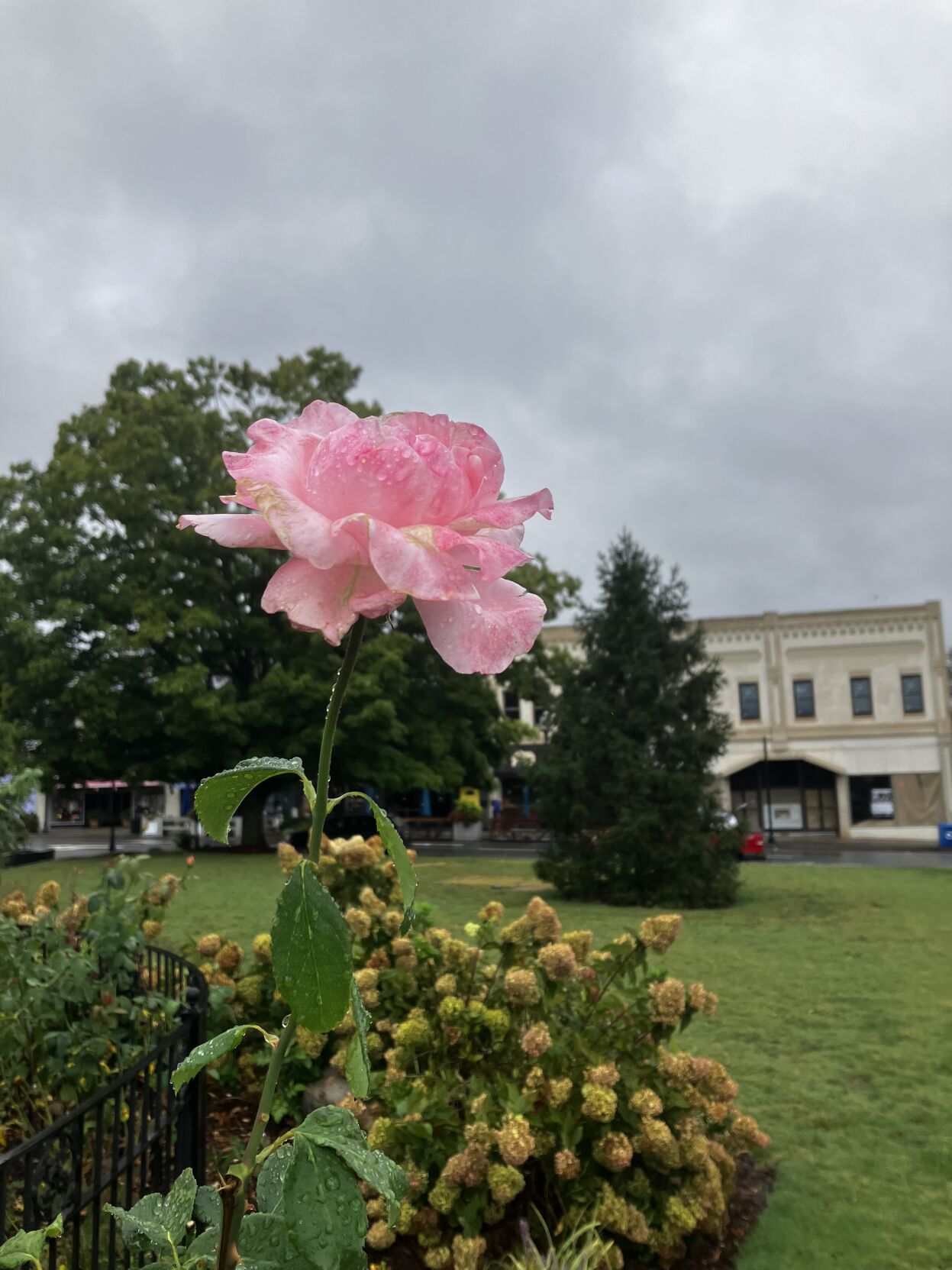
The blossoms have mostly faded now, as yet another summer gives way to the approaching autumn, but a few blooms of red and pink still reach up toward a gray September sky.
The small rose garden stands just off the east entrance to the Historic Morganton Courthouse in downtown Morganton, placed there in memory of the late Robert B. “Bob” Byrd by fellow members of his law firm.
Each time I walk by the garden, I’m reminded of the legendary attorney who helped mentor me during my early years in the newspaper game and of his love for growing, and sharing, roses with all he knew.
From my perch in the editor’s office at The News Herald, I would see Bob stride through the front door, his voice booming, his eyes sparkling, and a beautiful rose in each hand, roses that he had cut in his garden just moments before.
Bob would shower with compliments whichever workers were staffing the front desk when he arrived and then present each of them with a rose. What a wonderful way to start the day.
Bob didn’t make his living growing roses, of course. He made his living in the practice of law. And no one was better at that practice than he.
Admission was never charged when Bob argued a case before a jury. But, if it had been, any lover of drama, humor, and the human condition would gladly have paid the fee.
Bob, who died unexpectedly in the early winter of 2002, was a joy to observe in just about any circumstance. But he was at his best, his absolute best, in a courtroom in front of a jury.
Being successful in any number of public professions requires the ability to connect with others, be it teachers to students, ministers to parishioners, or politicians to voters.
No one could connect with a jury quite the way Bob could. He regaled them with a wealth of stories about Burke County and its people. He put them at ease with his humor and grace. He dazzled them with his knowledge of the law and its complexities. And, most importantly, he swayed them with the power of his conviction that his client was in the right.
A HUMBLE HERITAGE
Born on a farm between Drexel and Morganton during the dark years of the Great Depression, Bob had no silver spoon and no high family connections to make easy his path toward a law career.
What he did have, however, was an astoundingly quick mind, a recognition that hard work would be his only sure path to success, and a unique appreciation for the place and for the people from which he came.
College options were limited for poor boys from Burke County in the 1940s, and Byrd headed to Berea College in Kentucky, a school that allowed its students to work their way to a bachelor’s degree.
Law school followed at the University of North Carolina, as did decisions about his future. Immediately after graduation and passing the state bar exam, Bob was offered a position at the Institute of Government in Chapel Hill.
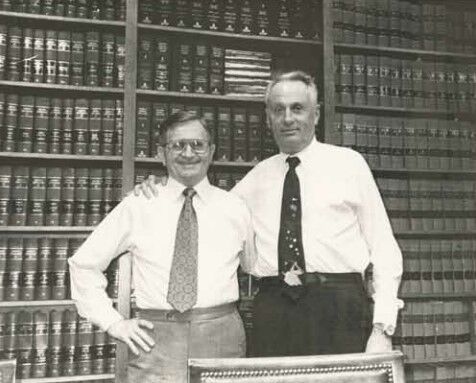
Had he accepted that post, Bob might have gone on to craft a career in the administrative councils of state government. Instead, he chose to come home to Burke County and join the law firm already established by his older brother and mentor, Joe Byrd.
That partnership grew over the years to become the most prestigious law firm in Burke County’s history, and the two brothers developed a reputation as a nearly unbeatable legal team.
As an ambitious young lawyer who was also a superb public speaker, Bob seemed a natural to seek political office. Yet the proud Democrat’s name never appeared on a ballot.
“I closed that door very early in my career,” he told me once, “and once I closed it, I never opened it again.”
A FOCUS ON COMMUNITY
Rather than seek elective office, Bob decided to focus his amazing energies and talents on his law practice, his family, his church, and on bettering the community where he chose to build his life.
No reflection on Bob’s life would be complete without the repeating of at least one of his stories. While they each contained an element of truth, Bob would adapt these tales to fit his audience and its members
This one was used often, and no matter how many times it had been heard, it still brought on gales of laughter.
“The Rev. W. Flemon McIntosh was speaking at a little country church one night in support of a school board bond referendum. It was a warm spring night and Rev. Mac was really getting cranked up, so he shouted, ‘Open the doors and open ’em wide and let my words be heard outside.’
“About that time, a brick came sailing through the back door and whizzed by Rev. Mac’s head, just missing by inches. Well, he never missed a beat. He bellowed, ‘Close the doors and close ’em quick. Some son of a gun has thrown a brick.’”
Nearly a quarter of a century has passed since Bob died suddenly, unexpectedly, and much too soon. Like many other Burke County folks, I still miss Bob’s stories. His humor was a reflection of a simpler, gentler time and of his own caring spirit.
More importantly, I miss Bob’s influence in the courtroom and in the boardroom. There was no stronger advocate for justice, for progress, or for the interests of working people than he.
But whenever I walk by that rose garden, I think of Bob, and I smile. He was a wonderful and remarkable man — a one-of-a-kind Burke County legend.