

A solitary journey measured in footsteps and winter light
-
Bill Poteat
Editor Emeritus


Bill Poteat

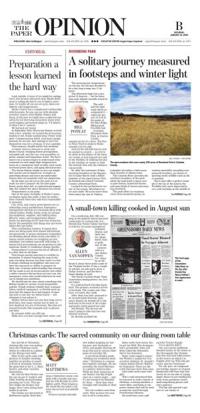
The open meadows that cover nearly 200 acres of Riverbend Park in Catawba County.

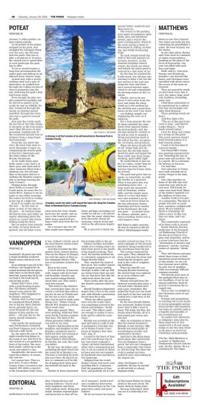
A chimney is all that remains of an old homestead in Riverbend Park in Catawba County.

A kayaker carries his water craft toward the input site along the Catawba River at Riverbend Park in Catawba County.
The morning low temperature on the day the old man decided to do a day-long tromp was 17 degrees.
The afternoon high was a projected 41 degrees — but he knew that such limited warmth would be hours in arriving.
The cold — and the light wind which accompanied it — ruled out any sort of trek in the peaks of the Blue Ridge. Hiking good. Frostbite bad.
Crowders Mountain State Park, in Gaston County, seemed too far of a drive. The Fonta Flora Trail in western Burke seemed a bit too dull.
And yet the old fella had an itch he needed to scratch — an itch to be alone in the silence of the January woods, to lose himself not only in the rhythms of walking but also in the rhythms of nature, to find the serenity that only the outdoors can provide.
So, after his customary Friday morning breakfast at the Morganton Cracker Barrel with a fellow member of the Aged Geezer Club, he headed east toward Catawba County’s Riverbend Park.
Located in the northeastern corner of the county, Riverbend covers just under 700 acres (more than three times the size of Valdese Lakeside) and offers a little more than 20 miles of hiking trails.
The Catawba River provides the northern boundary of the park while the land itself is given over to pine forests, hardwood forests, and open fields of brown and swaying grassland.
The park offers no stunning views from mountain peaks, no rushing waterfalls cascading over primeval boulders, no chance of spotting exotic wildlife such as elk or panther.
But it does offer a perfect example of the lay of the land in the Foothills and, more importantly, on a cold weekday in the middle of January, it offers perfect, uninterrupted solitude.
As he pulled on his jacket, snapped on his pack, and snuggled his toboggan down over his ears, the old man had two goals: One was to hike a minimum of 10 miles; the second was to spend time in each landscape the park has to offer.
To do so would require a long loop encompassing the entire park and adding an additional three shorter loops.
Armed only with a sturdy walking stick and a pair of binoculars, he walked first through the rolling terrain of what is primarily pine forests, following the park’s Red and Green trails.
Even though the pine needles quieted his footfalls and he moved as quietly as he could, he saw no wildlife. No deer wandered through the woods, no bobcats moved stealthily through the trees, not even a squirrel crossed his path.
Just past the 3-mile mark, the terrain of the hike changes abruptly as the trail enters more than 200 acres of open grassland, marked only by the occasional ancient tree or chimney from a long-forgotten homestead.
From the rise above the river, the land rolls away toward Alexander County, encompassing the nearby peak of Barrett’s Mountain and the other ridges of the Brushy Mountains.
As he walks these open fields under a sky that is at times gray and stark and at other moments filled with a dazzling sun, the old man likes to fantasize that he is walking the English countryside or perhaps touring the Lake Country.
Sloping down through these fields at around the 6-mile mark, he nears the Catawba River, hoping to see an eagle or two either scouting the waters for food or resting in the top of a high tree.
Even if no eagles are about this day — he has seen as many as four at one time in the past — he remains hopeful that he may spot either an osprey skimming above the waters or a great blue heron fishing along the shore.
But no matter how intently he looks, no large birds are spotted, and the hiker turns away from the river, climbs back into the woods, and enjoys a late lunch at a picnic table atop a small hill perhaps a half mile from the Catawba.
On a warmer day the old fella might have lingered there, perhaps stretching out under an oak for a 20-minute nap. But the wind, which has been blessedly absent all morning, returns brisk and chill as the afternoon lengthens.
He is spurred to finish his peanut butter sandwich and then move on.
The return to the parking area again encompasses open fields, pine and hardwood forests, and a stop by the park’s fishing pond, which in the early spring is home to thousands of yelling, screaming, and wildly fornicating frogs.
No such sounds break the chill of this mid-January afternoon, however. As the shadows lengthen toward sunset, the woods are silent and indeed the entire pond is covered in a thin layer of ice.
By the time he reached the 9-mile mark, the old man was starting to labor a bit, but the last section of the trail was along the river and there were several benches upon which to sit and contemplate the flowing waters of the Catawba.
Finally, just as he was about to turn away from the river and make the steep climb up to the parking lot, the old fella saw a great blue heron on the river’s far shore — not fishing, simply contemplating the river as it rolled by.
For a long moment the two of them regarded the same water from opposite banks — the bird perfectly still, the old man perfectly content to be still as well. It seemed a fitting punctuation mark at the end of the day: no spectacle, no drama, just presence.
When the heron finally lifted off, wings wide and unhurried, the old fella shouldered his pack and began the final climb, legs tired, lungs working, spirit oddly light.
He would finish at just under 10.5 miles, colder than he had been at noon, but far warmer than he’d been when he arrived.
The park had given him no peaks, no waterfalls, no wildlife worthy of a postcard. What it had given him was something more rare — a long, quiet day measured only in footsteps, winter light, and the steady movement of a river that didn’t care who watched it go by.
And as he drove home in the late afternoon, heater humming and boots muddy in the floorboard, the itch was gone — scratched clean by silence, solitude, and a heron standing watch over a cold January river.
Bill Poteat is editor emeritus. He may be reached at 828-445-8595 or bill@thepaper.media.