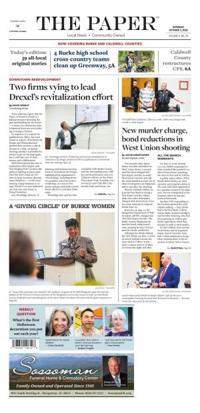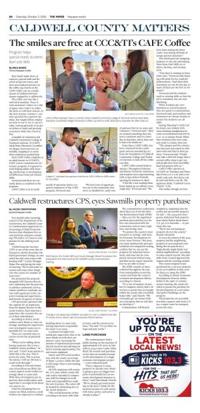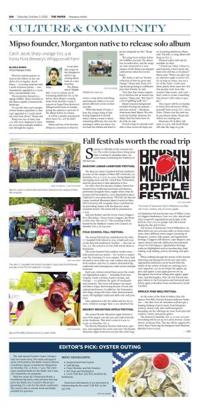

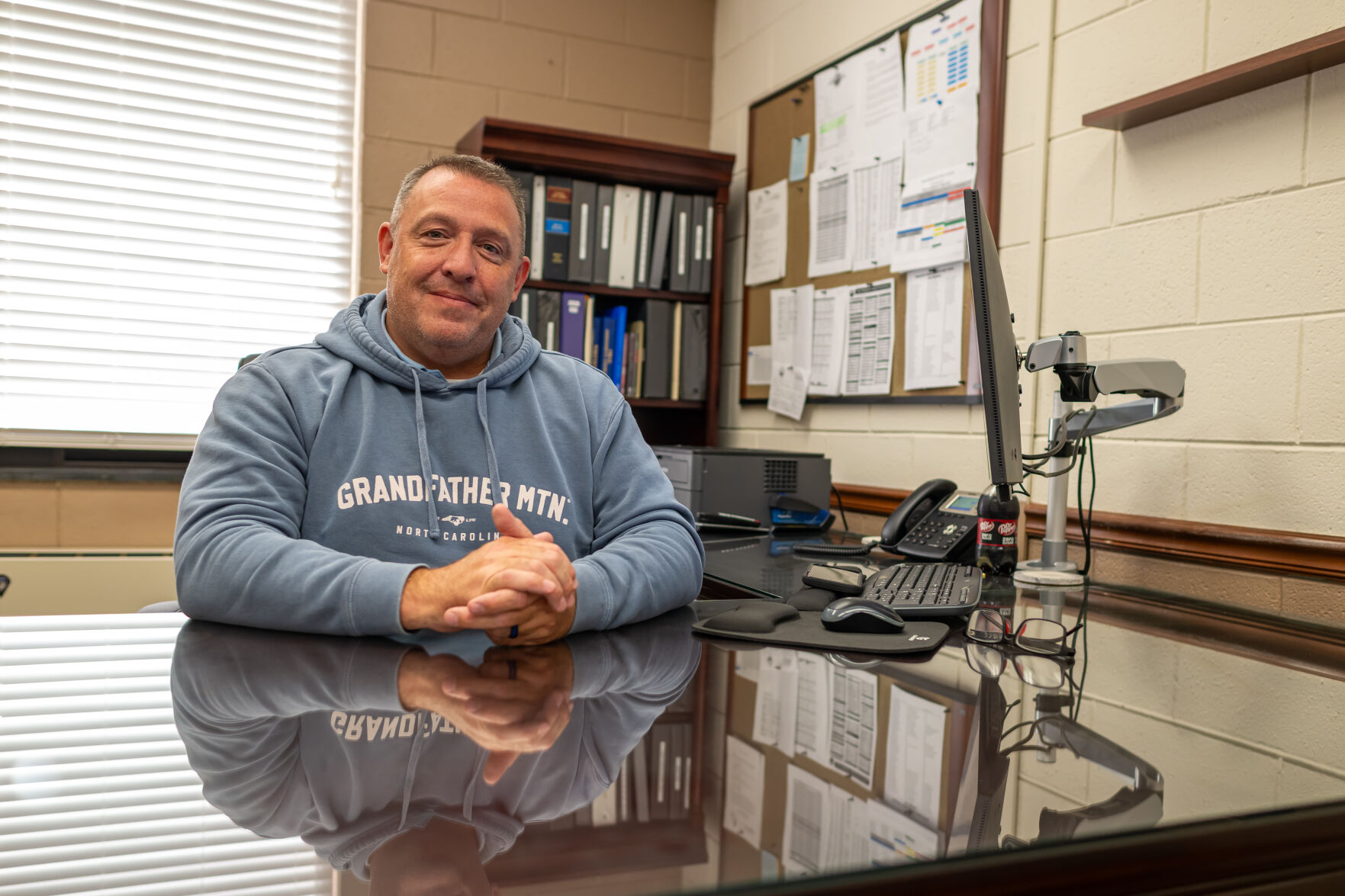
The retiring captain sits comfortably at an empty desk, enjoying his final working day. Brown at desk
Brown at desk
The retiring captain sits comfortably at an empty desk, enjoying his final working day. Brown at desk
Brown at desk
The retiring captain sits comfortably at an empty desk, enjoying his final working day. Brown at desk
Brown at desk
The retiring captain sits comfortably at an empty desk, enjoying his final working day. Brown at desk
Brown at desk
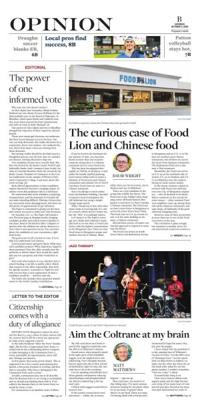
Do Food Lion grocery stores and Chinese restaurants go hand-in-hand?
If you’ve lived in the Southeast for any amount of time, you may have heard on more than one occasion someone saying there is a Chinese restaurant next to every Food Lion.
This has been investigated thoroughly on TikTok, of all places. A user under the handle @jeffrey.jiacheng used various online tools to create a database of Food Lions and Chinese restaurants and claimed 72% of North Carolina’s Food Lions are next to a Chinese restaurant.
Since I’m allergic to most online tools and database-building, I decided to launch a local investigation the old-fashioned way using a simple Google maps search.
What I found was in line with other closer looks at local legends: It’s a bit of a stretch, which doesn’t bother me, but the “why” is troublingly elusive.
Let’s keep it to The Paper’s coverage area. Burke and Caldwell County play host to no less than 10 Food Lion stores, with the highest concentration in the Morganton area. There are four Food Lions in Morganton proper and another close by in Valdese. Meanwhile, there are two in Lenoir, one in Hudson and one in Hildebran.
There are a few standouts in the group that solidify the theory. The Food Lion in the Fiddler’s Run shopping center off Enola Road in Morganton is next door to Chen’s Garden, a Chinese restaurant. The Food Lion on East Union Street in Morganton is across the street from Great China. The Food Lion on U.S. 64 in west Lenoir is in the same building as Jasmine, a Chinese restaurant.
Beyond these stores, a broader continental approach is required to maintain the theory.
The Food Lion stores on North Green Street and Burkemont Avenue in Morganton and on U.S. 70 in Valdese are nowhere near Chinese restaurants, but all three are across the street from Japanese restaurants. The Burkemont Food Lion is also near a Thai restaurant.
Meanwhile, the Food Lion stores on U.S. 64 on the northeast side of Lenoir; U.S. 321 in Hudson; and U.S. 70 in Hildebran were the outliers, having no Asian cuisine nearby.
In the course of about a dozen interviews with Food Lion staff and even two City of Morganton employees — who all declined to be identified or comment on the record, for some reason — other common Food Lion neighbors came up, among them nail salons, Mexican restaurants, and vape shops, all hallmarks of the great American shopping strip.
However, none of these are present at more than one or two of the Food Lion stores in the area.
The correlation is plain enough, but causation is another story: No one interviewed could even venture a guess at why there is an apparent connection between Food Lion stores and Asian food.
Calls to three of the Chinese restaurants in question offered even less information, with staff members at two hanging up shortly after answering and one saying the location of their restaurant was chosen entirely at random.
Asked for comment, Food Lion’s corporate office responded with a boilerplate statement containing about as much flavor as a crab rangoon:
“Our store locations are chosen based on a variety of factors, including the needs of the towns and cities we serve. In shopping centers where we typically lease our stores, the landlord ultimately determines the mix of tenants. We believe in being a good neighbor to our customers and fellow business owners.”
While offering little in the way of explanation, the statement may give a whisper of a clue.
Food Lion’s mission statement is to “deliver an easy, fresh and affordable shopping experience” in the communities it serves. Strip malls near dense population centers provide easy access for those seeking affordable groceries.
Meanwhile, a small, family-owned restaurant with a focus on affordable food may find such a location attractive for high traffic and low rent.
While there may not be a grand conspiracy — or even a clear reason — behind the connection, the legend remains, accomplishing what many do: It acts as a mirror to the community, clarifying our view of what means the most to us.
In this case, it’s cheap food.
Could the jazz sounds of Joel Frahm help preserve memory?
My wife read about new brain research that suggests sound may ease the effects of Alzheimer’s disease.
Sound waves, when properly aimed at the right parts of the befuddled noggin, coax the tangled wires into unknotting. One’s thoughts become buttery again and slip to their intended destination right on time, like Amtrak tries to do in the northeast.
I’m not speaking scientifically here, about gamma entrainment reducing amyloid plaque and phosphorylated tau. Buttery unknotting is the layman’s gist.
Clinical trials suggest sound deters memory loss.
If the curative sound waves were jazz music — Jobim, the crooners, Segovia — sign me up.
More and more, my memory is slip-sliding away. I’ve spent anxious moments looking for my phone when it’s in my hand, or glasses when they’re on my head. There are times I’m having lunch with a friend, and I momentarily forget his name. Hey, pal, pass the pepper.
I never forget who the president is or the opening lines of Whitman’s “Leaves of Grass,” nor the fifth verse of “Amazing Grace,” nor the speed limit on Main Street in Valdese (20 mph), but the other day when the online bank teller asked for my telephone number, I couldn’t remember. “Give me a clue,” I asked.
If sound helps, bring it on.
I fear 1970s esoteric album rock, angular punk, and the high fructose corn syrup of too many years of commercial pop have fractured my attention span and harmed my sense of rhythm. I can’t dance well and am hard of hearing. (And, look, a squirrel!)
I blame pop radio.
Jazz came later in life for me — a needed respite from an all-fat diet of classic rock and the earnest protest of folksingers.
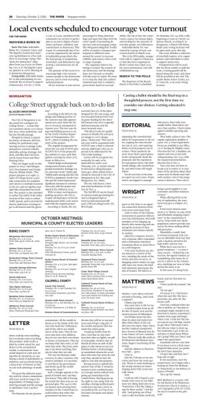
Joel Frahm closes his eyes when he plays and smiles boyishly when others in his trio dive into the charts. Matt Olsen, another inspired saxophonist, has a Doctor of Musical Arts; he is the Doctor of Cool. Guitarist Steve Watson looks like mafia in his black hat and Mexican mustache, fingers ricocheting off the strings.
And the oldsters at Preservation Hall — glory.
I love it.
Aim the Coltrane at my neo cortex and leave the room quietly. Throw in some birdsong or the steady murmur of waters tripping down Flat Creek into Lake Susan.
Yeah.
I told my wife I hoped a cure would come soon, as our elder years are taking dead aim on us. “Sometimes I feel like taking a nap for three weeks,” I tell my wife, “and getting out of bed only to take hot baths, stroll the beach, and eat chocolate ice cream.”
“That’s perfectly normal,” she says.
“At our age.”
Of course it is. I feel better when she says this. She has a doctorate, too, after all. She knows stuff.
I feel less confused when the vibe is mellow. As I become increasingly single-minded in my devotion to inertia, sometimes I awaken from naps and forget where I am. I look into the mirror and see my Old Man. How’d he get there? Microsoft Calendar tells me when to show up, but sometimes I get in the car and have to think hard: Where am I going? Why am I here? And what’s the speed limit?
Somebody told me once that if you know you’re a little more forgetful than usual, you probably don’t have dementia.
I forgot who said that, but I hope she is right.
In the meantime, start the sound waves. Let’s begin with a healing set from Pat Metheny, or Diana Krall, or Jon Batiste, or Arturo O’Farrill.
Turn up the volume.
Matt Matthews is co-pastor with his wife Rachel of the Waldensian Presbyterian Church in Valdese, a cool congregation of the PC (USA). He may be reached at 864-386-9138.
Who says one vote doesn’t matter?
In Glen Alpine last November, Sheila Perkins finished one vote ahead of Lucas Huffman for the final available seat on the Board of Aldermen. In Rhodhiss, which spans Burke and Caldwell counties, Joyce Karn secured the final commissioner seat with 28 votes to Kelly Michaels’ 26.
One person in Glen Alpine and two in Rhodhiss changed the trajectory of their respective elected boards.
Those were municipal elections, not midterms. But their lesson belongs in every election. One vote can help determine who makes decisions for a community. Every vote matters. Our midterm history shows how many voices are missing from those decisions.
But casting a ballot should be the final step in a thoughtful process, not the first time we consider our choices. Getting educated is step one.
Two candidate forums were recently held. The first was hosted by the Burke County NAACP and Indivisible Burke, with Common Cause North Carolina at Catawba Meadows Park; the second by the Burke County Chamber of Commerce in the Leviton Auditorium on the campus of Western Piedmont Community College (read more about this event on Page 3A).
Both offered opportunities to hear candidates explain themselves beyond a campaign slogan. In neither event did candidates talk to a full house.
We understand that work schedules, caregiving, transportation, and the demands of everyday life can make attending difficult. Missing a forum does not necessarily mean disengagement, and there are still plenty of opportunities to get informed.
The Paper is committed to giving you the facts and context you need to make your own decisions.
On Saturday, Oct. 10, The Paper will launch a new Elections page at thepaper.media, bringing candidate profiles and related stories together in one place. Read at the kitchen table. Compare responses after the children are asleep. Return to a story when a new question occurs. You can learn about the candidates at your convenience, right from home.
The goal is not to tell you how to vote. It is to help you understand your choices.
Look beyond names and party labels. What does each candidate propose? What experience supports those promises? Does the office actually have the authority to deliver them? How would the candidate pay for a proposal, and what would have to give?
Start with what matters to you, whether that is school funding, a tax bill, or public safety. Match that concern to the office responsible, then look for specific answers. A promise to “fight for you” tells you less than a clear explanation of what a candidate would do — and how and why.
The ballot also includes three proposed amendments to the North Carolina Constitution: expanding the constitutional photo ID requirement to all voters, capping the state income tax rate at 3.5%, and requiring limits on local property tax increases. Those questions deserve more than a quick glance in the voting booth. Read the proposals and the arguments for and against them. Ask what would change, who would benefit, and what trade-offs might follow.
You do not have to become an expert on every issue. Preparation can happen in manageable pieces. Start with your sample ballot. Read about one race, then another. Check claims against reliable reporting and sources.
Then make a plan to vote. The regular registration deadline is 5 p.m. Oct. 9. Voter registration forms are available in our office, 110 S. Sterling St. Eligible voters who miss the Oct. 9 deadline can register and vote at any early voting location, Oct. 15-31, with the required documentation. Election Day is Nov. 3.
Your vote does not have to break a tie to matter. It is your share of the decision about what comes next for Burke and Caldwell counties. Give it the preparation it deserves. Then cast it.
EDITOR’S NOTE: Morganton resident Joe Avery sent this March 4, 1954, column by Helen Jackson with the comment that he felt the content was appropriate for today and he suggested a reprint.
In the radio broadcast “Meet the Press” Sunday night, Martin Dies, Congressman from Texas, revealed that he has a bill pending before Congress to make belonging to the Communist Party a crime, punishable by imprisonment, and a stiff fine. Perhaps you heard it.
At first glance that seems pretty drastic. This is supposed to be a free country guaranteeing free speech, a free press, freedom to worship, and freedom to assemble. Why then is belonging to the Communist Party such a crime?
Actually, communism does not at all describe what the Russians have or are trying to accomplish, and we should stop labeling them with it. If we called it the Russian Party or the Soviet Party we would be closer to fact.
For communism is an idealistic state of affairs where nobody owns anything, but everybody owns everything they produce. Each works at what he is best suited for, and shares in the accumulated wealth. A communistic state would depend on each man doing what he should do, no one having a shred of individuality or ambition, and everybody having a deep sense of fairness so that no one took advantage of another.
The great big unknown quantity, and the reason communism will never work for long is the impossibility of finding somebody big enough and fair enough to administer such a perfect state.
The Russians do not practice communism. All the wealth in Russia is in the hands of the few men who head the USSR party, and all the others are simply slaves of the state. They do not even raise their own children, they do not own their own farms or homes or businesses. They do not keep what they want, or sell what they wish. They have nothing to say about anything, they just do what they are told.
The way the Russians make converts in other countries, this country included, is to promise to overthrow the government and divide up all the wealth among the “poor.”
Such a thought appeals to the greed of foolish men, and they join forces. They talk of freeing the world, but their eyes are on personal gain. The 24,000 who are known card-carrying Party members in the United State actually believe that when this government has been overthrown they will be in top positions and will get a big part of the wealth and power that has made this nation great.
I would go further than Dr. Dies. I feel that we who were born here take too lightly our gift of citizenship. I believe that we should all swear an oath of allegiance to this nation on our 21st birthday before a Federal judge, as naturalized citizens do, as soldiers who enter the Army do, and only then, should we have the right to vote and own property.
Having sworn to uphold this nation’s way of life, it would be treason to join a political party of a foreign nation without first giving up citizenship in the United States. Having given up the right to vote along with citizenship, a foreign political party could never become a force in our political life, as it has in unfortunate European and Asiatic nations.
Allen VanNoppen is the publisher. He may be reached at 828-445-8595 or allen@thepaper.media.