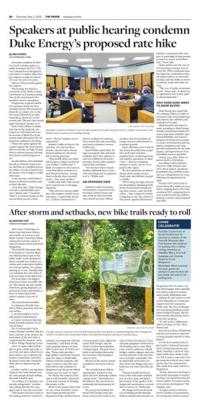



Seventeen residents of Western North Carolina spoke at the public hearing of the N.C. Utilities Commission at the Burke County Courthouse on Tuesday evening.
Seventeen residents of Western North Carolina spoke at a public hearing of the N.C. Utilities Commission in Morganton, convened to consider Duke Energy’s request to raise its rates by 18% over the next two years.
Sixteen of them spoke against the request.
The hearing was held in a courtroom of the Burke County Courthouse on Tuesday evening. Two of the commission’s five members were in attendance.
If approved, a typical residential customer would see their monthly electric bill increase by about $17.22 (about 15%) in the first year, followed by an additional $6.34 (about 3%) in the second year. The new rates would apply starting in January 2027.
Even if the Utilities Commission rejects the proposal, customers are still expected to see an increase of about $14.35 per month under alternative rate adjustments outlined in the filing.
Those who spoke against the request argued that their electric bills are already too high, forcing them to choose between heating their homes and buying groceries.
Brooke Melton, who identified herself as a Marine Corps veteran, said that as a disabled person, her ability to work is limited and she keeps a strict budget to make ends meet.
A rate increase would make it harder to afford necessities such as food, she said.
“How dare they (Duke Energy) ask such a reprehensible question,” Melton said. “You know, ‘There’s a recession going on, but can we bleed you dry a little more?’ They’re vampires on our community.”
Kamicia Griffin of Forest City said that, over the last three months, she has had to choose between paying her electricity bill or buying groceries.
“This month alone, my utility bill was $900, which exceeds my rent of $850,” Griffin said. “I think it is unjust to raise rates in a way that places customers in such financial distress, forcing them to decide what essential needs … they must sacrifice.”
Griffin said utility bills should never exceed rent or mortgage payments.
“This reflects a serious imbalance that requires careful reconsideration. I respectfully ask the N.C. Utilities Commission to protect residents by ensuring rates remain fair and reasonable, and return customers’ money,” Griffin said.
Sarah Wilder called Duke Energy a monopoly. She said most residents don’t have options to seek out a different electricity provider. Several other speakers echoed that sentiment.
“I’m not sure where I’d pull another additional $300 a year, with everything else as expensive as it is,” Wilder said.
AN OPPOSING VIEW
Catawba County Economic Development Corporation Vice President Nathan Huret said that, while he does not think rates should increase without scrutiny, lack of investment in energy sources is detrimental to economic growth.
Huret said that, every week, he sits across the table from companies of all types and sizes — manufacturers, technology firms, and logistics operations to name a few — that are evaluating whether to locate, invest, or expand in this region.
The first questions are almost always about energy sources, Huret said, and whether the grid is reliable.
“We’re living through a period of extraordinary demand growth, driven by advanced manufacturing, data centers, (and) electrification … that a region is actively competing to win. The answer to that power question determines whether a community like ours gets to participate in that growth, or watch as it goes somewhere else,” Huret said.
Huret said he sees the cost of not investing in energy sources every day. When companies pass the region by, communities miss job opportunities, an increased tax base, and the ability to invest in schools, roads, and other services.
“The cost of under-investment is real,” Huret said. “It shows up as opportunity lost slowly, quietly, and permanently.”
WHY DOES DUKE WANT TO RAISE RATES?
Duke Energy has stated that the company wishes to make investments that would modernize and improve the reliability and resiliency of its grid.
Modernization and improvement, according to Duke Energy, includes investments required to ensure long-term reliability, operational flexibility, and resource adequacy; investments necessary to ensure environmental and regulatory compliance; and “supply-side investments for the maintenance and improvement of its diversified resource portfolio.”
During 2025, Duke Power reported profits of $5 billion.
According to the Charlotte Observer, Duke Energy’s new CEO, Harry Sideris, earned approximately $13.6 million in partial-year compensation for 2025, following his appointment in April.
Former CEO Lynn Good received about $8.3 million in 2025 before stepping down. The total, combined CEO compensation in 2025 reached nearly $22 million, drawing criticism amid proposed rate hikes.