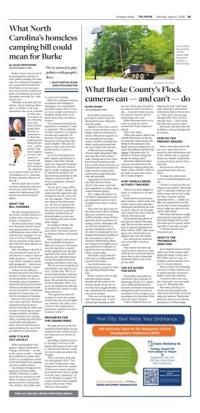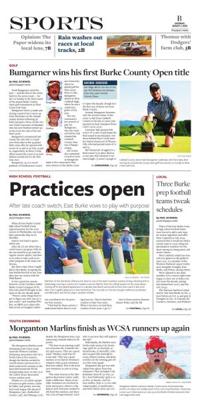


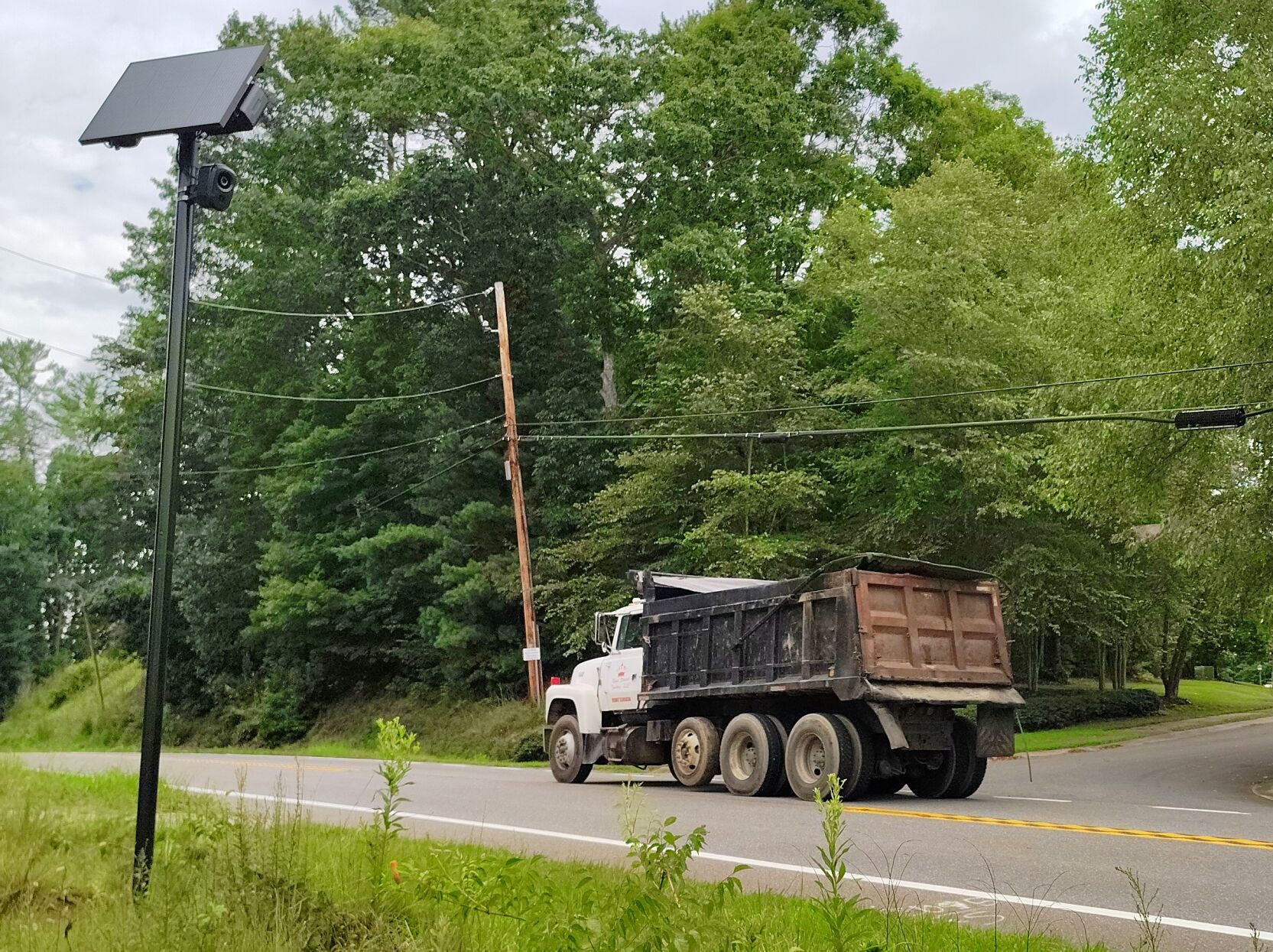
A truck drives by one of the 10 Flock License Plate Recognition cameras in Burke County.
Flock Safety cameras are growing in number, and with that growth comes rising fear from the public.
Adding to those fears, a provision in North Carolina’s 2026-27 budget explicitly authorizes local law enforcement agencies to use automated license plate readers (ALPRs), provided they adopt a policy governing their use and comply with state law.
ALPRs are an increasingly common sight along major highways and other well-traveled roads. Passing one or two of the pole-mounted cameras on the way to work, the grocery store, or a friend’s home is not unusual in today’s world, raising privacy concerns for people both statewide and nationally.
Organizations like the American Civil Liberties Union (ACLU) have been vocal with their opposition to ALPRs, citing “unprecedented spying.”
ACLU alleges the devices allow federal organizations to target immigrants and have led to wrongful arrests due to system errors.
There have also been cases of law enforcement officers stalking their exes or partners using ALPR technology. Some of these cases have led to convictions, including a former Milwaukee officer who was sentenced to 13 months of probation earlier in July after he pleaded guilty to attempted misconduct in public office. As recently as July 29, a Charlotte-Mecklenburg officer was charged with illegally accessing a government computer to search Flock for an undercover officer’s license plate.
The Burke County Sheriff’s Office has 10 ALPRs manufactured by Flock Safety.
One of the devices was knocked down a couple of weeks ago, said Sheriff Banks Hinceman.
Burke County is not the only area with cameras being knocked off their posts or destroyed. People across the nation have been caught attempting to dismantle the cameras in one way or another.
“I’m a very private guy myself,” Hinceman said. “I don’t want people keeping up with me, but I drive past one particular camera at least four times a day. … It doesn’t bother me one bit, because I know it doesn’t tell anybody who I am.”
When Hinceman went on vacation recently, he said he counted the Flock cameras he passed.
There were many.
“What (the camera) doesn’t say is Banks Hinceman was driving. He owns that vehicle. Renee was sitting in the passenger’s seat. Banks’ mom and stepdad were sitting in the backseat, and they had luggage,” Hinceman said. “It doesn’t do all those things that people are saying it does.”
Hinceman addressed safety concerns and shared how the technology is being used by the Burke County Sheriff’s Office to get leads on open cases and recover stolen property.
IS MY VEHICLE BEING ACTIVELY TRACKED?
Unless it has been flagged as stolen or connected to an open case, no.
Flock devices record license plate numbers, vehicle make and model, vehicle color, and other information identifying the vehicle itself. They do not automatically connect the owner with the vehicle, Hinceman said.
Flock cameras take photos of the back of a vehicle, Hinceman said. They do not have access to state or national Department of Motor Vehicle (DMV) data, meaning no one at Flock Safety can pinpoint who owns the vehicle.
Law enforcement, however, can access DMV records as needed.
State statute says data captured by Flock cameras or other ALPR devices cannot be kept for more than 90 days. Hinceman said Burke deletes data at the 30-day mark.
CAN ICE ACCESS THE DATA?
Flock Safety reportedly discontinued a pilot program collaborating with the U.S. Department of Homeland Security’s Customs and Border Protection Immigration and Customs Enforcement (ICE) in August 2025, according to an Associated Press article by John O’Connor.
“I don’t think ICE has ever asked us for that,” Hinceman said, referring to information collected by Burke’s Flock devices. “They (ICE) can run tags through DMV, (but) as far as through Flock … I don’t know that they have access to that.”
Hinceman said data collected by Burke’s cameras belongs solely to Burke.
HOW DO YOU PREVENT MISUSE?
When a law enforcement officer runs a query, they are required to enter information such as the offense code or organizational case number and provide a reason for their search, Hinceman said.
All queries are also timestamped and show who ran them.
Tracking this information serves as a guardrail against misuse.
“(Flock) is a tool, just like anything in your toolbox,” Hinceman said. “I could take a hammer and build a house with it, but I could also take a hammer and kill somebody with it. … I think (ALPRs) are a good tool for us, but you do have to have some guardrails to make sure that we’re doing the right things.”
Hinceman said anyone caught misusing the technology will be fired and charged with a crime. The same goes for people misusing DMV or any other records.
“I will not tolerate that,” Hinceman said.
WHAT IS THE TECHNOLOGY USED FOR?
Since implementation around April 2025, Flock cameras have helped the Burke County Sheriff’s Office close 29 cases, including 13 arrests and the recovery of 15 stolen vehicles.
Most recently, the technology was used to follow leads for one or both homicides reported in Burke County last weekend.
“It doesn’t solve your case, but it does give you some leads to go on,” Hinceman said.
Hinceman said $743,000 worth of stolen property and other items have been recovered using the cameras. That breaks down into $156,000 in vehicles and $587,000 in illicit drugs.