
Valdese officials accept properties to eventually build walking path connecting to state trail

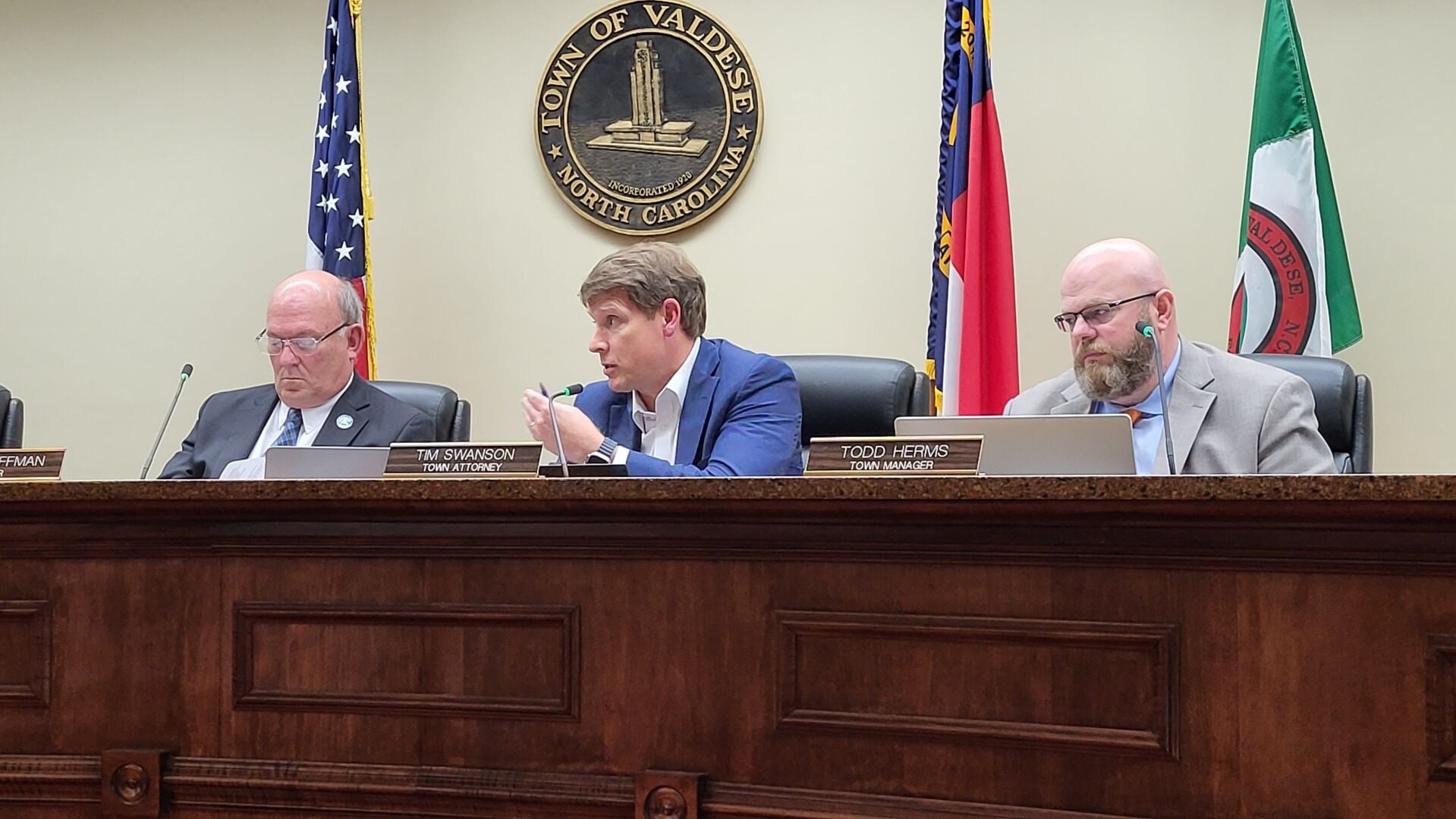
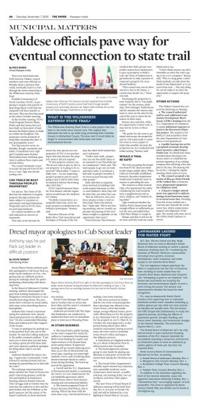
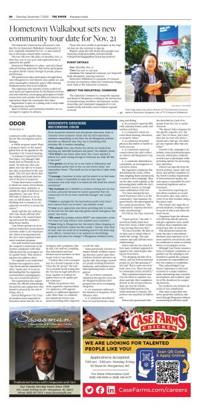
Valdese Town Attorney Tim Swanson (center) explained how Foothills Conservancy of North Carolina cannot build trails through people’s property but, technically, the town can. Mayor Keith Huffman sits on the left with Town Manager Todd Herms on the right.
There was much back-and-forth between Valdese council members and town officials on Monday about a decision that could, eventually, lead to a trail through the town connecting to the Wilderness Gateway State Trail.
Foothills Conservancy of North Carolina (FCNC) is preparing to acquire nine parcels of land along Micol Creek that the nonprofit will then transfer to the town. This was first discussed at the town’s October meeting.
At the October meeting, FCNC Trails Program Director Shane Prisby said that homes have not been built on these plots of land because the flattest places to build are within the floodplain. The properties consist primarily of steep hills, meaning they have “a low developability score.”
Two big concerns arose on Monday, though: easements and safety. Councilman Gary Ogle and Councilwoman Heather Ward asked many clarifying questions to address these topics and several others.
The council ultimately voted to accept the parcels from FCNC in a 5-1 vote. Ogle was the dissenting vote.
CAN TRAILS BE BUILT THROUGH PEOPLE’S PROPERTIES?
Yes and no. The Town of Valdese has the authority to acquire property through eminent domain, subject to statutory requirements and legal limitations. Nonprofits such as FCNC have no such legal authority.
No council members or officials indicated an interest in easements.
This topic arose because between the nine parcels are two properties FCNC is not purchasing at this time because the property owners did not respond.
“If (the property owners) say, ‘We do not want to give in, this is our property,’ is it going to be respected?” Ward asked. “I want to make sure … we are respecting people’s property and we aren’t going to put a trail in their front or backyard without them being okay with that.”
FCNC Land Protection Director Tom Kenney said the organization would honor the landowners’ wishes.
“Foothills Conservancy, as a nonprofit land trust, never imposes projects on landowners unwilling to participate,” Kenney said.
Executive Director of the Burke River Trail Association and President of Friends of the Valdese Rec Beth Heile backed Kenney’s statement.
“Under state trails, (properties) are not forcefully taken or an easement is not forcefully put on a landowner,” Heile said. “We want people to get out on trails and enjoy trails. It would put a bad taste in people’s mouths if we went around forcing trails onto people.”
Heile said that as organizations involved in building trails work toward Interstate 40 Exit 111 and Children’s Park, they will do what they can when they can.
“But we will never, ever, ever force anyone to have a trail on their land. That’s the bottom line,” Heile said. “We’re not forcing anything, and we (would) appreciate the passing of this resolution tonight to capitalize on the opportunity that exists.”
Town Attorney Tim Swanson clarified that while private nonprofits cannot force landowners to give up property to build a trail, the Town of Valdese has legal authority to take a portion of someone’s property for recreational facilities.
“This council may not sit there and do it, but in the future, a council may decide (to),” Swanson said.
Purchasing the properties is time-sensitive due to “tax implications” for the owners, Heile said. Town Manager Todd Herms said he assumes the owners may want to close on the sales by the end of the year to claim the donation on their taxes.
Kenney also said that, while the opportunity is there now, it may not be in two or three years.
“We prefer for the town to go ahead and accept the properties and we will stand ready to assist the town in every respect to make that possible, because the properties are in a residential and urban setting,” Kenney said.
WOULD A TRAIL BE SAFE?
The town accepting the properties from FCNC does not imminently impact public safety. When trails are eventually established, however, the police department would need to dedicate more resources to patrolling the area.
The location is what worried Ogle, who questioned the safety considering the trail would be near a neighborhood with seniors, children, and “widows living alone.”
Ogle wondered whether the Valdese Police Department had enough officers to sufficiently patrol the area and asked Police Chief Marc Sharpe to weigh in.
Sharpe said that it will not be an issue until the trails are established and in use.
“I don’t think anyone can tell a timetable on when the trail is going to be 100% complete,” Herms said. “This is a long game. I don’t think anybody can talk about the needs of any department 20 to 30 years from now. … The only thing we can do today is we have the opportunity to acquire the property.”
OTHER ACTIONS
The Valdese Council also covered the following on Monday.
- The council authorized staff to seek additional Community Development Block Grant (CDBG) funding from the N.C. Department of Commerce to
- cover additional expenses related to the Berrytown Waterline project. The request is for $688,470 and acceptance from the state Department of Commerce is not guaranteed.
- A public hearing was set for a proposed economic development incentive called Project Finish Line. No details have been revealed about the project yet. Herms said it is a small but important expansion of an existing company that will bring a few new jobs to the area. The hearing will be on Dec. 7 during the regular meeting, which starts at 6 p.m.
- The council accepted a donation of $84,320 from Friends of the Valdese Rec to help purchase
- playground equipment for Children’s Park.
- A $39,600 budget amendment was approved to address damage from Hurricane Isaias to an aerial sewer line. Flooding from the storm washed out a concrete pier beneath the aerial sewer line, which compromises support and alignment of the pipe. The money will come out of the Utility Fund’s balance reserves.