



Three Morganton areas have been designated as federal Opportunity Zones, opening the door to tax incentives intended to attract private investment, create jobs, and encourage housing development in economically distressed communities.
The three sites are among 204 across North Carolina approved by the U.S. Department of the Treasury, Gov. Josh Stein announced recently.
The designations take effect Jan. 1, 2027, and will remain in place for 10 years. They could help local economic development officials compete for investment in manufacturing, commercial redevelopment, housing, and other projects.
“BDI, along with the City of Morganton and The Industrial Commons, submitted every eligible tract in Burke County,” said Brandon Ruppe, CEO of BDI. “We advocated with Rep. Hugh Blackwell and some other local businesses to ensure Burke County’s wants were being considered.”
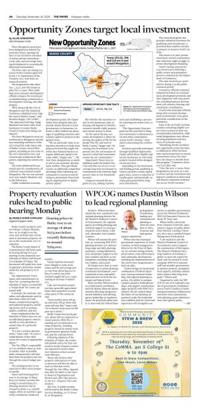
The three Morganton areas are northwestern Morganton and the area extending northwest of the city toward the Lake James side of Burke County; central Morganton, including an area close to the city’s downtown core; and western and southwestern Morganton, adjoining the central-city tract.
The team submitted five potential sites for consideration, all relatively concentrated around Morganton. The two not selected were near Quaker Meadows and in the Salem area.
Unlike traditional economic development grants, the Opportunity Zone program does not provide money directly to local governments or businesses. Instead, it offers federal tax advantages to qualifying investors who commit capital to projects in designated areas.
“We see particular value in using these incentives to help move projects forward that might otherwise face financial barriers or require additional capital to become viable,” Ruppe said. “... We view these designations as another tool in our economic development toolbox. They give Burke County an additional competitive advantage when marketing our community to investors and developers, particularly those looking for opportunities to deploy private capital.”
But whether the incentives result in new businesses, jobs, or housing will depend on whether investors identify viable projects and commit money to them.
“At the end of the day, economic development is about improving the quality of life for the people who live and work in Burke County,” Ruppe said. “Attracting new investment is important, but the real measure of success is what that investment creates for our communities.”
Opportunity Zones were established under the federal Tax Cuts and Jobs Act of 2017 to encourage long-term investment in communities with relatively high poverty rates or low household incomes.
Congress renewed the program in 2025, making it permanent and establishing a process for selecting new zones every 10 years.
“The Opportunity Zone program has the potential to bring new investment to distressed rural and urban communities across North Carolina,” Stein said in announcing the certifications.
Investors generally participate through Qualified Opportunity Funds, which direct eligible capital into businesses or real estate projects located within designated census tracts.
Depending on the investment and holding period, qualifying investors can defer certain capital gains taxes, receive a reduction in taxable gains, and potentially exclude gains generated by long-term investments.
The renewed program also provides enhanced incentives for qualifying rural investments, a provision that could be relevant to projects in western North Carolina.
The intent is to steer private investment toward communities that otherwise might struggle to attract development financing.
North Carolina selected its 204 census tracts following a public review and nomination process conducted by the Department of Commerce.
The state received 340 nominations during a 53-day public comment period.
Commerce officials evaluated submissions based on economic need, development potential, and their alignment with state priorities, including business development, job creation, housing, and community revitalization.
County and municipal officials, along with economic development professionals, were given particular consideration in the evaluation.
Each of the 93 North Carolina counties containing eligible census tracts received at least one recommended nomination. Additional designations were allocated using population and measures of economic need.
“Identifying North Carolina’s new opportunity zones has been a collaborative effort between state and local partners to ensure communities across the state have the chance to benefit from this program,” Commerce Secretary Lee Lilley said.
“Over the next 10 years, these designations can serve as a tool to attract private investment and improve conditions in distressed and disaster-impacted communities across North Carolina.”