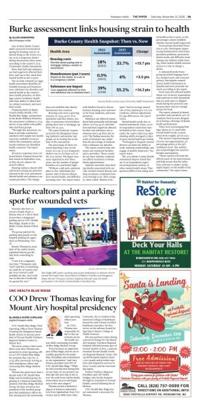


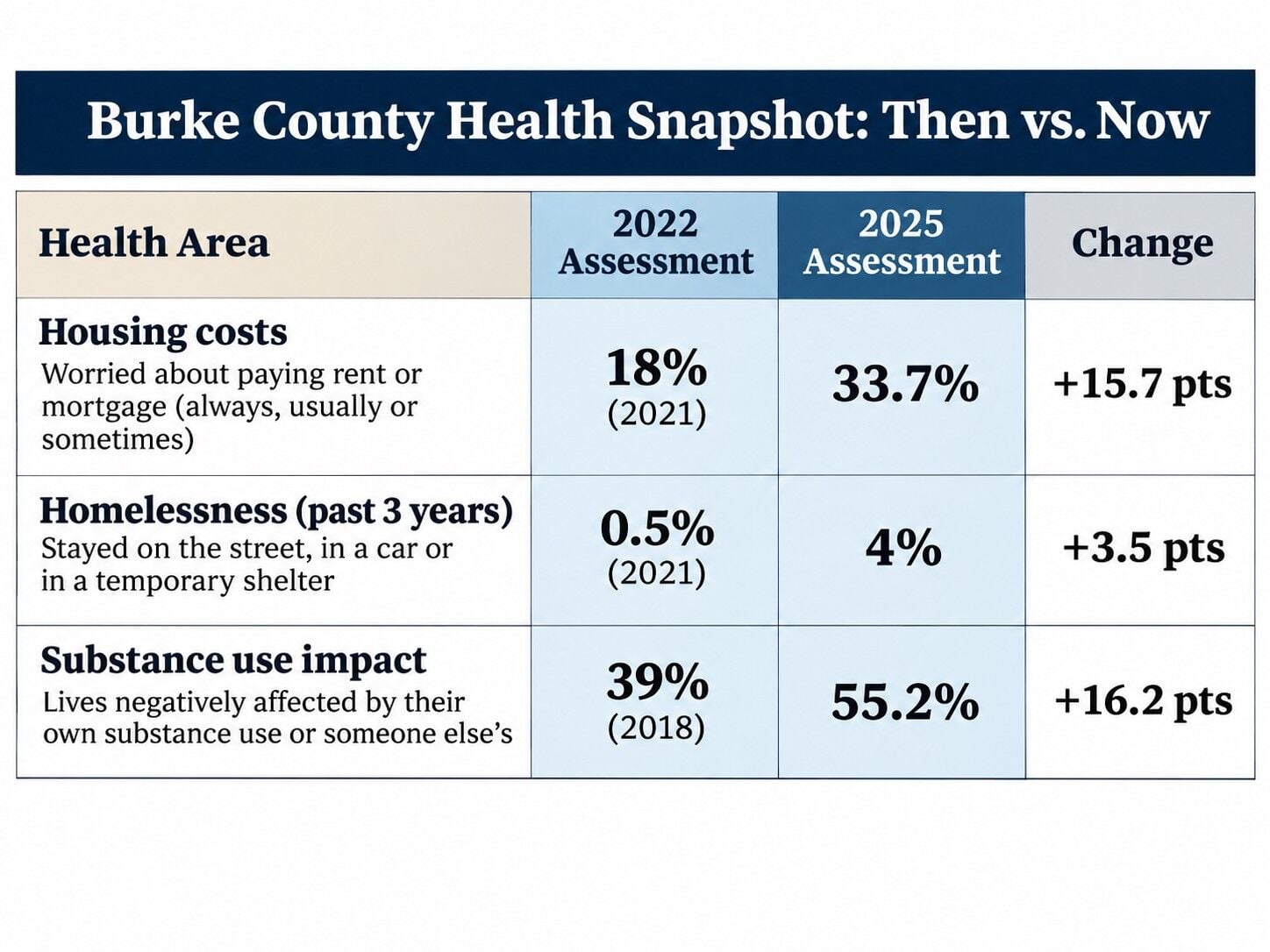
Source: Burke County 2025 Community Health Assessment
One in three Burke County adults surveyed worried about paying for housing, and 4% reported living on the street, in a car, or in a temporary shelter during the previous three years, according to the county’s 2025 Community Health Assessment.
More than half said substance use had negatively affected their lives, and one in five rated their mental health as fair or poor.
The recently released 307-page health assessment identifies affordable housing and homelessness, substance use disorder, and mental health as the county’s three health priorities. Its findings connect residents’ health with their ability to afford shelter, obtain treatment, and meet basic needs.
Prepared jointly by Burke County Public Health, UNC Health Blue Ridge, and partners in the Burke Wellness Initiative, the assessment combines a 2024 survey of 492 adults with public data and focus groups.
“Through this document, we hope to provide community members with insight into health concerns, available resources within the community, and potential solutions for identified health concerns,” the report states.
All survey responses were collected before Tropical Storm Helene struck in September 2024, so they do not capture the storm’s effects.
Housing replaces obesity with risk factors among the priorities selected in the 2022 assessment. Mental health and substance use remain priorities. The change does not establish that obesity has become less common.
Housing costs were a growing concern. In 2024, 33.7% of respondents said they always, usually, or sometimes worried about paying their rent or mortgage, up from 18% in 2021.
The report listed 567 tenants served by the Morganton Housing Authority and another 848 people on its waiting list at the time of the assessment.
The percentage of those surveyed reporting a stay on the street, in a car, or in a temporary shelter rose to 4% from 0.5% in the 2021 survey. The figure measures experiences over three years, not the number of people homeless on a particular night.
“Without a safe and consistent place to live, individuals face greater risks of chronic illness, poor mental health, and difficulty accessing care,” the report states, with families forced to choose between housing costs and money for food, medicine, and transportation.
Substance use affected respondents both personally and through others. In 2024, 55.2% said their lives had been negatively affected by their own substance use or someone else’s, up from 39% in 2018. The finding measures the reach of substance use, rather than the percentage of residents with a substance use disorder.
The report counted nine substance use treatment facilities and 21 providers. Those counts do not show whether residents can afford treatment or obtain timely appointments.
Separate mortality data show 384 deaths associated with suicide, alcohol-related disease and drug overdoses combined from 2019 through 2023. That category, often called “deaths of despair,” had an average annual rate of 86.3 deaths per 100,000 residents, without adjustment for age differences, the report states.
Mental health needs also remained substantial. Some 20.5% of respondents rated their mental health as fair or poor. Separately, the report cited 2022 data showing adults averaged 5.5 days of poor mental health per month.
“Prolonged or frequent mental distress can limit the ability to work, maintain relationships, and engage in healthy behaviors,” the report states.
The 2022 Burke County Health Assessment Report stated that 46.7% of respondents experienced depression, anxiety, or other mental health issues. That question differs from rating mental health as fair or poor, so the percentages cannot establish whether mental health improved.
Focus groups described obstacles to care. Participants experiencing homelessness cited transportation problems, unresolved dental needs, and difficulty maintaining care without stable housing. Some lacked reliable internet access or a way to charge a phone.
A cultural diversity focus group described language barriers, medical costs, and concerns privacy. Participants wanted clearer health information in Spanish and more personal outreach, according to the report.
Food costs also affected health. About 14% of survey respondents said someone in their household had cut meal sizes or skipped meals during the previous year because there was not enough money for food.
The report counted 38 dental providers and said about 40% of residents lived in areas designated as having a shortage of dental health professionals.
There were encouraging findings: About 16.7% rated their overall health as fair or poor, down from roughly 23% in 2012.
The survey’s reported margin of error was approximately 4.6 percentage points at the 95% confidence level. The authors also acknowledged the need for broader participation.
“These reports will track the effectiveness of the interventions and help ensure that the initiatives continue to make a meaningful impact on the health of the community,” the report states.