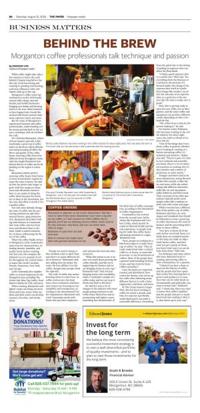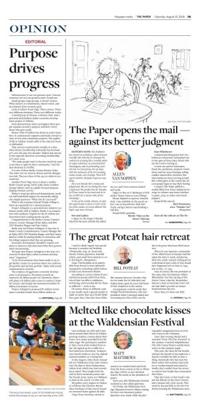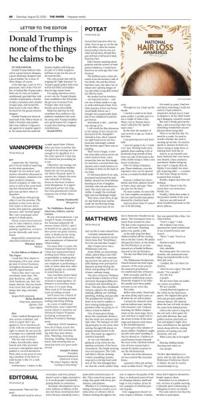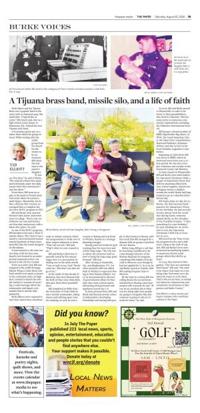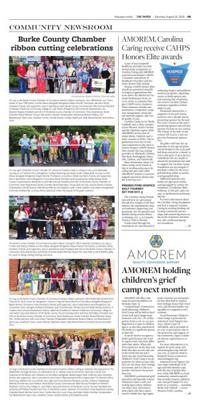



County Manager Brian Epley presents the details on the tax grant incentive to the Board of Commissioners.
Burke County commissioners are fighting to land a manufacturing facility in a former textile mill in Valdese, a move they hope will bring 64 new jobs and $7 million net investment over four years.
The Town of Valdese is holding a public hearing on Sept. 14 at 6 p.m. to review an incentive agreement proposed by Burke County Commissioners to attract the manufacturer.
County Manager Brian Epley referred to economic investment at the right pace and the right place as the “tide that lifts all ships,” a concept the county hopes will ring true should Project Arlington come to fruition.
Project Arlington is unusual not only because Burke is publicly discussing the possibility of the unidentified company, but also because of the measures commissioners voted on to sweeten the deal, promising tax incentives should the company occupy a vacant, former textile building in Valdese as planned.
The decision came after Epley and Burke Development Incorporated President and CEO Brandon Ruppe proposed to the board a tax grant — an annual reimbursement of 50% of the company’s taxes over a four-year period.
The total capital expenditures for the company would be about $15 million — that includes nearly $7 million in net new investment in the community, which is where the tax reimbursements would come into play.
At the current tax rate, which is $0.555 per $100 at full valuation, the reimbursement of 50% of taxes paid over four years would total around $61,050, although as taxes shift in the future, so would the reimbursement.
Ruppe also said the incentive is “performance-based and self-correcting,” meaning if their tax bill isn’t as high because they don’t do well in a particular year, the reimbursement shrinks. Ruppe said the county would also “establish a minimum threshold that will invalidate the contract should they significantly underperform.”
Epley explained that the state has already offered a $950,000 incentive package.
BACKGROUND ON THE BUSINESS
The fourth-generation American company manufactures point-of-purchase displays, similar to what shoppers might see at Walmart.
“All of their products have been made in the United States of America, and with any luck and with your support, maybe we can say that’s made in Burke County,” Ruppe told the board, raising his fist in the air with a grin on his face.
The snag in closing the deal traces back to the acquisition of the potential location the company is considering.
Burke is competing with a county in Virginia with similar demographics, according to Ruppe, who added that the Virginia property owners are difficult to do business with.
There are several reasons the identity of the company is under wraps, but it mainly boils down to protecting the company, should the attempts to expand fall through, according to Ruppe.
Ruppe explained that to give incentives, local governments have to provide a “but for” — “But for the government stepping in, the company would not have chosen to locate in North Carolina,” he said in a later phone interview.
“Nothing in economic development is guaranteed,” Ruppe said. “We feel very good about this company and feel very confident that they like Burke County. This incentive package does help us make that case that they should come here.”
WHY THE COUNTY NEEDS IT
According to Epley, economic development has been the top priority of both of the county’s strategic planning sessions in the last two years. Burke has historically trailed behind its neighbors by hundreds of millions of dollars in capital investment.
“There’s been a period of stagnation and a period of very critical need developed in the world of economic development,” Epley told the board. “A lot of investments have been made to try to get Burke County in a position where we could see job growth and tax base growth.”
Between 2017 and 2019, the county’s gross domestic product (GDP) — the sum of all goods and services produced in Burke — shrunk by 6.7% to $2.6 billion. At the same time, the GDP of the United States grew by 5.5%.
Following a small decline to $2.5 billion in 2020, the county’s GDP crept back up by 3.7% to $2.6 billion before stagnating again.
“Outside of revaluations in Burke County, there has not been a lot of change in our tax base, which is an indication that there has not been a significant amount of investment in our community,” Epley said. “I think the data is clear that in the last quarter of a century … there hasn’t been as quick of a remedy to the reinvention of our economy, maybe, as we had hoped.”
Epley explained that due to inflation and labor costs, existing resources often get strained, and the only way to compensate while keeping taxes low for residents is by attracting a larger commercial tax base.
For example, he explained, a company with a $100 million tax value is equivalent to 16,000 homes.
Since residents skilled in manufacturing make up slightly more than a quarter of the workers by occupation in Burke, the arrival of 64 jobs with an average annual wage of nearly $59,000 would stand apart in a community where the median household income falls at about $49,000.
Burke also pales in comparison to the surrounding counties in economic development from 2023 to 2025 — only hitting about $29.2 million in private capital investment, compared to Catawba County at $173.6 million, Caldwell County at $602.2 million, and Cleveland County at $649.8 million.
“Burke County was unfortunately unable to capture any of that here,” Epley said.