
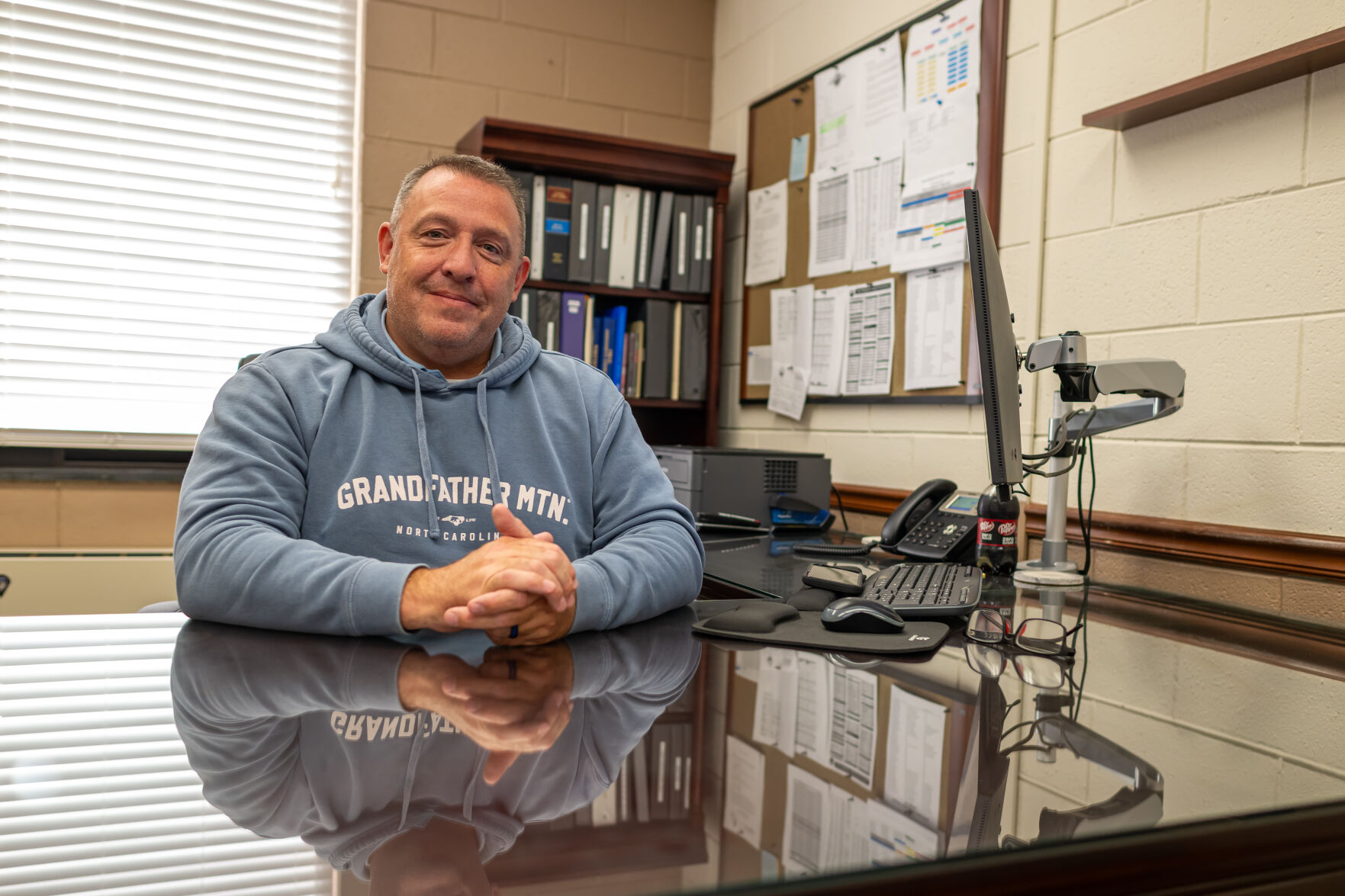
The retiring captain sits comfortably at an empty desk, enjoying his final working day. Brown at desk
Brown at desk
The retiring captain sits comfortably at an empty desk, enjoying his final working day. Brown at desk
Brown at desk
The retiring captain sits comfortably at an empty desk, enjoying his final working day. Brown at desk
Brown at desk
The retiring captain sits comfortably at an empty desk, enjoying his final working day. Brown at desk
Brown at desk
Every few months I move small mountains of books.
I move the leaning tower of Pisa of books on my bedside dresser to my upstairs study. I stack them neatly on my wide writing table. I move books from my home study to my church study.
I carry books by the armload. Academic books, commentaries, new story collections, nonfiction. I neatly fill cloth bags, from side to side and back to front, so tightly I can barely lift the bag. Packing books is a three-dimensional game of literary Tetris. A mason’s bag of bricks.
The books I’ve read (and those I’m saving to read later) are going to my professional library at the church. I leaf through the books I’ve read and skim the underlined passages. It’s like licking a dessert plate — just a taste of something sweet.
From Geoff Dyer’s book about jazz, “But Beautiful”, I find this passage about the great pianist Thelonious Monk, who, when it came time for others in the concert to solo, would famously get up and dance.
“He started quietly, tapping a foot, clicking his fingers, then he raised his knees and elbows, rotating, shaking his head, meandering everywhere with his arms outstretched.”
This puts a face on the Spirit brooding over creation.
I move dozens of half-filled notebooks around my rooms. Small Moleskines that fit into a back pocket. Large art journals with thick pages suitable for sketching and watercolor. These are filled with my scribbles, notes, story ideas, rants, grocery lists, sermon notes, and poems. With these notes I’m attempting to capture inspiration on the page like lightning bugs in a jar.
In one dog-eared journal are notes I wrote at a conference last year. I find lines about the difference between narrative thinking and lyrical thinking, the chronological versus the associative.
And this quote from a lecture by either Stuart Dybek or Alex Kotlowitz, both brilliant writers, “When you are writing, are you looking for swerves in reality?” And this: “The rhythm of speech can drive a story.” And this, from the late E.B. White: “Writers sit under storm clouds.”
In that same notebook, written when we were recently in Boston, are words that slay me. “I’ve known my wife longer than I knew my father.” I find this surreal, impossible. I want to rise like mist and dance like Thelonious, eyes closed, moving through and soaking in the moment, like lava in a lamp, a spirit dance.
That’s what all these pages of all these books and journals do. They soak up stories, ideas, moments. I carry these treasured tomes like launch codes handcuffed to my wrist in cloth bags to awaiting shelves. I’m a book mover on a mission.
In making room on the shelves in my office for the piles of books from my house, I select titles at church worthy of reading and stack them in my empty bag to take home.
I found two unopened copies of Philip Gerard’s gorgeous essays The Patron Saint of Dreams. Philip is a man I almost knew. We shared friends at Hub City Press.
Philip died in 2022. And yet I hold his book in my hand, fan its pages with my thumb, smell the paper, read his luminous essays about hurricanes, shipwreck, and his mother’s death, and I clearly hear his voice.
Is this being dead?
I’ve been shuttling Michel Quoist’s Prayers, published in 1954, from my bedside to my office to every writing table I’ve ever had for most of my adult life. Mine is a clean, new copy. Somewhere at my office, I have an underlined, prayed-through first edition.
I accidentally removed Ada Limón’s The Carrying from house to church, then returned it when I discovered my mistake. All poetry stays at home on the floor-to-ceiling shelf in the bedroom. Poetry (and visual art) is essential to both writing and dreams and needs to always be near my bed where I write and dream and sometimes sleep.
This spring I read and reread a stack of Katherine Paterson books. The Great Gilly Hopkins ends about as well as any story should. Too soon. The paperback pages of her old Christmas stories are brittle like flakes of mica. They shine silver and gold.
Katherine’s books, many of them inscribed, have been too-long scattered. Not anymore. These beloved books found space in my office shelved above Frederick Buechner, Kathleen Norris, and Anne Lamotte.
I hauled two Garrison Keillor essay collections to the office and hauled two more that I hadn’t cracked home to the bedside. Humor, like poetry, nicely seeds dreams, and his humor speaks to my Lake Wobegon heart.
All told, I shift about four heavy bags of books to various pieces of real estate at which I spend much of my life. Their spines line up like soldiers standing at attention on my shelves. Ever-present, they watch me like lifeguards ready to toss a line of inspiration should I start to sink staring at a blank page the size of an ocean.
I may move a book to an envelope and drop it in the mail to a friend.
I may pull another down because it speaks a word I need to hear again. How many times have I carted to and fro Heschel’s masterpiece The Prophets?
Many of these books will go the way of their predecessors, packed in liquor and banana boxes and donated to the library.
These books are always moving me.
And I am always moving them. History. Essays. Novels.
One small mountain at a time.
Matt Matthews is co-pastor with his wife Rachel of Waldensian Presbyterian Church in Valdese, a cool congregation of the PC(USA). You may reach him at 864.386.9138 or matt@waldpres.org
Yes, I’m a Boomer. With a capital “B.” To the bone. 1955. Just turned 71 on Aug. 26.
You got a problem with that?
Yes, my musical tastes atrophied about a quarter century ago. Not much modern on my playlist.
But hey, at least I have a playlist.
And yes, I’m a proud product of my small-town Southern culture who’s never claimed to know what rap or hip-hop or even bluegrass are all about.
Doesn’t matter. They certainly are not about me.
Given those parameters and my own set of prejudices, as my reverse birthday gift to Burke and Caldwell County readers, I’d like to present my list of Top 10 favorite songs from my Top 10 list of favorite artists.
Disagree all you like. You ain’t changin’ this boomer’s mind.
One caveat: This is my list of Top 10 favorite songs as I write on the morning of Tuesday, Aug. 25. Ask me next week when I’m in a different frame of mind and the list might change a bit.
This song was released in the spring of 1971, and I fell in love with it at age 15. That love has never faded.
Once I thought I’d never go through a divorce. I did. This song captures it all.
Yes, I’m growing older. But I’m not dead yet, and the fire still burns.
Back when I was teaching high school English, at the end of each semester, I played this song as a farewell blessing for my departing seniors. Few eyes were dry.
For my bride Dinah and me, this song about second chances and taking chances is “Our Song.”
Always loved this homage to the Old North State, never more so than during my years of youthful exile in Georgia.
Carly sings like an angel, and she sang this song just for me.
A song all about growing up in the 1960s, including a young girl’s memories of Robert Kennedy’s passing funeral train. Never fails to ignite my own memories of those years.
A tender young woman very gently broke my heart during my senior year at Chapel Hill a very long time ago. This is her song.
Did you really think an old white guy was not going to include this song in his Top 10? No way!
Some good artists and good tunes that didn’t quite make the cut:
Of course, this list would look very different if it included country artists and country tunes.
Real country artists, like Johnny Cash, Merle Haggard, Waylon Jennings, Willie Nelson, and Kris Kristofferson.
And real country songs like “Sunday Morning Coming Down,” “If We Make It Through December,” “Blue Eyes Cryin’ in the Rain,” and “When the Man Comes Around.”
But that’s a list for another column on another day.
Bill Poteat is editor emeritus. He may be reached at 828-445-8595 or bill@thepaper.media.
Dolly Parton once said, “I may look fake, but I’m real where it counts.”
Her realness and her authenticity, coupled with generosity and no hint of judgment, always set Dolly apart.
And those qualities are what drove countless fans and colleagues to mourn her death on Tuesday at the age of 80. During her time on this planet, she not only entertained us on stage and in film, but she also imparted valuable lessons.
Dolly never hid where she came from or tried to polish what others might have considered unsophisticated. Her thick East Tennessee accent stood as a reminder of her roots and never became a costume she put on for audiences. Her Tennessee mountain upbringing was the source of her stories, her humor, and her empathy.
Parton also managed something that has become exceedingly rare. She was loved by people who agreed on very little else. That was not because she carefully concealed who she was. It was because she made room for people. She could stand firmly in her own identity without treating someone else’s identity as a threat.
“Don’t be like me. Be like you.”
Her wealth instilled in her a sense of responsibility to support those who had much less than she did.
She created jobs and drew visitors to the area she grew up in through Dollywood. After wildfires devastated Sevier County in 2016, her My People Fund gave direct assistance to families who had lost their homes. She donated $1 million to coronavirus research at Vanderbilt University Medical Center, helping support work that contributed to the Moderna vaccine.
“I just see a need and if I can fill it, then I will.”
Her most enduring gift may be the Imagination Library. Parton started the program in her home county in 1995, inspired by her father, who could not read or write. What began as a local effort now mails free books each month to millions of children in five countries, including all 100 counties in North Carolina. Thousands of children in Burke County and Caldwell County have received books monthly.
“Inspiring kids to love to read became my mission.”
In an age that often rewards outrage and self-promotion, Parton demonstrated a different kind of influence. She was funny without making others small. She was confident without pretending to be flawless. She was generous without demanding that every good deed become a monument to herself.
Her life reminds us that kindness is not simply a pleasant disposition. It is work. It requires noticing what people need, deciding that their need matters, and doing something useful about it.
“If you see someone without a smile today, give ’em yours.”
Few of us will write a song known around the world or have the resources to give away millions of books. But the principle of Parton’s life is available to us all: Use what you have to make life better for somebody else.
Remember where you came from and be true to yourself. Let success enlarge your obligations, not your ego. Do not confuse disagreement with permission to be cruel. Find a need close to home.
The best tribute to Dolly Parton will not be merely playing her songs.
It will be living out the lessons she left behind.
Read more about Dolly’s connections to Burke County on today’s front page.
Kevin Baxter
Year five at the N.C.School of Science and Math-Morganton has started in a flash as our team welcomed 152 juniors to campus alongside 150 returning seniors over the last week.
Once again, our newest Dragons were treated to an incredible orientation experience highlighted by a dynamic walkabout in downtown Morganton where they learned about our community’s rich past while touring some of our newest assets (and yes, a lot of fudge may have been consumed!).
I’m grateful to our partners at the Industrial Commons, Thornwell Books, Merrill Mischief General Store, and throughout downtown Morganton for helping the newest members of our community feel so welcome.
August 18 marked the formal start to our academic year, and it was full of excitement.
Our students in Morganton, Durham, and across the state in NCSSM Online, gathered together for NCSSM’s 47th Convocation and were treated to an inspiring address from Belton Moore ’16.
Following Convocation, we celebrated last year’s Wells Fargo Cup recognition and enjoyed a wonderful community picnic.
The start of any new academic year brings with it untold promise and opportunity for our students, employees, and partners.
As we celebrate our fifth entering class, we recognize the strong roots and early traditions that have already been seeded in Morganton.
This foundation is only possible because of the rich tapestry of partners, investors, and friends who believed in the promise of NCSSM-Morganton.
I was grateful to see our community of champions so well-represented on campus over the last week as we welcomed N.C. Secretary Lee Lilley, Sen. Warren Daniel, Rep. Hugh Blackwell, and the N.C. High School Athletic Association to engage our students and teammates.
I am profoundly grateful for your ongoing support and welcome your renewed investments in supporting our mission in Morganton and across the state in Durham as we advance public education and deliver innovative curricula and student experiences at the No. 1 public high school in America.
On behalf of our students and workforce, we thank you.
Kevin Baxter is the vice chancellor and chief campus officer for NCSSM-Morganton.