
Young doctors describe rewards and challenges of medical profession
-
Bill Poteat
Editor Emeritus


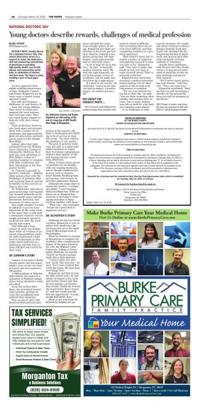
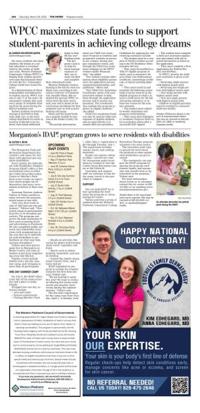
Drs. McKenzie Cannon and Dustin Kilpatrick are still smiling at the end of a long day at UNC Health Blue Ridge in Morganton.
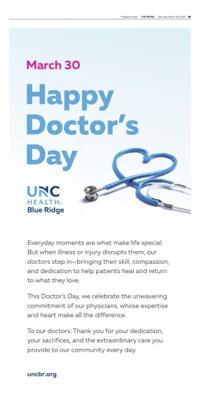
EDITOR’S NOTE: Sunday, March 30, is National Doctors’ Day. This annual observance serves as a moment to honor the dedication, skill and unwavering commitment of physicians in providing high-quality health care to individuals and communities worldwide. In celebration of doctors and their work, The Paper is today profiling a pair of local physicians.
As they approach their eighth wedding anniversary in May, McKenzie Cannon and Dustin Kilpatrick are in many ways a typical young married couple.
The wife and husband — McKenzie, 34, and Dustin, 36 — have two young children. They strive to attain that magical life/work balance that everyone seeks. They rely upon family support to help out with their youngsters.
Their profession, however, sets them apart and presents them with a unique set of challenges and opportunities. Both are physicians and both are on staff at UNC Health Blue Ridge.
Indeed, after they both graduated from the William Carey University College of Osteopathic Medicine, they both also took advantage of Blue Ridge’s status as a teaching hospital to complete both their residencies and their fellowships at the Morganton facility.
Dr. Cannon’s specialty is geriatric medicine — helping older patients deal with the challenges of growing older and assisting them in staying as healthy as they can for as long as they can.
Dr. Kilpatrick’s specialty is gastroenterology and hepatology, focused primarily on digestive health issues and the prevention, detection, and treatment of colon cancer.
One might imagine it would be difficult to get two busy physicians in the same room at the same time to talk with a newspaper reporter, but the couple graciously agreed to an interview after the working day had ended.
And although a long stretch of work was behind them while an evening of parental responsibilities awaited, both maintained a high level of enthusiasm as they spoke about medicine as a profession and why they remain fulfilled and excited by their work.
DR. CANNON’S STORY
Cannon is not quite a Burke County native, but she comes mighty close, as she was born in Lenoir and has cousins in Morganton.
A 2008 graduate of Hibriten High School, she majored in chemistry at Wofford College before being admitted to medical school.
From her earliest days there, she gravitated toward older patients, perhaps because her grandfather had suffered from dementia.
Now, as one of only 7,200 board-certified geriatric physicians in the country, she finds it challenging and fulfilling to be of service to what she terms, “the most vulnerable members of our society.”
The goal of geriatric medicine, she said, is to help older adults maintain or regain their functional independence, improve their quality of life, and manage chronic conditions effectively.
Often, Cannon noted, geriatric patients are not dealing with one ongoing medical issue or chronic condition but several, such as diabetes, heart disease, declining mental function, and chronic obstructive pulmonary disease.
Although she stops short of saying her work is “a calling,” she added, “I can’t imagine doing anything else. Older patients are so thankful that someone is listening to them, paying attention to them, working together with them.”
“What I do,” she concluded, “brings me a great deal of happiness and joy.”
DR. KILPATRICK’S STORY
Although not born in North Carolina, Kilpatrick is very familiar with small-town life, having grown up in the small, central Mississippi town of Philadelphia.
When he decided on coming to Morganton to complete his residency after completing his degree at the same school as his wife, the William Carey University College of Osteopathic Medicine, he said the “North” in North Carolina made him a little hesitant.
“I wasn’t quite sure just how ‘north’ this area was,” he said, “but I soon realized that it felt like home. We have been very happy here.”
Kilpatrick said that during his high school years, he was always strongest in his math and science classes and that he was seeking a profession that would “enable me to leave the world better than I found it,” and that would provide him the opportunity “to help people lead better lives.”
Much as his wife finds fulfillment in helping her patients navigate the sometimes-choppy waters of old age, Kilpatrick also finds satisfaction in his work, particularly when he removes a suspicious polyp that, left unattended, could quite possibly lead to colorectal cancer.
“A lot of what we do as doctors,” he said, “is basically medical detective work. We seek the right diagnosis, we set up the proper course of treatment, and we make sure the follow-up is appropriate.
“It’s great to see results,” he continued, “and to know that you had an impact, a positive impact, on another person’s life.”
BUT ABOUT THE HARDEST PARTS ...
But Cannon and Kilpatrick acknowledge that getting into medical school is difficult, that succeeding there can be even more difficult, and that completing residency is a grueling experience.
“Med school is hard, but it’s mostly a matter of willpower and applying yourself to what you have to do,” Kilpatrick said. “You want to make your family proud; you want to make yourself proud. That’s a powerful motivator.”
Kilpatrick also noted that pursuing a medical education means putting a lot of other aspects of life on hold until that process is complete.
“You see your friends having fun in their 20s,” he said. “You see them launching their families and starting their careers. You’re really putting your life on hold for a bit until you complete some things.”
As to challenges in their current situation, the couple talk about working to attain a balance between work and family life, dealing with the burgeoning burden of paperwork, and staying up to date with constantly evolving methods of treatment.
Despite those challenges, both doctors said they would advise a young person interested in medicine to take up that challenge and pursue their passion.
“You’ll never regret pursuing your dreams,” said Cannon. “They can come true.”
Kilpatrick concluded, “Realize that you will be making a sacrifice in the present for what you will be attaining in the future.”
Bill Poteat is editor emeritus. He may be reached at 828-445-8595 or bill@thepaper.media.